Luke 20:20–38
New Living TranslationOther versions
English
- NLT New Living Translation
- DARBY 1890 Darby Bible
- ASV American Standard Version
- AV 1873 The Cambridge Paragraph Bible of the Authorized English Version
- CSB Christian Standard Bible
- D-R Douay-Rheims Bible
- ESV English Standard Version
- GW GOD’S WORD Translation
- GNB Good News Translation
- HCSB The Holman Christian Standard Bible
- KJV 1900 King James Version
- LSB Legacy Standard Bible
- LEB The Lexham English Bible
- MSG The Message: The Bible in Contemporary Language
- NET The NET Bible
- NASB95 New American Standard Bible (1995)
- NCV New Century Version
- NIrV New International Reader’s Version (1998)
- NIV New International Version (2011)
- NKJV The New King James Version
- NRSVue New Revised Standard Version: Updated Edition
- RSV The Revised Standard Version
- RSVCE The Revised Standard Version, Catholic Edition
- TNIV Today’s New International Version
- YLT Young’s Literal Translation
Arabic
Czech
French
German
Greek
Hungarian
Italian
Korean
Latin
Portuguese
Russian
Simplified Chinese
Spanish
Traditional Chinese
Taxes for Caesar
20Watching for their opportunity, the leaders sent spies pretending to be honest men. They tried to get Jesus to say something that could be reported to the Roman governor so he would arrest Jesus. 21“Teacher,” they said, “we know that you speak and teach what is right and are not influenced by what others think. You teach the way of God truthfully. 22Now tell us—is it right for us to pay taxes to Caesar or not?”
23He saw through their trickery and said, 24“Show me a Roman coin.* Whose picture and title are stamped on it?”
“Caesar’s,” they replied.
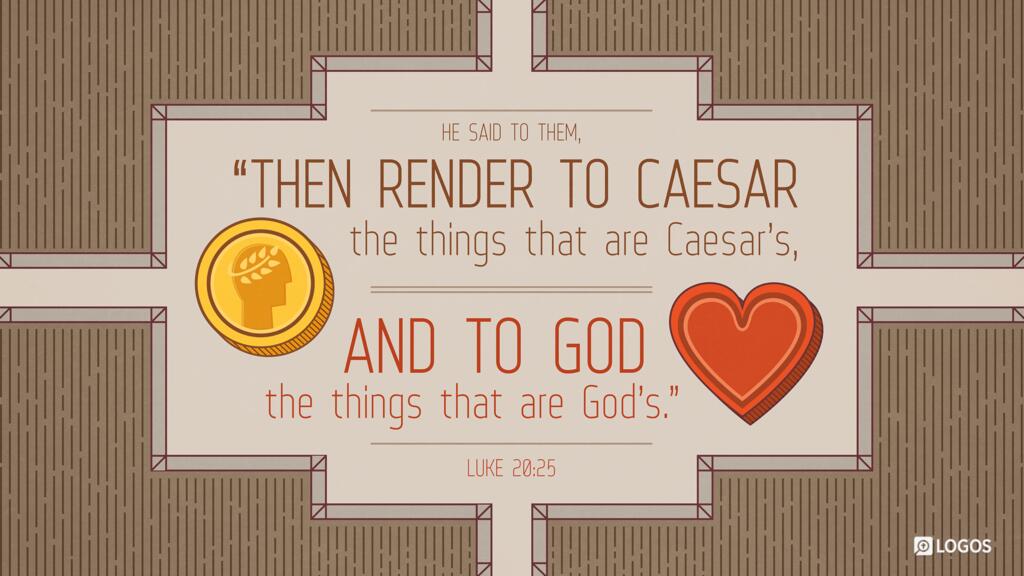
25“Well then,” he said, “give to Caesar what belongs to Caesar, and give to God what belongs to God.”
26So they failed to trap him by what he said in front of the people. Instead, they were amazed by his answer, and they became silent.
Discussion about Resurrection
27Then Jesus was approached by some Sadducees—religious leaders who say there is no resurrection from the dead. 28They posed this question: “Teacher, Moses gave us a law that if a man dies, leaving a wife but no children, his brother should marry the widow and have a child who will carry on the brother’s name. 29Well, suppose there were seven brothers. The oldest one married and then died without children. 30So the second brother married the widow, but he also died. 31Then the third brother married her. This continued with all seven of them, who died without children. 32Finally, the woman also died. 33So tell us, whose wife will she be in the resurrection? For all seven were married to her!”
34Jesus replied, “Marriage is for people here on earth. 35But in the age to come, those worthy of being raised from the dead will neither marry nor be given in marriage. 36And they will never die again. In this respect they will be like angels. They are children of God and children of the resurrection.
37“But now, as to whether the dead will be raised—even Moses proved this when he wrote about the burning bush. Long after Abraham, Isaac, and Jacob had died, he referred to the Lord* as ‘the God of Abraham, the God of Isaac, and the God of Jacob.’ 38So he is the God of the living, not the dead, for they are all alive to him.”
Footnotes
Holy Bible, New Living Translation, copyright © 1996, 2004, 2015 by Tyndale House Foundation. Used by permission of Tyndale House Publishers. All rights reserved.