Luke 20:20–38
The Lexham English BibleOther versions
English
- LEB The Lexham English Bible
- DARBY 1890 Darby Bible
- ASV American Standard Version
- AV 1873 The Cambridge Paragraph Bible of the Authorized English Version
- CSB Christian Standard Bible
- D-R Douay-Rheims Bible
- ESV English Standard Version
- GW GOD’S WORD Translation
- GNB Good News Translation
- HCSB The Holman Christian Standard Bible
- KJV 1900 King James Version
- LSB Legacy Standard Bible
- MSG The Message: The Bible in Contemporary Language
- NET The NET Bible
- NASB95 New American Standard Bible (1995)
- NCV New Century Version
- NIrV New International Reader’s Version (1998)
- NIV New International Version (2011)
- NKJV The New King James Version
- NLT New Living Translation
- NRSVue New Revised Standard Version: Updated Edition
- RSV The Revised Standard Version
- RSVCE The Revised Standard Version, Catholic Edition
- TNIV Today’s New International Version
- YLT Young’s Literal Translation
Arabic
Czech
French
German
Greek
Hungarian
Italian
Korean
Latin
Portuguese
Russian
Simplified Chinese
Spanish
Traditional Chinese
Paying Taxes to Caesar
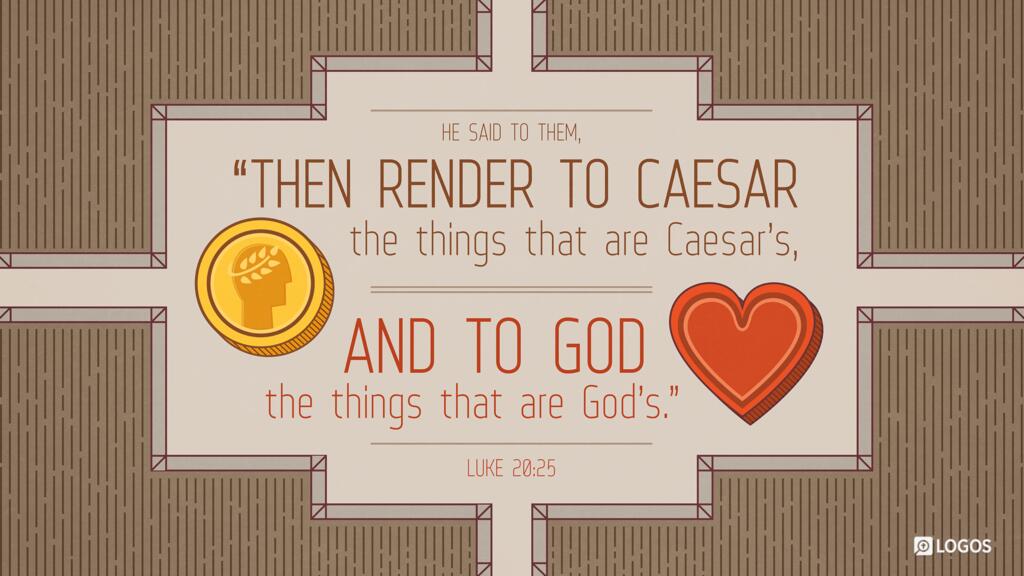
20And they watched him* closely and* sent spies who pretended they were upright, in order that they could catch him in a statement, so that they could hand him over to the authority and the jurisdiction of the governor. 21And they asked him, saying, “Teacher, we know that you speak and teach rightly, and do not show partiality,c but teach the way of God in truth. 22Is it permitted for us to pay taxesd to Caesar or not?” 23But seeing through their craftiness, he said to them, 24“Show me a denarius! Whose image and inscription does it have?” And they answered and* said,e “Caesar’s.” 25So he said to them, “Well then, give to Caesar the things of Caesar, and to God the things of God!” 26And they were not able to catch him*f in a statement in the sight of the people, and astonished at his answer, they became silent.
A Question About Marriage and the Resurrection
27Now some of the Sadducees—who deny that there is a resurrectiong—came up and* asked him, 28saying, “Teacher, Moses wrote for us if someone’s brother dies having a wife, and this man is childless, that his brother should take the wife and fatherh descendants for his brother. 29Now there were seven brothers, and the first took a wife and* died childless, 30and the second, 31and the third took her, and likewise also the seven did not leave children and died. 32Finally the woman also died. 33Therefore in the resurrection, the woman—whose wife will she be? For the seven had her as wife.” 34And Jesus said to them, “The sons of this age marry and are given in marriage, 35but those who are considered worthy to attain to that age and to the resurrection from the dead neither marry nor are given in marriage, 36for they are not even able to die any longer, because they are like the angels and are sons of God, because they* are sons of the resurrection. 37But that the dead are raised, even Moses revealed in the passage about* the bush, when he calls the Lord the God of Abraham and the God of Isaac and the God of Jacob. 38Now he is not God of the dead, but of the living, for all live to him!”
Footnotes
- *Here the direct object is supplied from context in the English translation
- *Here “and” is supplied because the previous participle (“watched closely”) has been translated as a finite verb
- cLiterally “receive face”
- dOr “the tribute tax”
- *Here “and” is supplied because the previous participle (“answered”) has been translated as a finite verb
- eSome manuscripts have “And they said”
- *Here the direct object is supplied from context in the English translation
- fSome manuscripts explicitly state “him”
- gLiterally “resurrection not to exist”
- *Here “and” is supplied because the previous participle (“came up”) has been translated as a finite verb
- hLiterally “raise up”
- *Here “and” is supplied because the previous participle (“took”) has been translated as a finite verb
- *Here “because” is supplied as a component of the participle (“are”) which is understood as causal
- *The words “the passage about” are not in the Greek text but are implied; here a common form of rabbinic citation is being used to refer to an Old Testament passage
Copyright 2012 Lexham Press