Psalm 22:1–18
The NET BibleOther versions
English
- NET The NET Bible
- DARBY 1890 Darby Bible
- ASV American Standard Version
- AV 1873 The Cambridge Paragraph Bible of the Authorized English Version
- CSB Christian Standard Bible
- D-R Douay-Rheims Bible
- ESV English Standard Version
- GW GOD’S WORD Translation
- GNB Good News Translation
- HCSB The Holman Christian Standard Bible
- KJV 1900 King James Version
- LSB Legacy Standard Bible
- LEB The Lexham English Bible
- MSG The Message: The Bible in Contemporary Language
- NASB95 New American Standard Bible (1995)
- NCV New Century Version
- NIrV New International Reader’s Version (1998)
- NIV New International Version (2011)
- NKJV The New King James Version
- NLT New Living Translation
- NRSVue New Revised Standard Version: Updated Edition
- RSV The Revised Standard Version
- RSVCE The Revised Standard Version, Catholic Edition
- TNIV Today’s New International Version
- YLT Young’s Literal Translation
Arabic
Czech
French
German
Hebrew
Hungarian
Italian
Korean
Latin
Portuguese
Russian
Simplified Chinese
Spanish
Traditional Chinese
22:1My God, my God, why have you abandoned me?1
I groan in prayer, but help seems far away.2
22:2My God, I cry out during the day,
but you do not answer,
and during the night my prayers do not let up.3
22:3You are holy;
you sit as king receiving the praises of Israel.4
22:4In you our ancestors5 trusted;
they trusted in you6 and you rescued them.
22:5To you they cried out, and they were saved;
in you they trusted and they were not disappointed.7
22:6But I8 am a worm,9 not a man;10
people insult me and despise me.11
22:7All who see me taunt12 me;
they mock me13 and shake their heads.14
22:8They say,15
“Commit yourself16 to the Lord!
Let the Lord17 rescue him!
Let the Lord18 deliver him, for he delights in him.”19
22:9Yes, you are the one who brought me out20 from the womb
and made me feel secure on my mother’s breasts.
22:10I have been dependent on you since birth;21
from the time I came out of my mother’s womb you have been my God.22
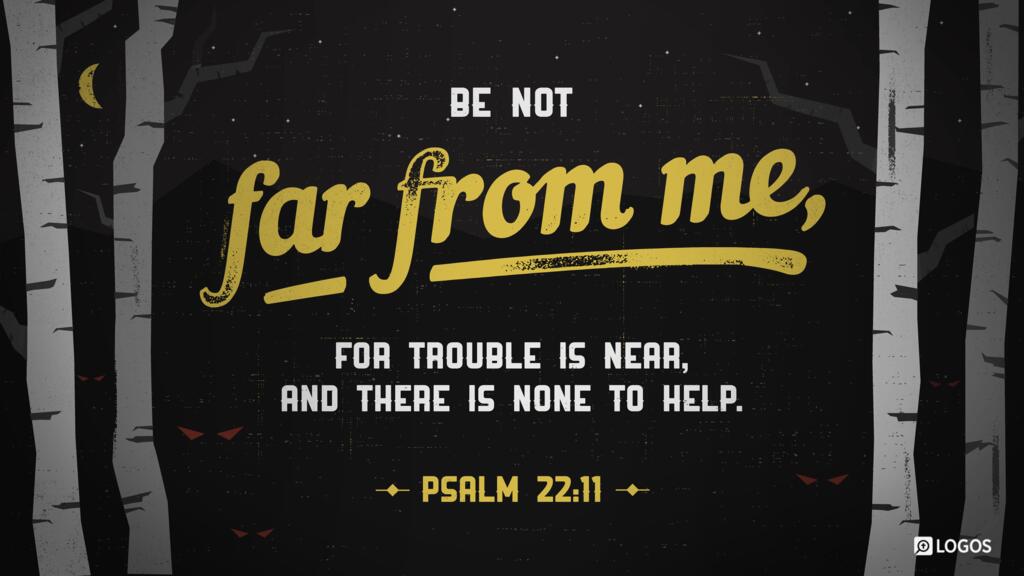
22:11Do not remain far away from me,
for trouble is near and I have no one to help me.23
22:12Many bulls24 surround me;
powerful bulls of Bashan25 hem me in.
22:13They26 open their mouths to devour me27
like a roaring lion that rips its prey.28
22:14My strength drains away like water;29
all my bones are dislocated;
my heart30 is like wax;
it melts away inside me.
22:15The roof of my mouth31 is as dry as a piece of pottery;
my tongue sticks to my gums.32
You33 set me in the dust of death.34
22:16Yes,35 wild dogs surround me—
a gang of evil men crowd around me;
like a lion they pin my hands and feet.36
22:17I can count37 all my bones;
my enemies38 are gloating over me in triumph.39
22:18They are dividing up my clothes among themselves;
they are rolling dice40 for my garments.
Footnotes
- 1 From the psalmist’s perspective it seems that God has abandoned him, for he fails to answer his cry for help (vv. 1b–2).
- 2 Heb “far from my deliverance [are] the words of my groaning.” The Hebrew noun שְׁאָגָה (shé’agah) and its related verb שָׁאַג (sha’ag) are sometimes used of a lion’s roar, but they can also describe human groaning (see Job 3:24 and Pss 32:3 and 38:8.
- 3 Heb “there is no silence to me.”
- 4 Heb “[O] one who sits [on] the praises of Israel.” The verb “receiving” is supplied in the translation for clarity. The metaphorical language pictures the Lord as sitting enthroned as king in his temple, receiving the praises that his people Israel offer up to him.
- 5 Heb “fathers.”
- 6 The words “in you” are supplied in the translation. They are understood by ellipsis (see the preceding line).
- 7 Or “were not ashamed.”
- 8 The grammatical construction (conjunction + pronoun) highlights the contrast between the psalmist’s experience and that of his ancestors. When he considers God’s past reliability, it only heightens his despair and confusion, for God’s present silence stands in stark contrast to his past saving acts.
- 9 The metaphor expresses the psalmist’s self-perception, which is based on how others treat him (see the following line).
- 10 Or “not a human being.” The psalmist perceives himself as less than human.
- 11 Heb “a reproach of man and despised by people.”
- 12 Or “scoff at, deride, mock.”
- 13 Heb “they separate with a lip.” Apparently this refers to their verbal taunting.
- 14 Shake their heads. Apparently this refers to a taunting gesture. See also Job 16:4; Ps 109:25; Lam 2:15.
- 15 The words “they say” are supplied in the translation for clarification and for stylistic reasons. The psalmist here quotes the sarcastic taunts of his enemies.
- 16 Heb “roll [yourself].” The Hebrew verb גלל here has the sense of “commit” (see Prov 16:3). The imperatival form in the Hebrew text indicates the enemies here address the psalmist. Since they refer to him in the third person in the rest of the verse, some prefer to emend the verb to a perfect, “he commits himself to the Lord.”
- 17 Heb “Let him”; the referent (the Lord) has been specified in the translation for clarity.
- 18 Heb “Let him”; the referent (the Lord) has been specified in the translation for clarity.
- 19 That is, “for he [the Lord] delights in him [the psalmist].” For other cases where the expression “delight in” refers to God’s delight in a person, see Num 14:8; 1 Kgs 10:9; Pss 18:19; 40:8. This statement does not necessarily reflect the enemies’ actual belief, but it does reflect the psalmist’s confession. The psalmist’s enemies sarcastically appeal to God to help him, because he claims to be an object of divine favor. However, they probably doubted the reality of his claim.
- 20 Or “the one who pulled me.” The verb is derived from either גָחָה (gakhah; see גחה) or גִּיחַ (giyakh; see 161 גִּיחַ) and seems to carry the nuance “burst forth” or “pull out.”
- 21 Heb “upon you I was cast from [the] womb.”
- 22 Heb “from the womb of my mother you [have been] my God.” Despite the enemies’ taunts, the psalmist is certain of his relationship with God, which began from the time of his birth (from the time I came out of my mother’s womb).
- 23 Heb “and there is no helper.”
- 24 The psalmist figuratively compares his enemies to dangerous bulls.
- 25 Bashan, located east of the Jordan River, was well-known for its cattle. See Ezek 39:18; Amos 4:1.
- 26 “They” refers to the psalmist’s enemies, who in the previous verse are described as “powerful bulls.”
- 27 Heb “they open against me their mouth[s].” To “open the mouth against” is a Hebrew idiom associated with eating and swallowing (see Ezek 2:8; Lam 2:16).
- 28 Heb “a lion ripping and roaring.”
- 29 Heb “like water I am poured out.”
- 30 The heart is viewed here as the seat of the psalmist’s strength and courage.
- 31 Heb “my strength” (כֹּחִי, kokhiy), but many prefer to emend the text to חִכִּי (khikiy, “my palate”; cf. , “my mouth”) assuming that an error of transposition has occurred in the traditional Hebrew text.
- 32 Cf. “my jaw”; , “my jaws”; “the roof of my mouth.”
- 33 Here the psalmist addresses God and suggests that God is ultimately responsible for what is happening because of his failure to intervene (see vv. 1–2, 11).
- 34 The imperfect verbal form draws attention to the progressive nature of the action. The psalmist is in the process of dying.
- 35 Or “for.”
- 36 Heb “like a lion, my hands and my feet.” This reading is often emended because it is grammatically awkward, but perhaps its awkwardness is by rhetorical design. Its broken syntax may be intended to convey the panic and terror felt by the psalmist. The psalmist may envision a lion pinning the hands and feet of its victim to the ground with its paws (a scene depicted in ancient Near Eastern art), or a lion biting the hands and feet. The line has been traditionally translated, “they pierce my hands and feet,” and then taken as foreshadowing the crucifixion of Christ. Though Jesus does appropriate the language of this psalm while on the cross (compare v. 1 with Matt 27:46 and Mark 15:34), the NT does not cite this verse in describing the death of Jesus. (It does refer to vv. 7–8 and 18, however. See Matt 27:35, 39, 43; Mark 15:24, 29; Luke 23:34; John 19:23–24.) If one were to insist on an emendation of כָּאֲרִי (ka’ariy, “like a lion”) to a verb, the most likely verbal root would be כָּרָה (karah, “dig”; see the ). In this context this verb could refer to the gnawing and tearing of wild dogs (cf. , , ). The ancient Greek version produced by Symmachus reads “bind” here, perhaps understanding a verbal root כרך, which is attested in later Hebrew and Aramaic and means “to encircle, entwine, embrace” (see כרך and 668 כָּרַךְ). Neither one of these proposed verbs can yield a meaning “bore, pierce.”
- 37 The imperfect verbal forms in vv. 17–18 draw attention to the progressive nature of the action.
- 38 Heb “they.” The masculine form indicates the enemies are in view. The referent (the psalmist’s enemies) has been specified in the translation for clarity.
- 39 Heb “they gaze, they look upon me.”
- 40 Heb “casting lots.” The precise way in which this would have been done is not certain.
The NET Bible First Edition, Copyright 1996-2005 by Biblical Studies Press