Psalm 18:29–42
The NET BibleOther versions
English
- NET The NET Bible
- DARBY 1890 Darby Bible
- ASV American Standard Version
- AV 1873 The Cambridge Paragraph Bible of the Authorized English Version
- CSB Christian Standard Bible
- D-R Douay-Rheims Bible
- ESV English Standard Version
- GW GOD’S WORD Translation
- GNB Good News Translation
- HCSB The Holman Christian Standard Bible
- KJV 1900 King James Version
- LSB Legacy Standard Bible
- LEB The Lexham English Bible
- MSG The Message: The Bible in Contemporary Language
- NASB95 New American Standard Bible (1995)
- NCV New Century Version
- NIrV New International Reader’s Version (1998)
- NIV New International Version (2011)
- NKJV The New King James Version
- NLT New Living Translation
- NRSVue New Revised Standard Version: Updated Edition
- RSV The Revised Standard Version
- RSVCE The Revised Standard Version, Catholic Edition
- YLT Young’s Literal Translation
Arabic
Czech
French
German
Hebrew
Hungarian
Italian
Korean
Latin
Portuguese
Russian
Simplified Chinese
Spanish
Traditional Chinese
18:29Indeed,80 with your help81 I can charge against82 an army;83
by my God’s power84 I can jump over a wall.85
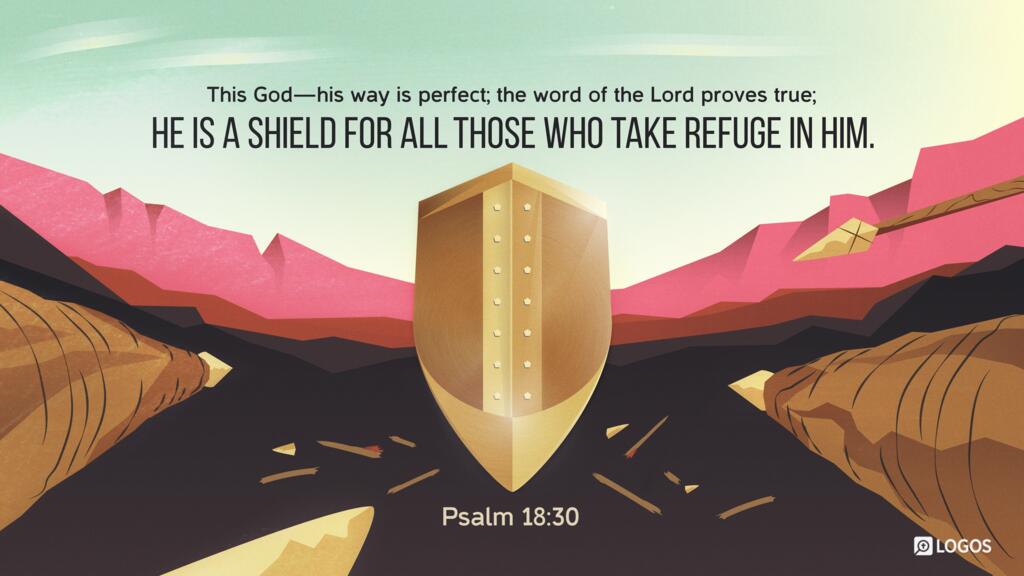
18:30The one true God acts in a faithful manner;86
the Lord’s promise87 is reliable;88
he is a shield to all who take shelter89 in him.
18:31Indeed,90 who is God besides the Lord?
Who is a protector91 besides our God?92
18:32The one true God93 gives94 me strength;95
he removes96 the obstacles in my way.97
18:33He gives me the agility of a deer;98
he enables me to negotiate the rugged terrain.99
18:34He trains my hands for battle;100
my arms can bend even the strongest bow.101
18:35You give me your protective shield;102
your right hand supports me;103
your willingness to help104 enables me to prevail.105
18:36You widen my path;106
my feet107 do not slip.
18:37I chase my enemies and catch108 them;
I do not turn back until I wipe them out.
18:38I beat them109 to death;110
they fall at my feet.111
18:39You give me strength112 for battle;
you make my foes kneel before me.113
18:40You make my enemies retreat;114
I destroy those who hate me.115
18:41They cry out, but there is no one to help them;116
they cry out to the Lord,117 but he does not answer them.
18:42I grind them as fine windblown dust;118
Footnotes
- 80 Or “for.” The translation assumes that כִּי (ki) is asseverative here.
- 81 Heb “by you.”
- 82 Heb “I will run.” The imperfect verbal forms in v. 29 indicate the subject’s potential or capacity to perform an action. Though one might expect a preposition to follow the verb here, this need not be the case with the verb רוּץ (ruts; see 1 Sam 17:22). Some emend the Qal to a Hiphil form of the verb and translate, “I put to flight [Heb “cause to run”] an army.”
- 83 More specifically, the noun גְּדוּד (gédud) refers to a raiding party or to a contingent of troops. I can charge against an army. The picture of a divinely empowered warrior charging against an army in almost superhuman fashion appears elsewhere in ancient Near Eastern literature. See R. B. Chisholm, “An Exegetical and Theological Study of Psalm 18/2 Samuel 22” (Th.D. diss., Dallas Theological Seminary, 1983), 228.
- 84 Heb “and by my God.”
- 85 I can jump over a wall. The psalmist uses hyperbole to emphasize his God-given military superiority.
- 86 Heb “[As for] the God, his way is blameless.” The term הָאֵל (ha’el, “the God”) stands as a nominative (or genitive) absolute in apposition to the resumptive pronominal suffix on “way.” The prefixed article emphasizes his distinctiveness as the one true God (cf. Deut 33:26). God’s “way” in this context refers to his protective and salvific acts in fulfillment of his promise (see also Deut 32:4; Pss 67:2; 77:13 [note vv. 11–12, 14]; 103:7; 138:5; 145:17).
- 87 The Lord’s promise. In the ancient Near East kings would typically seek and receive oracles from their god(s) prior to battle. For examples, see R. B. Chisholm, “An Exegetical and Theological Study of Psalm 18/2 Samuel 22” (Th.D. diss., Dallas Theological Seminary, 1983), 241–42.
- 88 Heb “the word of the Lord is purified.” The Lord’s “word” probably refers here to his oracle(s) of victory delivered to the psalmist before the battle(s) described in the following context. See also Pss 12:5–7 and 138:2–3. David frequently received such oracles before going into battle (see 1 Sam 23:2, 4–5, 10–12; 30:8; 2 Sam 5:19). The Lord’s word of promise is absolutely reliable; it is compared to metal that has been refined in fire and cleansed of impurities. See Ps 12:6.
- 89 Take shelter. See the note on the word “shelter” in v. .
- 90 Or “for.”
- 91 Heb “rocky cliff,” which is a metaphor of divine protection. See v. 2, where the Hebrew term צוּר (tsur) is translated “rocky summit.”
- 92 The rhetorical questions anticipate the answer, “No one.” In this way the psalmist indicates that the Lord is the only true God and reliable source of protection. See also Deut 32:39, where the Lord affirms that he is the only true God. Note as well the emphasis on his role as protector (Heb “rocky cliff,” צוּר, tsur) in Deut 32:4, 15, 17–18, 30.
- 93 Heb “the God.” The prefixed article emphasizes the Lord’s distinctiveness as the one true God (cf. Deut 33:26). See v. 30.
- 94 Heb “is the one who clothes.” For similar language see 1 Sam 2:4; Pss 65:6; 93:1. The psalmist employs a generalizing hymnic style in vv. 32–34; he uses participles in vv. 32a, 33a, and 34a to describe what God characteristically does on his behalf.
- 95 2 Sam 22:33 reads, “the God is my strong refuge.” Gives me strength. As the following context makes clear, this refers to physical and emotional strength for battle (see especially v. 39).
- 96 The prefixed verbal form with vav (ו) consecutive here carries along the generalizing force of the preceding participle.
- 97 Heb “he made my path smooth.” The Hebrew term תָּמִים (tamim, “smooth”) usually carries a moral or ethical connotation, “blameless, innocent.” However, in Ps 18:33 it refers to a pathway free of obstacles. The reality underlying the metaphor is the psalmist’s ability to charge into battle without tripping (see vv. 33, 36).
- 98 Heb “[the one who] makes my feet like [those of] a deer.”
- 99 Heb “and on my high places he makes me walk.” The imperfect verbal form emphasizes God’s characteristic provision. The psalmist compares his agility in battle to the ability of a deer to negotiate rugged, high terrain without falling or being injured. Habakkuk uses similar language to describe his faith during difficult times. See Hab 3:19.
- 100 He trains my hands. The psalmist attributes his skill with weapons to divine enablement. Egyptian reliefs picture gods teaching the king how to shoot a bow. See O. Keel, The Symbolism of the Biblical World, 265.
- 101 Heb “and a bow of bronze is bent by my arms”; or “my arms bend a bow of bronze.” The verb נָחַת (nakhat) apparently means “pull back, bend” here (see נחת). The third feminine singular verbal form appears to agree with the feminine singular noun קֶשֶׁת (qeshet, “bow”). In this case the verb must be taken as Niphal (passive). However, it is possible that “my arms” is the subject of the verb and “bow” the object. In this case the verb is Piel (active). For other examples of a feminine singular verb being construed with a plural noun, see §145.k. The strongest bow (Heb “bow of bronze”) probably refers to a bow laminated with bronze strips, or to a purely ceremonial or decorative bow made entirely from bronze. In the latter case the language is hyperbolic, for such a weapon would not be functional in battle.
- 102 Heb “and you give to me the shield of your deliverance.” You give me your protective shield. Ancient Near Eastern literature often refers to a god giving a king special weapons. See R. B. Chisholm, “An Exegetical and Theological Study of Psalm 18/2 Samuel 22” (Th.D. diss., Dallas Theological Seminary, 1983), 260–61.
- 103 2 Sam 22:36 omits this line, perhaps due to homoioarcton. A scribe’s eye may have jumped from the vav (ו) prefixed to “your right hand” to the vav prefixed to the following “and your answer,” causing the copyist to omit by accident the intervening words (“your right hand supports me and”).
- 104 The of Ps 18:35 appears to read, “your condescension,” apparently referring to God’s willingness to intervene (cf. “you stoop down”). However, the noun עֲנָוָה (’anavah) elsewhere means “humility” and is used only here of God. The form עַנְוַתְךָ (’anvatékha) may be a fully written form of the suffixed infinitive construct of עָנָה (’anah, “to answer”; a defectively written form of the infinitive appears in 2 Sam 22:36). In this case the psalmist refers to God’s willingness to answer his prayer; one might translate, “your favorable response.”
- 105 Heb “makes me great.”
- 106 Heb “you make wide my step under me.” “Step” probably refers metonymically to the path upon which the psalmist walks. Another option is to translate, “you widen my stride.” This would suggest that God gives the psalmist the capacity to run quickly.
- 107 Heb “lower legs.” On the meaning of the Hebrew noun, which occurs only here, see H. R. Cohen, Biblical Hapax Legomena (), 112. A cognate Akkadian noun means “lower leg.”
- 108 2 Sam 22:38 reads “destroy.”
- 109 Or “smash them.” 2 Sam 22:39 reads, “and I wiped them out and smashed them.”
- 110 Heb “until they are unable to rise.” 2 Sam 22:39 reads, “until they do not rise.”
- 111 They fall at my feet. For ancient Near Eastern parallels, see O. Keel, The Symbolism of the Biblical World, 294–97.
- 112 Heb “clothed me.” See v. 32.
- 113 Heb “you make those who rise against me kneel beneath me.” My foes kneel before me. For ancient Near Eastern parallels, see R. B. Chisholm, “An Exegetical and Theological Study of Psalm 18/2 Samuel 22” (Th.D. diss., Dallas Theological Seminary, 1983), 268.
- 114 Heb “and [as for] my enemies, you give to me [the] back [or “neck”].” The idiom “give [the] back” means “to cause [one] to turn the back and run away.” Cf. Exod 23:27.
- 115 Those who hate me. See v. 17, where it is the Lord who delivered the psalmist from those who hated him.
- 116 Heb “but there is no deliverer.”
- 117 Heb “to the Lord.” The words “they cry out” are supplied in the translation because they are understood by ellipsis (see the preceding line). They cry out. This reference to the psalmist’s enemies crying out for help to the Lord suggests that the psalmist refers here to enemies within the covenant community, rather than foreigners. However, the militaristic context suggests foreign enemies are in view. Ancient Near Eastern literature indicates that defeated enemies would sometimes cry out for mercy to the god(s) of their conqueror. See R. B. Chisholm, “An Exegetical and Theological Study of Psalm 18/2 Samuel 22” (Th.D. diss., Dallas Theological Seminary, 1983), 271.
- 118 Heb “I pulverize them like dust upon the face of the wind.” The phrase “upon the face of” here means “before.” 2 Sam 22:43 reads, “like dust of the earth.”
- 119 Ps 18:42 reads, “I empty them out” (Hiphil of ריק), while 2 Sam 22:43 reads, “I crush them, I stomp on them” (juxtaposing the synonyms דקק and רקע). It is likely that the latter is a conflation of variants. One, but not both, of the verbs in 2 Sam 22:43 is probably original; “empty out” does not form as good a parallel with “grind, pulverize” in the parallel line.
- 120 Or “mud.”
The NET Bible First Edition, Copyright 1996-2005 by Biblical Studies Press