Psalm 119:97–112
The NET BibleOther versions
English
- NET The NET Bible
- DARBY 1890 Darby Bible
- ASV American Standard Version
- AV 1873 The Cambridge Paragraph Bible of the Authorized English Version
- CSB Christian Standard Bible
- D-R Douay-Rheims Bible
- ESV English Standard Version
- GW GOD’S WORD Translation
- GNB Good News Translation
- HCSB The Holman Christian Standard Bible
- KJV 1900 King James Version
- LSB Legacy Standard Bible
- LEB The Lexham English Bible
- MSG The Message: The Bible in Contemporary Language
- NASB95 New American Standard Bible (1995)
- NCV New Century Version
- NIrV New International Reader’s Version (1998)
- NIV New International Version (2011)
- NKJV The New King James Version
- NLT New Living Translation
- NRSVue New Revised Standard Version: Updated Edition
- RSV The Revised Standard Version
- RSVCE The Revised Standard Version, Catholic Edition
- YLT Young’s Literal Translation
Arabic
Czech
French
German
Hebrew
Hungarian
Italian
Korean
Latin
Portuguese
Russian
Simplified Chinese
Spanish
Traditional Chinese
ם (Mem)
119:97O how I love your law!
All day long I meditate on it.
119:98Your commandments131 make me wiser than my enemies,
for I am always aware of them.
119:99I have more insight than all my teachers,
for I meditate on your rules.
119:100I am more discerning than those older than I,
for I observe your precepts.
119:101I stay away132 from the evil path,
so that I might keep your instructions.133
119:102I do not turn aside from your regulations,
for you teach me.
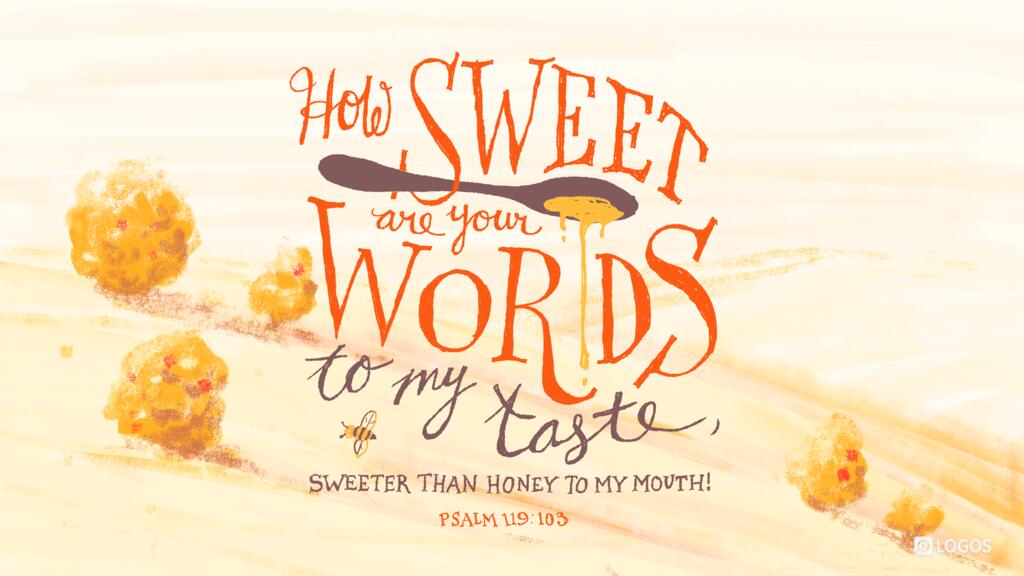
119:103Your words are sweeter
in my mouth than honey!134
119:104Your precepts give me discernment.
Therefore I hate all deceitful actions.135
ן (Nun)
119:105Your word136 is a lamp to walk by,
and a light to illumine my path.137
119:106I have vowed and solemnly sworn
to keep your just regulations.
119:107I am suffering terribly.
O Lord, revive me with your word!138
119:108O Lord, please accept the freewill offerings of my praise!139
Teach me your regulations!
119:109My life is in continual danger,140
but I do not forget your law.
119:110The wicked lay a trap for me,
but I do not wander from your precepts.
119:111I claim your rules as my permanent possession,
for they give me joy.141
119:112I am determined to obey142 your statutes
at all times, to the very end.
Footnotes
- 131 The plural form needs to be revocalized as a singular in order to agree with the preceding singular verb and the singular pronoun in the next line. The Lord’s “command” refers here to the law (see Ps 19:8).
- 132 Heb “I hold back my feet.”
- 133 Heb “your word.” Many medieval Hebrew read the plural.
- 134 Heb “How smooth they are to my palate, your word, more than honey to my mouth.” A few medieval Hebrew , as well as several other ancient witnesses, read the plural “your words,” which can then be understood as the subject of the plural verb “they are smooth.”
- 135 Heb “every false path.”
- 136 Many medieval Hebrew read the plural (“words”).
- 137 Heb “[is] a lamp for my foot and a light for my path.”
- 138 Heb “according to your word.”
- 139 Heb “of my mouth.”
- 140 Heb “my life [is] in my hands continually.”
- 141 Heb “for the joy of my heart [are] they.”
- 142 Heb “I turn my heart to do.”
The NET Bible First Edition, Copyright 1996-2005 by Biblical Studies Press