Galatians 4:1–5:1
English Standard VersionOther versions
English
- ESV English Standard Version
- DARBY 1890 Darby Bible
- ASV American Standard Version
- AV 1873 The Cambridge Paragraph Bible of the Authorized English Version
- CSB Christian Standard Bible
- D-R Douay-Rheims Bible
- GW GOD’S WORD Translation
- GNB Good News Translation
- HCSB The Holman Christian Standard Bible
- KJV 1900 King James Version
- LSB Legacy Standard Bible
- LEB The Lexham English Bible
- MSG The Message: The Bible in Contemporary Language
- NET The NET Bible
- NASB95 New American Standard Bible (1995)
- NCV New Century Version
- NIrV New International Reader’s Version (1998)
- NIV New International Version (2011)
- NKJV The New King James Version
- NLT New Living Translation
- NRSVue New Revised Standard Version: Updated Edition
- RSV The Revised Standard Version
- RSVCE The Revised Standard Version, Catholic Edition
- YLT Young’s Literal Translation
Arabic
Czech
French
German
Greek
Hungarian
Italian
Korean
Latin
Portuguese
Russian
Simplified Chinese
Spanish
Traditional Chinese
Sons and Heirs
4I mean that the heir, as long as he is a child, is no different from a slave,1 though he is the owner of everything, 2but he is under guardians and managers until the date set by his father. 3In the same way we also, when we were children, cwere enslaved to the elementary principles2 of the world. 4But dwhen the fullness of time had come, God sent forth his Son, eborn fof woman, born gunder the law, 5hto redeem those who were under the law, so that we might receive iadoption as sons. 6And because you are sons, God has sent jthe Spirit of his Son into our hearts, crying, “Abba! Father!” 7So you are no longer a slave, but a son, and if a son, then kan heir through God.
Paul’s Concern for the Galatians
8Formerly, when you ldid not know God, you mwere enslaved to those that by nature nare not gods. 9But now that you have come to know God, or rather oto be known by God, phow can you turn back again to qthe weak and worthless elementary principles of the world, whose slaves you want to be once more? 10rYou observe days and months and seasons and years! 11I am afraid sI may have labored over you in vain.
12Brothers,3 tI entreat you, become as I am, for I also have become as you are. uYou did me no wrong. 13You know it was vbecause of a bodily ailment that I preached the gospel to you wat first, 14and though my condition was a trial to you, you did not scorn or despise me, but received me xas an angel of God, yas Christ Jesus. 15What then has become of your blessedness? For I testify to you that, if possible, you would have gouged out your eyes and given them to me. 16Have I then become your enemy by ztelling you the truth?4 17They make much of you, but for no good purpose. They want to shut you out, that you may make much of them. 18It is always good to be made much of for a good purpose, and anot only when I am present with you, 19bmy little children, cfor whom I am again in the anguish of childbirth until Christ dis formed in you! 20I wish I could be present with you now and change my tone, for I am perplexed about you.
Example of Hagar and Sarah
21Tell me, you who desire to be under the law, do you not listen to the law? 22For it is written that Abraham had two sons, eone by a slave woman and fone by a free woman. 23But gthe son of the slave was born according to the flesh, while hthe son of the free woman was born through promise. 24Now this may be interpreted allegorically: these women are two icovenants. jOne is from Mount Sinai, bearing children for slavery; she is Hagar. 25Now Hagar is Mount Sinai in Arabia;5 she corresponds to the present Jerusalem, for she is in slavery with her children. 26But kthe Jerusalem above is free, and she is our mother. 27For it is written,
l“Rejoice, O barren one who does not bear;
break forth and cry aloud, you who are not in labor!
For the children of the desolate one will be more
than those of the one who has a husband.”
28Now you,6 brothers, mlike Isaac, nare children of promise. 29But just as at that time he who was born according to the flesh opersecuted him who was born according to the Spirit, pso also it is now. 30But what does the Scripture say? q“Cast out the slave woman and her son, for the son of the slave woman shall not inherit with the son of the free woman.” 31So, brothers, we are not children of the slave but rof the free woman.
Christ Has Set Us Free
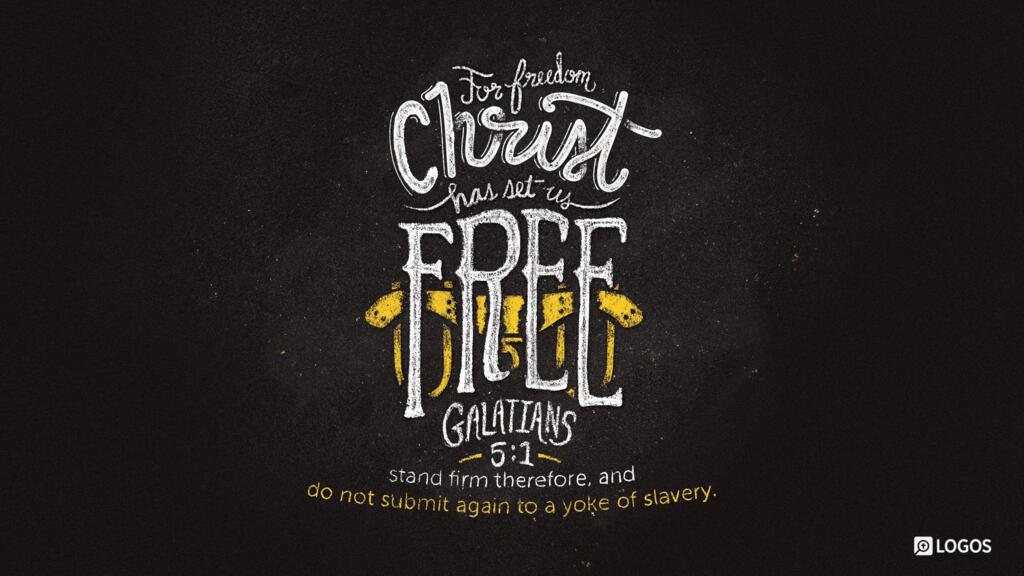
5For sfreedom Christ has tset us free; ustand firm therefore, and do not submit again to va yoke of wslavery.
Footnotes
Cross references
- cSee ch. 2:4
- d[1 Tim. 2:6]; See Mark 1:15
- ePhil. 2:7; See John 1:14
- f[1 Tim. 2:15]; See Gen. 3:15
- g[Luke 2:21, 22, 27]
- hSee ch. 3:13
- ich. 3:26; See Rom. 8:15
- j[Rom. 5:5; 2 Cor. 3:17]; See Acts 16:7
- kSee ch. 3:29
- l1 Cor. 1:21; 1 Thess. 4:5; 2 Thess. 1:8; 1 John 4:8
- m[Eph. 2:11, 12; 1 Thess. 1:9]
- n2 Chr. 13:9; Isa. 37:19; Jer. 2:11; 5:7; 16:20; [1 Cor. 8:4]
- oSee 1 Cor. 8:3
- p[ch. 3:3]
- qRom. 8:3; Heb. 7:18
- rRom. 14:5; Col. 2:16
- sch. 2:2; 5:2, 4; 1 Thess. 3:5
- t[2 Cor. 6:13]
- u[2 Cor. 2:5]
- vSee 1 Cor. 2:3
- w[ch. 1:6]
- x1 Sam. 29:9; [Mal. 2:7 (Gk.); 2 Cor. 5:20]
- ySee Matt. 10:40
- zSee ch. 2:5
- a[ver. 13]
- b[1 Cor. 4:15; Philem. 10]
- c[James 1:18]
- dRom. 8:10
- eGen. 16:5
- fGen. 21:2
- gver. 29; [Rom. 9:7]
- hver. 28; Gen. 17:16–19; 18:10, 14; 21:1, 2; Heb. 11:11
- iSee Rom. 9:4
- jDeut. 33:2
- k[Heb. 12:22; Rev. 3:12; 21:2, 10]
- lCited from Isa. 54:1
- mSee ver. 23
- nRom. 9:8; See ch. 3:29
- oGen. 21:9
- pSee ch. 5:11
- qCited from Gen. 21:10; [John 8:35]
- r[1 Pet. 3:6]
- sver. 13; ch. 2:4; See James 1:25
- tSee John 8:32
- uSee 1 Cor. 16:13
- vActs 15:10
- wSee ch. 2:4
Copyright 2001 Crossway Bibles