Hebrews 9:11–22
New International Version (2011)Other versions
English
- NIV New International Version (2011)
- DARBY 1890 Darby Bible
- ASV American Standard Version
- AV 1873 The Cambridge Paragraph Bible of the Authorized English Version
- CSB Christian Standard Bible
- D-R Douay-Rheims Bible
- ESV English Standard Version
- GW GOD’S WORD Translation
- GNB Good News Translation
- HCSB The Holman Christian Standard Bible
- KJV 1900 King James Version
- LSB Legacy Standard Bible
- LEB The Lexham English Bible
- MSG The Message: The Bible in Contemporary Language
- NET The NET Bible
- NASB95 New American Standard Bible (1995)
- NCV New Century Version
- NIrV New International Reader’s Version (1998)
- NKJV The New King James Version
- NLT New Living Translation
- NRSVue New Revised Standard Version: Updated Edition
- RSV The Revised Standard Version
- RSVCE The Revised Standard Version, Catholic Edition
- YLT Young’s Literal Translation
Arabic
Czech
French
German
Greek
Hungarian
Italian
Korean
Latin
Portuguese
Russian
Simplified Chinese
Spanish
Traditional Chinese
The Blood of Christ
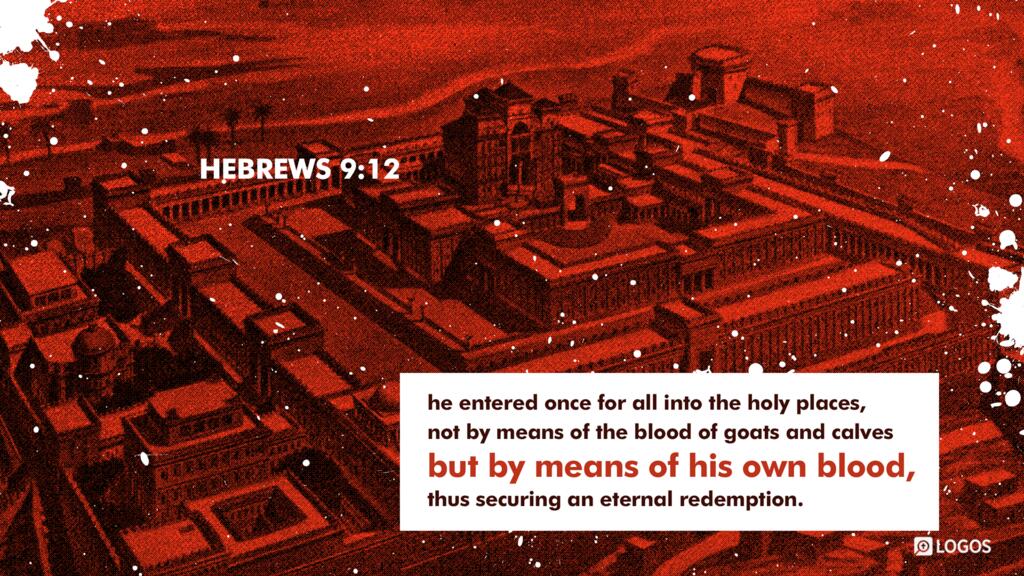
11But when Christ came as high priestu of the good things that are now already here,av he went through the greater and more perfect tabernaclew that is not made with human hands,x that is to say, is not a part of this creation. 12He did not enter by means of the blood of goats and calves;y but he entered the Most Holy Placez once for alla by his own blood,b thus obtainingb eternal redemption. 13The blood of goats and bullsc and the ashes of a heiferd sprinkled on those who are ceremonially unclean sanctify them so that they are outwardly clean. 14How much more, then, will the blood of Christ, who through the eternal Spirite offered himselff unblemished to God, cleanse our consciencesg from acts that lead to death,ch so that we may serve the living God!i
15For this reason Christ is the mediatorj of a new covenant,k that those who are calledl may receive the promisedm eternal inheritancen—now that he has died as a ransom to set them free from the sins committed under the first covenant.o
16In the case of a will,d it is necessary to prove the death of the one who made it, 17because a will is in force only when somebody has died; it never takes effect while the one who made it is living. 18This is why even the first covenant was not put into effect without blood.p 19When Moses had proclaimedq every command of the law to all the people, he took the blood of calves,r together with water, scarlet wool and branches of hyssop, and sprinkled the scroll and all the people.s 20He said, “This is the blood of the covenant, which God has commanded you to keep.”et 21In the same way, he sprinkled with the blood both the tabernacle and everything used in its ceremonies. 22In fact, the law requires that nearly everything be cleansed with blood,u and without the shedding of blood there is no forgiveness.v
Footnotes
Cross references
- uSee Heb 2:17
- vHeb 10:1
- wver 24; Heb 8:2
- xSee Jn 2:19
- yver 19; Lev 16:6, 15; Heb 10:4
- zver 24
- aver 26, 28; See Heb 7:27
- bver 14; See Ro 3:25
- cHeb 10:4
- dNu 19:9, 17, 18
- e1 Pe 3:18
- fSee Eph 5:2
- gPs 51:2; 65:3; Jer 33:8; Zec 13:1; See Tit 2:14; Heb 10:2, 22
- hHeb 6:1
- iSee Mt 16:16
- jSee Gal 3:20
- kSee Lk 22:20
- lSee Ro 8:28; See 11:29
- mHeb 6:15; 10:36
- nSee Ac 20:32
- oHeb 7:22
- pEx 24:6–8
- qHeb 1:1
- rver 12
- sEx 24:6–8
- tEx 24:8; See Mt 26:28
- uEx 29:21; Lev 8:15
- vLev 17:11
Copyright 1973, 1978, 1984, 2011 Biblica, Inc.