Psalm 31:1–18
The NET BibleOther versions
English
- NET The NET Bible
- DARBY 1890 Darby Bible
- ASV American Standard Version
- AV 1873 The Cambridge Paragraph Bible of the Authorized English Version
- CSB Christian Standard Bible
- D-R Douay-Rheims Bible
- ESV English Standard Version
- GW GOD’S WORD Translation
- GNB Good News Translation
- HCSB The Holman Christian Standard Bible
- KJV 1900 King James Version
- LSB Legacy Standard Bible
- LEB The Lexham English Bible
- MSG The Message: The Bible in Contemporary Language
- NASB95 New American Standard Bible (1995)
- NCV New Century Version
- NIrV New International Reader’s Version (1998)
- NIV New International Version (2011)
- NKJV The New King James Version
- NLT New Living Translation
- NRSVue New Revised Standard Version: Updated Edition
- RSV The Revised Standard Version
- RSVCE The Revised Standard Version, Catholic Edition
- TNIV Today’s New International Version
- YLT Young’s Literal Translation
Arabic
Czech
French
German
Hebrew
Hungarian
Italian
Korean
Latin
Portuguese
Russian
Simplified Chinese
Spanish
Traditional Chinese
31:1In you, O Lord, I have taken shelter!
Never let me be humiliated!
Vindicate me by rescuing me!1
31:2Listen to me!2
Quickly deliver me!
Be my protector and refuge,3
a stronghold where I can be safe!4
31:3For you are my high ridge5 and my stronghold;
for the sake of your own reputation6 you lead me and guide me.7
31:4You will free me8 from the net they hid for me,
for you are my place of refuge.
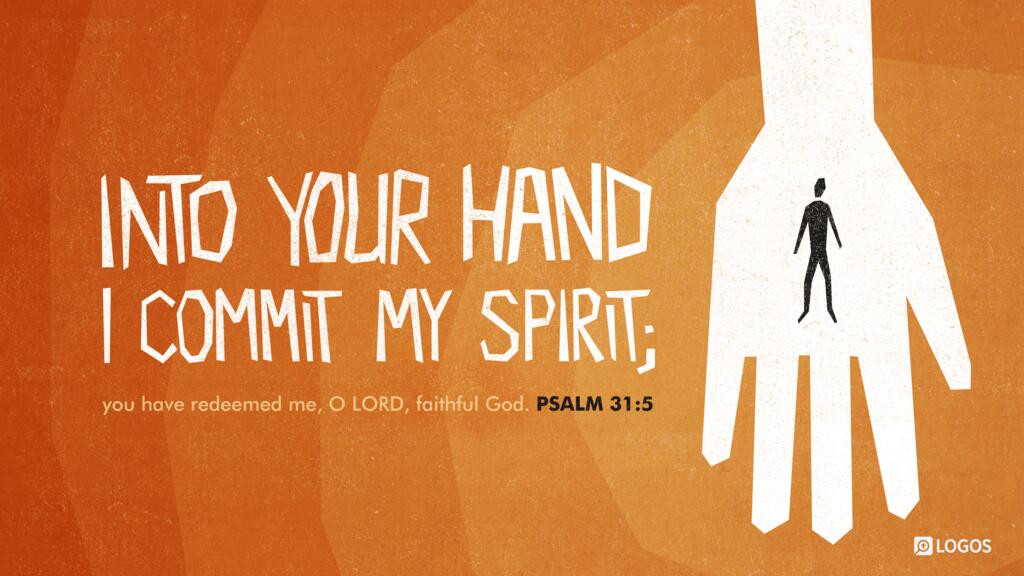
31:5Into your hand I entrust my life;9
you will rescue10 me, O Lord, the faithful God.
31:6I hate those who serve worthless idols,11
but I trust in the Lord.
31:7I will be happy and rejoice in your faithfulness,
because you notice my pain
and you are aware of how distressed I am.12
31:8You do not deliver me over to the power of the enemy;
you enable me to stand13 in a wide open place.
31:9Have mercy on me, for I am in distress!
My eyes grow dim14 from suffering.15
I have lost my strength.16
31:10For my life nears its end in pain;
my years draw to a close as I groan.17
My strength fails me because of18 my sin,
and my bones become brittle.19
31:11Because of all my enemies, people disdain me;20
my neighbors are appalled by my suffering21—
those who know me are horrified by my condition;22
those who see me in the street run away from me.
31:12I am forgotten, like a dead man no one thinks about;23
I am regarded as worthless, like a broken jar.24
31:13For I hear what so many are saying,25
the terrifying news that comes from every direction.26
When they plot together against me,
they figure out how they can take my life.
31:14But I trust in you, O Lord!
I declare, “You are my God!”
31:15You determine my destiny!27
Rescue me from the power of my enemies and those who chase me.
31:16Smile28 on your servant!
Deliver me because of your faithfulness!
31:17O Lord, do not let me be humiliated,
for I call out to you!
May evil men be humiliated!
May they go wailing to the grave!29
31:18May lying lips be silenced—
lips30 that speak defiantly against the innocent31
with arrogance and contempt!
Footnotes
- 1 Heb “in your vindication rescue me.”
- 2 Heb “turn toward me your ear.”
- 3 Heb “become for me a rocky summit of refuge.”
- 4 Heb “a house of strongholds to deliver me.”
- 5 The metaphor of the high ridge pictures God as a rocky, relatively inaccessible summit, where one would be able to find protection from enemies. See 1 Sam 23:25, 28.
- 6 Heb “name.” The Hebrew term שֵׁם (shem, “name”) refers here to the Lord’s reputation. (The English term “name” is often used the same way.)
- 7 The present translation assumes that the imperfect verbal forms are generalizing, “you lead me and guide me.” Other options are to take them as an expression of confidence about the future, “you will lead me and guide me” (cf. ), or as expressing a prayer, “lead me and guide me” (cf. , , ).
- 8 Heb “bring me out.” The translation assumes that the imperfect verbal form expresses the psalmist’s confidence about the future. Another option is to take the form as expressing a prayer, “free me.”
- 9 Heb “my spirit.” The noun רוּחַ (ruakh, “spirit”) here refers to the animating spirit that gives the psalmist life.
- 10 Or “redeem.” The perfect verbal form is understood here as anticipatory, indicating rhetorically the psalmist’s certitude and confidence that God will intervene. The psalmist is so confident of God’s positive response to his prayer that he can describe his deliverance as if it had already happened. Another option is to take the perfect as precative, expressing a wish or request (“rescue me”; cf. ). See §30.5.4c, d. However, not all grammarians are convinced that the perfect is used as a precative in biblical Hebrew.
- 11 Heb “the ones who observe vain things of falsehood.” See Jonah 2:9.
- 12 Heb “you know the distresses of my life.”
- 13 Heb “you cause my feet to stand.”
- 14 Or perhaps, “are swollen.”
- 15 Cf. Ps 6:7, which has a similar line.
- 16 Heb “my breath and my stomach [grow weak].” Apparently the verb in the previous line (“grow dim, be weakened”) is to be understood here. The Hebrew term נפשׁ can mean “life,” or, more specifically, “throat, breath.” The psalmist seems to be lamenting that his breathing is impaired because of the physical and emotional suffering he is forced to endure.
- 17 Heb “and my years in groaning.”
- 18 Heb “stumbles in.”
- 19 Heb “grow weak.”
- 20 Heb “because of all my enemies I am a reproach.”
- 21 Heb “and to my neighbors, exceedingly.” If the is retained, then these words probably go with what precedes. However the syntactical awkwardness of the text suggests it is textually corrupt. P. C. Craigie (Psalms 1–50 [], ) suggests that the initial mem (ם) on מְאֹד (me’od, “exceedingly”) be understood as an enclitic mem (ם) which was originally suffixed to the preceding form and then later misinterpreted. The resulting form אֵד (’ed) can then be taken as a defectively written form of אֵיד (’ed, “calamity”). If one follows this emendation, then the text reads literally, “and to my neighbors [I am one who experiences] calamity.” The noun פַחַד (fakhad, “[object of] horror”) occurs in the next line; אֵיד and פַחַד appear in parallelism elsewhere (see Prov 1:26–27).
- 22 Heb “and [an object of] horror to those known by me.”
- 23 Heb “I am forgotten, like a dead man, from [the] heart.” The “heart” is here viewed as the center of one’s thoughts.
- 24 Heb “I am like a broken jar.” One throws away a broken jar without a second thought because it is considered worthless and useless.
- 25 Heb “the report of many.”
- 26 Heb “the terror from all around.”
- 27 Heb “in your hand [are] my times.”
- 28 Heb “cause your face to shine.”
- 29 The verb יִדְּמוּ (yiddému) is understood as a form of דָּמַם (damam, “wail, lament”). Another option is to take the verb from דָּמַם (“be quiet”; see 198–99 I דָּמַם), in which case one might translate, “May they lie silent in the grave.”
- 30 Heb “the [ones which].”
- 31 Or “godly.”
The NET Bible First Edition, Copyright 1996-2005 by Biblical Studies Press