Luke 1:39–80
The NET BibleOther versions
English
- NET The NET Bible
- DARBY 1890 Darby Bible
- ASV American Standard Version
- AV 1873 The Cambridge Paragraph Bible of the Authorized English Version
- CSB Christian Standard Bible
- D-R Douay-Rheims Bible
- ESV English Standard Version
- GW GOD’S WORD Translation
- GNB Good News Translation
- HCSB The Holman Christian Standard Bible
- KJV 1900 King James Version
- LSB Legacy Standard Bible
- LEB The Lexham English Bible
- MSG The Message: The Bible in Contemporary Language
- NASB95 New American Standard Bible (1995)
- NCV New Century Version
- NIrV New International Reader’s Version (1998)
- NIV New International Version (2011)
- NKJV The New King James Version
- NLT New Living Translation
- NRSVue New Revised Standard Version: Updated Edition
- RSV The Revised Standard Version
- RSVCE The Revised Standard Version, Catholic Edition
- YLT Young’s Literal Translation
Arabic
Czech
French
German
Greek
Hungarian
Italian
Korean
Latin
Portuguese
Russian
Simplified Chinese
Spanish
Traditional Chinese
Mary and Elizabeth
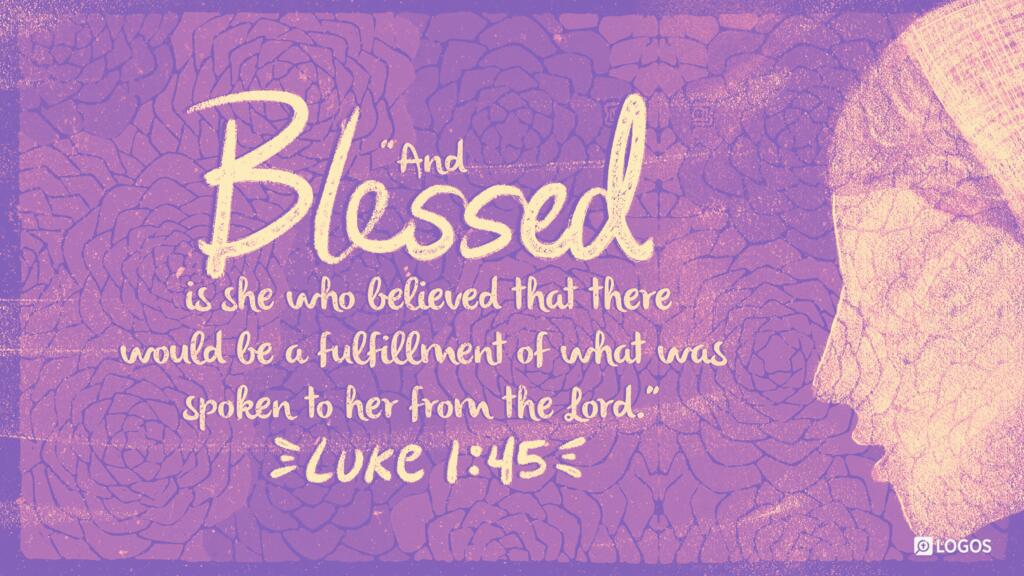
1:39In those days128 Mary got up and went hurriedly into the hill country, to a town of Judah,1291:40and entered Zechariah’s house and greeted Elizabeth. 1:41When130 Elizabeth heard Mary’s greeting, the baby leaped131 in her132 womb, and Elizabeth was filled with the Holy Spirit.1331:42She134 exclaimed with a loud voice,135 “Blessed are you among women,136 and blessed is the child137 in your womb! 1:43And who am I138 that the mother of my Lord should come and visit me? 1:44For the instant139 the sound of your greeting reached my ears,140 the baby in my womb leaped for joy.1411:45And blessed142 is she who believed that143 what was spoken to her by144 the Lord would be fulfilled.”145
Mary’s Hymn of Praise
“My soul exalts148 the Lord,149
1:47and my spirit has begun to rejoice150 in God my Savior,
1:48because he has looked upon the humble state of his servant.151
For152 from now on153 all generations will call me blessed,154
1:49because he who is mighty155 has done great things for me, and holy is his name;
1:50from156 generation to generation he is merciful157 to those who fear158 him.
1:51He has demonstrated power159 with his arm; he has scattered those whose pride wells up from the sheer arrogance160 of their hearts.
1:52He has brought down the mighty161 from their thrones, and has lifted up those of lowly position;162
1:53he has filled the hungry with good things,163 and has sent the rich away empty.164
1:54He has helped his servant Israel, remembering165 his mercy,166
1:55as he promised167 to our ancestors,168 to Abraham and to his descendants169 forever.”
1:56So170 Mary stayed with Elizabeth171 about three months172 and then returned to her home.
The Birth of John
1:57Now the time came173 for Elizabeth to have her baby,174 and she gave birth to a son. 1:58Her175 neighbors and relatives heard that the Lord had shown176 great mercy to her, and they rejoiced177 with her.
1:59On178 the eighth day179 they came to circumcise the child, and they wanted to name180 him Zechariah after his father. 1:60But181 his mother replied,182 “No! He must be named183 John.”1841:61They185 said to her, “But186 none of your relatives bears this name.”1871:62So188 they made signs to the baby’s189 father,190 inquiring what he wanted to name his son.1911:63He192 asked for a writing tablet193 and wrote,194 “His name is John.” And they were all amazed.1951:64Immediately196 Zechariah’s197 mouth was opened and his tongue198 released,199 and he spoke, blessing God. 1:65All200 their neighbors were filled with fear, and throughout the entire hill country of Judea all these things were talked about. 1:66All201 who heard these things202 kept them in their hearts,203 saying, “What then will this child be?”204 For the Lord’s hand205 was indeed with him.
Zechariah’s Praise and Prediction
1:67Then206 his father Zechariah was filled with the Holy Spirit and prophesied,207
1:68“Blessed208 be the Lord God of Israel,
because he has come to help209 and has redeemed210 his people.
1:69For211 he has raised up212 a horn of salvation213 for us in the house of his servant David,214
1:70as he spoke through the mouth of his holy prophets from long ago,215
1:71that we should be saved216 from our enemies,217
and from the hand of all who hate us.
1:72He has done this218 to show mercy219 to our ancestors,220
and to remember his holy covenant221—
1:73the oath222 that he swore to our ancestor223 Abraham.
This oath grants224
1:74that we, being rescued from the hand of our225 enemies,
may serve him without fear,226
1:75in holiness and righteousness227 before him for as long as we live.228
1:76And you, child,229 will be called the prophet230 of the Most High.231
For you will go before232 the Lord to prepare his ways,233
1:77to give his people knowledge of salvation234 through the forgiveness235 of their sins.
1:78Because of236 our God’s tender mercy237
the dawn238 will break239 upon us from on high
1:79to give light to those who sit in darkness and in the shadow of death,240
to guide our feet into the way241 of peace.”
1:80And the child kept growing242 and becoming strong243 in spirit, and he was in the wilderness244 until the day he was revealed245 to Israel.
Footnotes
- 128 The expression In those days is another general time reference, though the sense of the context is that the visit came shortly after Mary miraculously conceived and shortly after the announcement about Jesus.
- 129 The author does not say exactly where Elizabeth stayed. The location is given generally as a town of Judah. Judah is about a three day trip south of Nazareth.
- 130 Grk “And it happened that.” The introductory phrase ἐγένετο (egeneto, “it happened that”), common in Luke (69 times) and Acts (54 times), is redundant in contemporary English and has not been translated. Because of the difference between Greek style, which often begins sentences or clauses with “and,” and English style, which generally does not, καί (kai) has not been translated here either.
- 131 When the baby leaped John gave his first testimony about Jesus, a fulfillment of 1:15.
- 132 The antecedent of “her” is Elizabeth.
- 133 The passage makes clear that Elizabeth spoke her commentary with prophetic enablement, filled with the Holy Spirit.
- 134 Grk “and she.” Because of the length and complexity of the Greek sentence, a new sentence was begun here in the translation. Here καί (kai) has not been translated because of differences between Greek and English style.
- 135 Grk “and she exclaimed with a great cry and said.” The verb εἶπεν (eipen, “said”) has not been included in the translation since it is redundant in contemporary English.
- 136 The commendation Blessed are you among women means that Mary has a unique privilege to be the mother of the promised one of God.
- 137 Grk “fruit,” which is figurative here for the child she would give birth to.
- 138 Grk “From where this to me?” The translation suggests the note of humility and surprise that Elizabeth feels in being a part of these events. The ἵνα (hina) clause which follows explains what “this” is. A literal translation would read “From where this to me, that is, that the mother of my Lord comes to visit me?”
- 139 Grk “for behold.”
- 140 Grk “when the sound of your greeting [reached] my ears.”
- 141 On the statement the baby in my womb leaped for joy see both 1:14 and 1:41. This notes a fulfillment of God’s promised word.
- 142 Again the note of being blessed makes the key point of the passage about believing God.
- 143 This ὅτι (hoti) clause, technically indirect discourse after πιστεύω (pisteuō), explains the content of the faith, a belief in God’s promise coming to pass.
- 144 That is, “what was said to her (by the angel) at the Lord’s command” ( παρά A.2).
- 145 Grk “that there would be a fulfillment of what was said to her from the Lord.” This term speaks of completion of something planned (2 Chr 29:35).
- 146 A few witnesses, especially Latin , (a b l* Irarm Orlat Nic) read “Elizabeth” here, since she was just speaking, but the evidence overwhelmingly supports “Mary” as the speaker.
- 147 The following passage has been typeset as poetry because many scholars regard this passage as poetic or hymnic. These terms are used broadly to refer to the genre of writing, not to the content. There are two broad criteria for determining if a passage is poetic or hymnic: “(a) stylistic: a certain rhythmical lilt when the passages are read aloud, the presence of parallelismus membrorum (i.e., an arrangement into couplets), the semblance of some metre, and the presence of rhetorical devices such as alliteration, chiasmus, and antithesis; and (b) linguistic: an unusual vocabulary, particularly the presence of theological terms, which is different from the surrounding context” (P. T. O’Brien, Philippians [], ). Classifying a passage as hymnic or poetic is important because understanding this genre can provide keys to interpretation. However, not all scholars agree that the above criteria are present in this passage, so the decision to typeset it as poetry should be viewed as a tentative decision about its genre.
- 148 Or “lifts up the Lord in praise.”
- 149 This psalm (vv. 46–55) is one of the few praise psalms in the NT. Mary praises God and then tells why both in terms of his care for her (vv. 46–49) and for others, including Israel (vv. 50–55). Its traditional name, the “Magnificat,” comes from the Latin for the phrase My soul magnifies the Lord at the hymn’s start.
- 150 Or “rejoices.” The translation renders this aorist, which stands in contrast to the previous line’s present tense, as ingressive, which highlights Mary’s joyous reaction to the announcement. A comprehensive aorist is also possible here.
- 151 See the note on the word “servant” in v. .
- 152 Grk “for behold.”
- 153 From now on is a favorite phrase of Luke’s, showing how God’s acts change things from this point on (5:10; 12:52; 22:18, 69; Acts 18:6).
- 154 Mary is seen here as an example of an object of God’s grace (blessed) for all generations.
- 155 Traditionally, “the Mighty One.”
- 156 Grk “and from.” Here καί (kai) has been translated by a semicolon to improve the English style.
- 157 God’s mercy refers to his “loyal love” or “steadfast love,” expressed in faithful actions, as the rest of the psalm illustrates.
- 158 That is, “who revere.” This refers to those who show God a reverential respect for his sovereignty.
- 159 Or “shown strength,” “performed powerful deeds.” The verbs here switch to aorist tense through 1:55. This is how God will act in general for his people as they look to his ultimate deliverance.
- 160 Grk “in the imaginations of their hearts.” The psalm rebukes the arrogance of the proud, who think that power is their sovereign right. Here διανοίᾳ (dianoia) can be understood as a dative of sphere or reference/respect.
- 161 Or “rulers.”
- 162 Or “those of humble position” The contrast between the mighty and those of lowly position is fundamental for Luke. God cares for those that the powerful ignore (Luke 4:18–19).
- 163 Good things refers not merely to material blessings, but blessings that come from knowing God.
- 164 Another fundamental contrast of Luke’s is between the hungry and the rich (Luke 6:20–26).
- 165 Or “because he remembered mercy,” understanding the infinitive as causal.
- 166 Or “his [God’s] loyal love.”
- 167 Grk “as he spoke.” Since this is a reference to the covenant to Abraham, ἐλάλησεν (elalēsen) can be translated in context “as he promised.” God keeps his word.
- 168 Grk “fathers.”
- 169 Grk “his seed” (an idiom for offspring or descendants).
- 170 Grk “And.” Here (kai) has been translated as “so” to indicate the conclusion of the topic.
- 171 Grk “her”; the referent (Elizabeth) has been specified in the translation for clarity.
- 172 As is typical with Luke the timing is approximate (about three months), not specific.
- 173 Grk “the time was fulfilled.”
- 174 The words “her baby” are not in the Greek text, but have been supplied for clarity.
- 175 Grk “And her.” Here καί (kai) has not been translated because of differences between Greek and English style.
- 176 Grk “had magnified his mercy with her.”
- 177 The verb συνέχαιρον (sunechairon) is an imperfect and could be translated as an ingressive force, “they began to rejoice.”
- 178 Grk “And it happened that.” The introductory phrase ἐγένετο (egeneto, “it happened that”), common in Luke (69 times) and Acts (54 times), is redundant in contemporary English and has not been translated. Here καί (kai) has not been translated because of differences between Greek and English style.
- 179 They were following OT law (Lev 12:3) which prescribed that a male child was to be circumcised on the eighth day.
- 180 This could be understood as a conative imperfect, expressing an unrealized desire (“they were trying to name him”). It has been given more of a voluntative nuance in the translation.
- 181 Grk “And,” but with clearly contrastive emphasis in context.
- 182 Grk “his mother answering, said.” The combination of participle and finite verb is redundant in English and has been simplified to “replied” in the translation.
- 183 This future passive indicative verb has imperatival force and thus has been translated “he must be named.”
- 184 “No! He must be named John.” By insisting on the name specified by the angel, Elizabeth (v. 60) and Zechariah (v. 63) have learned to obey God (see Luke 1:13).
- 185 Grk “And they.” Here καί (kai) has not been translated because of differences between Greek and English style.
- 186 The word “but” is not in the Greek text but has been supplied in the translation for clarity.
- 187 Grk “There is no one from your relatives who is called by this name.”
- 188 Here καί (kai) has been translated as “so” to indicate the consequential nature of the action described.
- 189 Grk “his”; the referent (the baby) has been specified in the translation for clarity.
- 190 The crowd was sure there had been a mistake, so they appealed to the child’s father. But custom was not to be followed here, since God had spoken. The fact they needed to signal him (made signs) shows that he was deaf as well as unable to speak.
- 191 Grk “what he might wish to call him.”
- 192 Grk “And he.” Here καί (kai) has not been translated because of differences between Greek and English style.
- 193 The writing tablet requested by Zechariah would have been a wax tablet.
- 194 Grk “and wrote, saying.” The participle λέγων (legōn) is redundant is English and has not been translated.
- 195 The response, they were all amazed, expresses a mixture of surprise and reflection in this setting where they were so certain of what the child’s name would be.
- 196 Grk “And immediately.” Here καί (kai) has not been translated because of differences between Greek and English style.
- 197 Grk “his”; the referent (Zechariah) has been specified in the translation for clarity.
- 198 The mention of both mouth and tongue here is a figure called zeugma and emphasizes that the end of the temporary judgment came instantly and fully upon Zechariah’s expression of faith in naming the child. He had learned to trust and obey God during his short period of silence. He had learned from his trial.
- 199 “Released” is implied; in the Greek text both στόμα (stoma) and γλῶσσα (glōssa) are subjects of ἀνεῴχθη (aneōchthē), but this would be somewhat redundant in English.
- 200 Grk “And all.” Here καί (kai) has not been translated because of differences between Greek and English style. Fear is the emotion that comes when one recognizes something unusual, even supernatural, has taken place.
- 201 Here καί (kai) has not been translated because of differences between Greek and English style. A new sentence was begun at this point in the translation because of the length and complexity of the Greek sentence.
- 202 Grk “heard them”; the referent (these things, from the previous verse) has been specified in the translation for clarity.
- 203 Grk “heart.” The term “heart” (καρδία, kardia) could also be translated as “mind,” or “thoughts,” and the entire phrase be rendered as “kept them in mind,” “thought about,” or the like. But the immediate context is clearly emotive, suggesting that much more is at work than merely the mental processes of thinking or reasoning about “these things.” There is a sense of joy and excitement (see the following question, “What then will this child be?”) and even fear. Further, the use of καρδία in 1:66 suggests connections with the same term in 2:19 where deep emotion is being expressed as well. Therefore, recognizing both the dramatic nature of the immediate context and the literary connections to 2:19, the translation renders the term in 1:66 as “hearts” to capture both the cognitive and emotive aspects of the people’s response.
- 204 Or “what manner of child will this one be?”
- 205 The reference to the Lord’s hand indicates that the presence, direction, and favor of God was with him (Acts 7:9b).
- 206 Here καί (kai) has been translated as “then” to indicate the implied sequence of events within the narrative.
- 207 Grk “and he prophesied, saying.” The participle λέγων (legōn) is redundant and has not been translated. Prophesied. The reference to prophecy reflects that Zechariah is enabled by the Spirit to speak God’s will. He does so in this case through a praise psalm, which calls for praise and then gives the reason why God should be praised.
- 208 The traditional name of this psalm, the “Benedictus,” comes from the Latin wording of the start of the hymn (“Blessed be …”).
- 209 The verb come to help can refer to a visit, but can also connote concern or assistance (L&N 85.11).
- 210 Or “has delivered”; Grk “has accomplished redemption.” Has redeemed is a reference to redemption, but it anticipates the total release into salvation that the full work of Messiah will bring for Israel. This involves both spiritual and material benefits eventually.
- 211 Grk “and,” but specifying the reason for the praise in the psalm.
- 212 The phrase raised up means for God to bring someone significant onto the scene of history.
- 213 The horn of salvation is a figure that refers to the power of Messiah and his ability to protect, as the horn refers to what an animal uses to attack and defend (Ps 75:4–5, 10; 148:14; 2 Sam 22:3). Thus the meaning of the figure is “a powerful savior.”
- 214 In the house of his servant David is a reference to Messiah’s Davidic descent. Zechariah is more interested in Jesus than his own son John at this point.
- 215 Grk “from the ages,” “from eternity.”
- 216 Grk “from long ago, salvation.”
- 217 The theme of being saved from our enemies is like the release Jesus preached in Luke 4:18–19. Luke’s narrative shows that one of the enemies in view is Satan and his cohorts, with the grip they have on humanity.
- 218 The words “He has done this” (referring to the raising up of the horn of salvation from David’s house) are not in the Greek text, but are supplied to allow a new sentence to be started in the translation. The Greek sentence is lengthy and complex at this point, while contemporary English uses much shorter sentences.
- 219 Mercy refers to God’s loyal love (steadfast love) by which he completes his promises. See Luke 1:50.
- 220 Or “our forefathers”; Grk “our fathers.” This begins with the promise to Abraham (vv. 55, 73), and thus refers to many generations of ancestors.
- 221 The promises of God can be summarized as being found in the one promise (the oath that he swore) to Abraham (Gen 12:1–3).
- 222 This is linked back grammatically by apposition to “covenant” in v. 72, specifying which covenant is meant.
- 223 Or “forefather”; Grk “father.”
- 224 Again for reasons of English style, the infinitival clause “to grant us” has been translated “This oath grants” and made the beginning of a new sentence in the translation.
- 225 Many important early (א B L W [0130] f1, 13 565 892 ) lack “our,” while most (A C D [K] Θ Ψ 0177 33 𝔐 ) supply it. Although the addition is most likely not authentic, “our” has been included in the translation due to English stylistic requirements.
- 226 This phrase in Greek is actually thrown forward to the front of the verse to give it emphasis.
- 227 The phrases that we … might serve him … in holiness and righteousness from Luke 1:74–75 well summarize a basic goal for a believer in the eyes of Luke. Salvation frees us up to serve God without fear through a life full of ethical integrity.
- 228 Grk “all our days.”
- 229 Now Zechariah describes his son John (you, child) through v. 77.
- 230 Or “a prophet”; but since Greek nouns can be definite without the article, and since in context this is a reference to the eschatological forerunner of the Messiah (cf. John 1:17), the concept is better conveyed to the English reader by the use of the definite article “the.”
- 231 In other words, John is a prophet of God; see 1:32 and 7:22–23, 28.
- 232 Most , especially the later ones (A C D L Θ Ψ 0130 f1, 13 33 𝔐 sy), have πρὸ προσώπου κυρίου (pro prosōpou kuriou, “before the face of the Lord”), but the translation follows the reading ἐνώπιον κυρίου (enōpion kuriou, “before the Lord”), which has earlier and better support (𝔓4 א B W 0177 ) and is thus more likely to be authentic.
- 233 This term is often translated in the singular, looking specifically to the forerunner role, but the plural suggests the many elements in that salvation. On the phrase prepare his ways see Isa 40:3–5 and Luke 3:1–6.
- 234 John’s role, to give his people knowledge of salvation, is similar to that of Jesus (Luke 3:1–14; 5:31–32).
- 235 Forgiveness is another major Lukan theme (Luke 4:18; 24:47; Acts 10:37).
- 236 For reasons of style, a new sentence has been started in the translation at this point. God’s mercy is ultimately seen in the deliverance John points to, so v. 78a is placed with the reference to Jesus as the light of dawning day.
- 237 God’s loyal love (steadfast love) is again the topic, reflected in the phrase tender mercy; see Luke 1:72.
- 238 The Greek term translated dawn (ἀνατολή, anatolē) can be a reference to the morning star or to the sun. The Messiah is pictured as a saving light that shows the way. The Greek term was also used to translate the Hebrew word for “branch” or “sprout,” so some see a double entendre here with messianic overtones (see Isa 11:1–10; Jer 23:5; 33:15; Zech 3:8; 6:12).
- 239 Grk “shall visit us.”
- 240 On the phrases who sit in darkness … and … death see Isa 9:1–2; 42:7; 49:9–10.
- 241 Or “the path.”
- 242 This verb is imperfect.
- 243 This verb is also imperfect.
- 244 Or “desert.”
- 245 Grk “until the day of his revealing.”
The NET Bible First Edition, Copyright 1996-2005 by Biblical Studies Press