Acts 17:16–34
The New King James VersionOther versions
English
- NKJV The New King James Version
- DARBY 1890 Darby Bible
- ASV American Standard Version
- AV 1873 The Cambridge Paragraph Bible of the Authorized English Version
- CSB Christian Standard Bible
- D-R Douay-Rheims Bible
- ESV English Standard Version
- GW GOD’S WORD Translation
- GNB Good News Translation
- HCSB The Holman Christian Standard Bible
- KJV 1900 King James Version
- LSB Legacy Standard Bible
- LEB The Lexham English Bible
- MSG The Message: The Bible in Contemporary Language
- NET The NET Bible
- NASB95 New American Standard Bible (1995)
- NCV New Century Version
- NIrV New International Reader’s Version (1998)
- NIV New International Version (2011)
- NLT New Living Translation
- NRSVue New Revised Standard Version: Updated Edition
- RSV The Revised Standard Version
- RSVCE The Revised Standard Version, Catholic Edition
- YLT Young’s Literal Translation
Arabic
Czech
French
German
Greek
Hungarian
Italian
Korean
Latin
Portuguese
Russian
Simplified Chinese
Spanish
Traditional Chinese
The Philosophers at Athens
16Now while Paul waited for them at Athens, ohis spirit was provoked within him when he saw that the city was 5given over to idols. 17Therefore he reasoned in the synagogue with the Jews and with the Gentile worshipers, and in the marketplace daily with those who happened to be there. 186Then certain Epicurean and Stoic philosophers encountered him. And some said, “What does this 7babbler want to say?”
Others said, “He seems to be a proclaimer of foreign gods,” because he preached to them pJesus and the resurrection.
19And they took him and brought him to the 8Areopagus, saying, “May we know what this new doctrine is of which you speak? 20For you are bringing some strange things to our ears. Therefore we want to know what these things mean.” 21For all the Athenians and the foreigners who were there spent their time in nothing else but either to tell or to hear some new thing.
Addressing the Areopagus
22Then Paul stood in the midst of the 9Areopagus and said, “Men of Athens, I perceive that in all things you are very religious; 23for as I was passing through and considering the objects of your worship, I even found an altar with this inscription:
TO THE UNKNOWN GOD
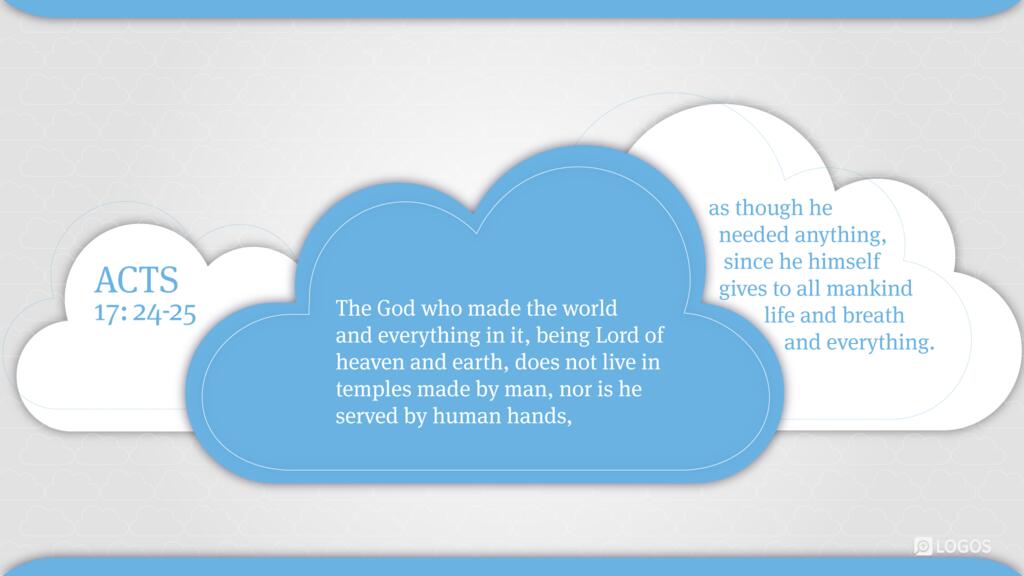
Therefore, the One whom you worship without knowing, Him I proclaim to you: 24qGod, who made the world and everything in it, since He is rLord of heaven and earth, sdoes not dwell in temples made with hands. 25Nor is He worshiped with men’s hands, as though He needed anything, since He tgives to all life, breath, and all things. 26And He has made from one 1blood every nation of men to dwell on all the face of the earth, and has determined their preappointed times and uthe boundaries of their dwellings, 27vso that they should seek the Lord, in the hope that they might grope for Him and find Him, wthough He is not far from each one of us; 28for xin Him we live and move and have our being, yas also some of your own poets have said, ‘For we are also His offspring.’ 29Therefore, since we are the offspring of God, zwe ought not to think that the Divine Nature is like gold or silver or stone, something shaped by art and man’s devising. 30Truly, athese times of ignorance God overlooked, but bnow commands all men everywhere to repent, 31because He has appointed a day on which cHe will judge the world in righteousness by the Man whom He has ordained. He has given assurance of this to all by draising Him from the dead.”
32And when they heard of the resurrection of the dead, some mocked, while others said, “We will hear you again on this matter.” 33So Paul departed from among them. 34However, some men joined him and believed, among them Dionysius the Areopagite, a woman named Damaris, and others with them.
Footnotes
Cross references
- o2 Pet. 2:8
- p1 Cor. 15:12
- qIs. 42:5; Acts 14:15
- rDeut. 10:14; Ps. 115:16; Matt. 11:25
- s1 Kin. 8:27; Acts 7:48–50
- tGen. 2:7; Is. 42:5; Dan. 5:23
- uDeut. 32:8; Job 12:23; Dan. 4:35
- v[Rom. 1:20]
- wDeut. 4:7; Ps. 139:7, 10; Jer. 23:23, 24; [Acts 14:17]
- x[Col. 1:17; Heb. 1:3]
- yTitus 1:12
- zPs. 115:4–7; Is. 40:18, 19; Rom. 1:23
- aActs 14:16; [Rom. 3:25]
- bLuke 24:47; Acts 26:20; [Titus 2:11, 12]; 1 Pet. 1:14; 4:3
- cPs. 9:8; 96:13; 98:9; John 5:22, 27; Acts 10:42; Rom. 2:16
- dActs 2:24
Copyright 1982 Thomas Nelson, Inc.