Acts 17:16–34
New Century VersionOther versions
English
- NCV New Century Version
- DARBY 1890 Darby Bible
- ASV American Standard Version
- AV 1873 The Cambridge Paragraph Bible of the Authorized English Version
- CSB Christian Standard Bible
- D-R Douay-Rheims Bible
- ESV English Standard Version
- GW GOD’S WORD Translation
- GNB Good News Translation
- HCSB The Holman Christian Standard Bible
- KJV 1900 King James Version
- LSB Legacy Standard Bible
- LEB The Lexham English Bible
- MSG The Message: The Bible in Contemporary Language
- NET The NET Bible
- NASB95 New American Standard Bible (1995)
- NIrV New International Reader’s Version (1998)
- NIV New International Version (2011)
- NKJV The New King James Version
- NLT New Living Translation
- NRSVue New Revised Standard Version: Updated Edition
- RSV The Revised Standard Version
- RSVCE The Revised Standard Version, Catholic Edition
- YLT Young’s Literal Translation
Arabic
Czech
French
German
Greek
Hungarian
Italian
Korean
Latin
Portuguese
Russian
Simplified Chinese
Spanish
Traditional Chinese
Paul Preaches in Athens
16While Paul was waiting for Silas and Timothy in Athens, he was troubled because he saw that the city was full of idols. 17In the synagogue, he talked with the Jews and the Greeks who worshiped God. He also talked every day with people in the marketplace.
18Some of the Epicurean and Stoic philosophers n argued with him, saying, “This man doesn’t know what he is talking about. What is he trying to say?” Others said, “He seems to be telling us about some other gods,” because Paul was telling them about Jesus and his rising from the dead. 19They got Paul and took him to a meeting of the Areopagus, n where they said, “Please explain to us this new idea you have been teaching. 20The things you are saying are new to us, and we want to know what this teaching means.” 21(All the people of Athens and those from other countries who lived there always used their time to talk about the newest ideas.)
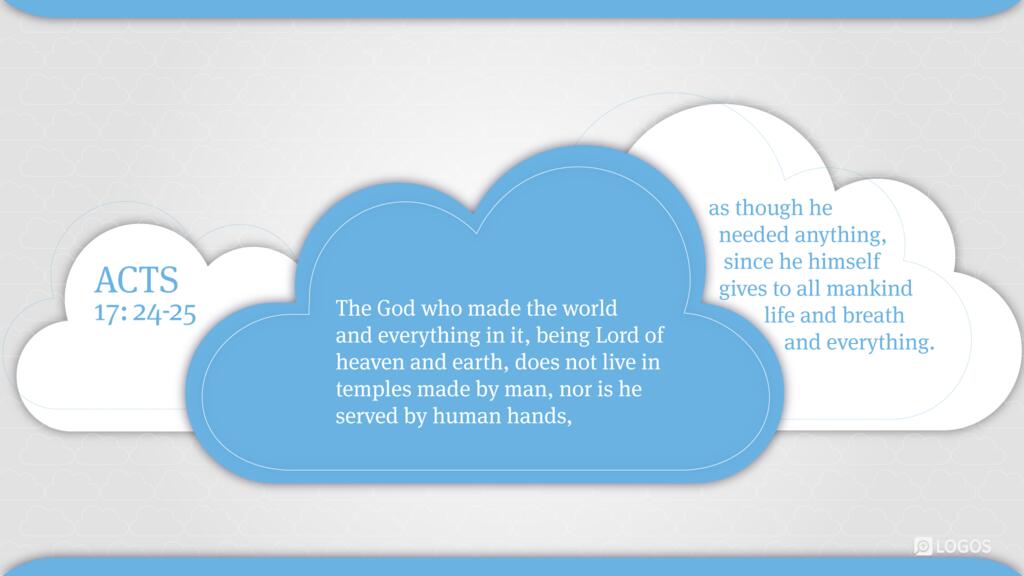
22Then Paul stood before the meeting of the Areopagus and said, “People of Athens, I can see you are very religious in all things. 23As I was going through your city, I saw the objects you worship. I found an altar that had these words written on it: to a god who is not known. You worship a god that you don’t know, and this is the God I am telling you about! 24The God who made the whole world and everything in it is the Lord of the land and the sky. He does not live in temples built by human hands. 25This God is the One who gives life, breath, and everything else to people. He does not need any help from them; he has everything he needs. 26God began by making one person, and from him came all the different people who live everywhere in the world. God decided exactly when and where they must live. 27God wanted them to look for him and perhaps search all around for him and find him, though he is not far from any of us: 28‘By his power we live and move and exist.’ Some of your own poets have said: ‘For we are his children.’ 29Since we are God’s children, you must not think that God is like something that people imagine or make from gold, silver, or rock. 30In the past, people did not understand God, and he ignored this. But now, God tells all people in the world to change their hearts and lives. 31God has set a day that he will judge all the world with fairness, by the man he chose long ago. And God has proved this to everyone by raising that man from the dead!”
32When the people heard about Jesus being raised from the dead, some of them laughed. But others said, “We will hear more about this from you later.” 33So Paul went away from them. 34But some of the people believed Paul and joined him. Among those who believed was Dionysius, a member of the Areopagus, a woman named Damaris, and some others.
Footnotes
- nEpicurean and Stoic philosophers Philosophers were those who searched for truth. Epicureans believed that pleasure, especially pleasures of the mind, were the goal of life. Stoics believed that life should be without feelings of joy or grief.
- nAreopagus A council or group of important leaders in Athens. They were like judges.
Copyright 2005 by Thomas Nelson, Inc.