Job 19:23–29
The NET BibleOther versions
English
- NET The NET Bible
- DARBY 1890 Darby Bible
- ASV American Standard Version
- AV 1873 The Cambridge Paragraph Bible of the Authorized English Version
- CSB Christian Standard Bible
- D-R Douay-Rheims Bible
- ESV English Standard Version
- GW GOD’S WORD Translation
- GNB Good News Translation
- HCSB The Holman Christian Standard Bible
- KJV 1900 King James Version
- LSB Legacy Standard Bible
- LEB The Lexham English Bible
- MSG The Message: The Bible in Contemporary Language
- NASB95 New American Standard Bible (1995)
- NCV New Century Version
- NIrV New International Reader’s Version (1998)
- NIV New International Version (2011)
- NKJV The New King James Version
- NLT New Living Translation
- NRSVue New Revised Standard Version: Updated Edition
- RSV The Revised Standard Version
- RSVCE The Revised Standard Version, Catholic Edition
- TNIV Today’s New International Version
- YLT Young’s Literal Translation
Arabic
Czech
French
German
Hebrew
Hungarian
Italian
Korean
Latin
Portuguese
Russian
Simplified Chinese
Spanish
Traditional Chinese
Job’s Assurance of Vindication
19:23“O that55 my words were written down,
O that they were written on a scroll,56
19:24that with an iron chisel and with lead57
they were engraved in a rock forever!
19:25As for me, I know that my Redeemer58 lives,
and that as the last59
he will stand upon the earth.60
19:26And after my skin has been destroyed,61
yet in my flesh62 I will see God,63
19:27whom I will see for myself,64
and whom my own eyes will behold,
and not another.65
My heart66 grows faint within me.67
19:28If you say, ‘How we will pursue him,
since the root of the trouble is found in him!’68
19:29Fear the sword yourselves,
for wrath69 brings the punishment70 by the sword,
so that you may know
that there is judgment.”71
Footnotes
- 55 The optative is again expressed with the interrogative clause “Who will give that they be written?” Job wishes that his words be preserved long after his death.
- 56 While the sense of this line is clear, there is a small problem and a plausible solution. The last word is indeed סֶפֶר (sefer, “book”), usually understood here to mean “scroll.” But the verb that follows it in the verse is יֻחָקוּ (yukhaqu), from חָקַק (khaqaq, “to engrave; to carve”). While the meaning is clearly that Job wants his words to be retained, the idea of engraving in a book, although not impossible, is unusual. And so many have suggested that the Akkadian word siparru, “copper; brass,” is what is meant here (see Isa 30:8; Judg 5:14). The consonants are the same, and the vowel pattern is close to the original vowel pattern of this segholate noun. Writing on copper or bronze sheets has been attested from the 12th to the 2nd centuries, notably in the copper scroll, which would allow the translation “scroll” in our text (for more bibliography see D. J. A. Clines, Job [], ). But H. S. Gehman notes that in Phoenician our word can mean “inscription” (“SEÝFER, an inscription, in the book of Job,” 63 [1944]: 303–7), making the proposed substitution unnecessary.
- 57 There is some question concerning the use of the lead. It surely cannot be a second description of the tool, for a lead tool would be of no use in chiseling words into a rock. It was Rashi’s idea, followed by Dillmann and Duhm, that lead was run into the cut-out letters. The suggestion that they wrote on lead tablets does not seem to fit the verse (cf. ). See further A. Baker, “The Strange Case of Job’s Chisel,” 31 (1969): 370–79.
- 58 Or “my Vindicator.” The word is the active participle from גָּאַל (ga’al, “to redeem, protect, vindicate”). The word is well-known in the OT because of its identification as the kinsman-redeemer (see the Book of Ruth). This is the near kinsman who will pay off one’s debts, defend the family, avenge a killing, marry the widow of the deceased. The word “redeemer” evokes the wrong connotation for people familiar with the NT alone; a translation of “Vindicator” would capture the idea more. The concept might include the description of the mediator already introduced in Job 16:19, but surely here Job is thinking of God as his vindicator. The interesting point to be stressed here is that Job has said clearly that he sees no vindication in this life, that he is going to die. But he knows he will be vindicated, and even though he will die, his vindicator lives. The dilemma remains though: his distress lay in God’s hiding his face from him, and his vindication lay only in beholding God in peace.
- 59 The word אַחֲרוּן (’akharon, “last”) has triggered a good number of interpretations. Here it is an adjectival form and not adverbial; it is an epithet of the vindicator. Some commentators, followed by the , change the form to make it adverbial, and translate it “at last.” T. H. Gaster translates it “even if he were the last person to exist” (“Short notes,” 4 [1954]: 78).
- 60 The Hebrew has “and he will rise/stand upon [the] dust.” The verb קוּם (qum) is properly “to rise; to arise,” and certainly also can mean “to stand.” Both English ideas are found in the verb. The concept here is that of God rising up to mete out justice. And so to avoid confusion with the idea of resurrection (which although implicit in these words which are pregnant with theological ideas yet to be revealed, is not explicitly stated or intended in this context) the translation “stand” has been used. The had “I will rise,” which introduced the idea of Job’s resurrection. The word “dust” is used as in 41:33. The word “dust” is associated with death and the grave, the very earthly particles. Job assumes that God will descend from heaven to bring justice to the world. The use of the word also hints that this will take place after Job has died and returned to dust. Again, the words of Job come to mean far more than he probably understood.
- 61 This verse on the whole has some serious interpretation problems that have allowed commentators to go in several directions. The verbal clause is “they strike off this,” which is then to be taken as a passive in view of the fact that there is no expressed subject. Some have thought that Job was referring to this life, and that after his disease had done its worst he would see his vindication (see T. J. Meek, “Job 19:25–27,” 6 [1956]: 100–103; E. F. Sutcliffe, “Further notes on Job, textual and exegetical,” 31 [1950]: 377; and others). But Job has been clear—he does not expect to live and see his vindication in this life. There are a host of other interpretations that differ greatly from the sense expressed in the . Duhm, for example, has “and another shall arise as my witness.” E. Dhorme (Job, 284–85) argues that the vindication comes after death; he emends the verb to get a translation: “and that, behind my skin, I shall stand up.” He explains this to mean that it will be Job in person who will be present at the ultimate drama. But the interpretation is forced, and really unnecessary.
- 62 The Hebrew phrase is “and from my flesh.” This could mean “without my flesh,” i.e., separated from my flesh, or “from my flesh,” i.e., in or with my flesh. The former view is taken by those who think Job’s vindication will come in this life, and who find the idea of a resurrection unlikely to be in Job’s mind. The latter view is taken by those who interpret the preceding line as meaning death and the next verse underscoring that it will be his eye that will see. This would indicate that Job’s faith rises to an unparalleled level at this point.
- 63 H. H. Rowley (Job [], 140) says, “The text of this verse is so difficult, and any convincing reconstruction is so unlikely, that it seems best not to attempt it.” His words have gone unheeded, even by himself, and rightly so. There seem to be two general interpretations, the details of some words notwithstanding. An honest assessment of the evidence would have to provide both interpretations, albeit still arguing for one. Here Job says he will see God. This at the least means that he will witness his vindication, which it seems clear from the other complaints of Job will occur after his death (it is his blood that must be vindicated). But in what way, exactly, Job will see God is not clarified. In this verse the verb that is used is often used of prophetic visions; but in the next verse the plain word for seeing—with his eye—is used. The fulfillment will be more precise than Job may have understood. Rowley does conclude: “Though there is no full grasping of a belief in a worthwhile Afterlife with God, this passage is a notable landmark in the program toward such a belief.” The difficulty is that Job expects to die—he would like to be vindicated in this life, but is resolved that he will die. (1) Some commentators think that vv. 25 and 26 follow the wish for vindication now; (2) others (traditionally) see it as in the next life. Some of the other interpretations that take a different line are less impressive, such as Kissane’s, “did I but see God … were I to behold God”; or L. Waterman’s translation in the English present, making it a mystic vision in which Job already sees that God is his vindicator (“Note on Job 19:23–27: Job’s Triumph of Faith,” 69 [1950]: 379–80).
- 64 The emphasis is on “I” and “for myself.” No other will be seeing this vindication, but Job himself will see it. Of that he is confident. Some take לִי (li, “for myself”) to mean favorable to me, or on my side (see A. B. Davidson, Job, 143). But Job is expecting (not just wishing for) a face-to-face encounter in the vindication.
- 65 Hitzig offered another interpretation that is somewhat forced. The “other” (זָר, zar) or “stranger” would refer to Job. He would see God, not as an enemy, but in peace.
- 66 Heb “kidneys,” a poetic expression for the seat of emotions.
- 67 Heb “fail/grow faint in my breast.” Job is saying that he has expended all his energy with his longing for vindication.
- 68 The reads “in me.” If that is retained, then the question would be in the first colon, and the reasoning of the second colon would be Job’s. But over 100 have “in him,” and so this reading is accepted by most editors. The verse is a little difficult, but it seems to form a warning by Job that God’s appearance which will vindicate Job will bring judgment on those who persecute him and charge him falsely.
- 69 The word “wrath” probably refers to divine wrath for the wicked. Many commentators change this word to read “they,” or more precisely, “these things.”
- 70 The word is “iniquities”; but here as elsewhere it should receive the classification of the punishment for iniquity (a category of meaning that developed from a metonymy of effect).
- 71 The last word is problematic because of the textual variants in the Hebrew. In place of שַׁדִּין (shaddin, “judgment”) some have proposed שַׁדַּי (shadday, “Almighty”) and read it “that you may know the Almighty” (Ewald, Wright). Some have read it יֵשׁ דַּיָּן (yesh dayyan, “there is a judge,” Gray, Fohrer). Others defend the traditional view, arguing that the שׁ (shin) is the abbreviated relative particle on the word דִּין (din, “judgment”).
The NET Bible First Edition, Copyright 1996-2005 by Biblical Studies Press
In other versions
ESVEnglish Standard Version
“Oh that my words were written!
Oh that they were inscribed in a book!
Oh that with an iron pen and lead
they were engraved in the rock forever!
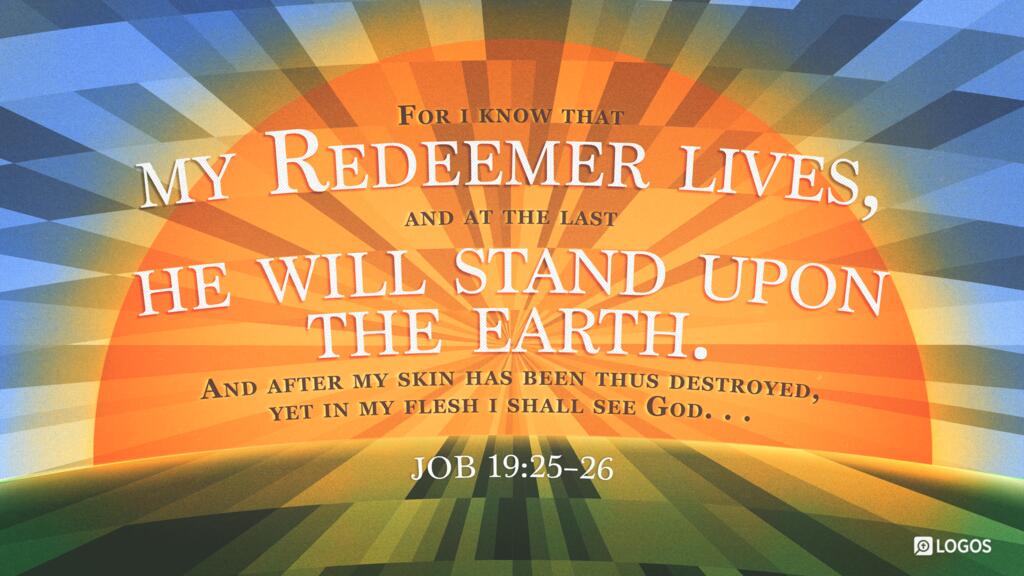
For I know that my Redeemer lives,
and at the last he will stand upon the earth.
And after my skin has been thus destroyed,
yet in my flesh I shall see God,
whom I shall see for myself,
and my eyes shall behold, and not another.
My heart faints within me!
If you say, ‘How we will pursue him!’
and, ‘The root of the matter is found in him,’
be afraid of the sword,
for wrath brings the punishment of the sword,
that you may know there is a judgment.”
Copyright 2001 Crossway Bibles
NIVNew International Version (2011)
“Oh, that my words were recorded,
that they were written on a scroll,
that they were inscribed with an iron tool on lead,
or engraved in rock forever!
I know that my redeemer lives,
and that in the end he will stand on the earth.
And after my skin has been destroyed,
yet in my flesh I will see God;
I myself will see him
with my own eyes—I, and not another.
How my heart yearns within me!
“If you say, ‘How we will hound him,
since the root of the trouble lies in him,’
you should fear the sword yourselves;
for wrath will bring punishment by the sword,
and then you will know that there is judgment.”
Copyright 1973, 1978, 1984, 2011 Biblica, Inc.
CSBChristian Standard Bible
I wish that my words were written down,
that they were recorded on a scroll
or were inscribed in stone forever
by an iron stylus and lead!
But I know that my Redeemer lives,
and at the end he will stand on the dust.
Even after my skin has been destroyed,
yet I will see God in my flesh.
I will see him myself;
my eyes will look at him, and not as a stranger.
My heart longs within me.
If you say, “How will we pursue him,
since the root of the problem lies with him?”
then be afraid of the sword,
because wrath brings punishment by the sword,
so that you may know there is a judgment.
Copyright 2017 Holman Bible Publishers
NLTNew Living Translation
“Oh, that my words could be recorded.
Oh, that they could be inscribed on a monument,
carved with an iron chisel and filled with lead,
engraved forever in the rock.
“But as for me, I know that my Redeemer lives,
and he will stand upon the earth at last.
And after my body has decayed,
yet in my body I will see God!
I will see him for myself.
Yes, I will see him with my own eyes.
I am overwhelmed at the thought!
“How dare you go on persecuting me,
saying, ‘It’s his own fault’?
You should fear punishment yourselves,
for your attitude deserves punishment.
Then you will know that there is indeed a judgment.”
Holy Bible, New Living Translation, copyright © 1996, 2004, 2015 by Tyndale House Foundation. Used by permission of Tyndale House Publishers. All rights reserved.
LEBThe Lexham English Bible
“O that my words could be written down!
O that they could be inscribed in a scroll!
That with a pen of iron and with lead
they might be engraved on a rock forever!
But I myself know that my redeemer is alive,
and at the last he will stand up upon the earth.
And after my skin has been thus destroyed,
but from my flesh I will see God,
whom I will see for myself,
and whom my eyes will see and not a stranger.
My heart faints within me.
“If you say, ‘How will we persecute him?’
And ‘The root of the trouble is found’ in me,
be afraid for yourselves because of the sword,
for wrath brings punishment by the sword,
so that you may know that there is judgment.”
Copyright 2012 Lexham Press
KJV 1900King James Version
Oh that my words were now written!
Oh that they were printed in a book!
That they were graven with an iron pen and lead
In the rock for ever!
For I know that my redeemer liveth,
And that he shall stand at the latter day upon the earth:
And though after my skin worms destroy this body,
Yet in my flesh shall I see God:
Whom I shall see for myself,
And mine eyes shall behold, and not another;
Though my reins be consumed within me.
But ye should say, Why persecute we him,
Seeing the root of the matter is found in me?
Be ye afraid of the sword:
For wrath bringeth the punishments of the sword,
That ye may know there is a judgment.
Public Domain