Job 19:25
The NET BibleOther versions
English
- NET The NET Bible
- DARBY 1890 Darby Bible
- ASV American Standard Version
- AV 1873 The Cambridge Paragraph Bible of the Authorized English Version
- CSB Christian Standard Bible
- D-R Douay-Rheims Bible
- ESV English Standard Version
- GW GOD’S WORD Translation
- GNB Good News Translation
- HCSB The Holman Christian Standard Bible
- KJV 1900 King James Version
- LSB Legacy Standard Bible
- LEB The Lexham English Bible
- MSG The Message: The Bible in Contemporary Language
- NASB95 New American Standard Bible (1995)
- NCV New Century Version
- NIrV New International Reader’s Version (1998)
- NIV New International Version (2011)
- NKJV The New King James Version
- NLT New Living Translation
- NRSVue New Revised Standard Version: Updated Edition
- RSV The Revised Standard Version
- RSVCE The Revised Standard Version, Catholic Edition
- TNIV Today’s New International Version
- YLT Young’s Literal Translation
Arabic
Czech
French
German
Hebrew
Hungarian
Italian
Korean
Latin
Portuguese
Russian
Simplified Chinese
Spanish
Traditional Chinese
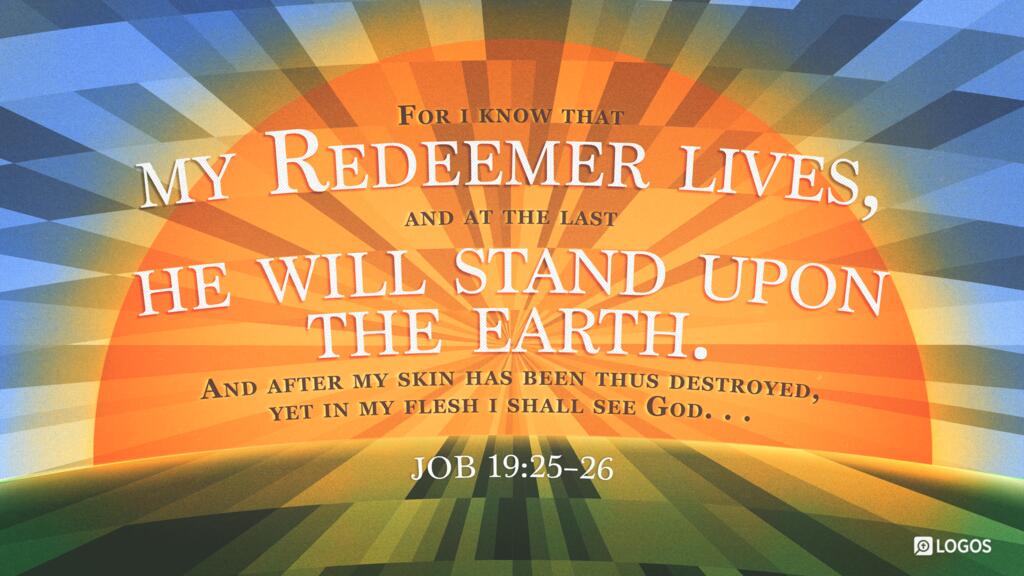
19:25As for me, I know that my Redeemer58 lives,
and that as the last59
he will stand upon the earth.60
Footnotes
- 58 Or “my Vindicator.” The word is the active participle from גָּאַל (ga’al, “to redeem, protect, vindicate”). The word is well-known in the OT because of its identification as the kinsman-redeemer (see the Book of Ruth). This is the near kinsman who will pay off one’s debts, defend the family, avenge a killing, marry the widow of the deceased. The word “redeemer” evokes the wrong connotation for people familiar with the NT alone; a translation of “Vindicator” would capture the idea more. The concept might include the description of the mediator already introduced in Job 16:19, but surely here Job is thinking of God as his vindicator. The interesting point to be stressed here is that Job has said clearly that he sees no vindication in this life, that he is going to die. But he knows he will be vindicated, and even though he will die, his vindicator lives. The dilemma remains though: his distress lay in God’s hiding his face from him, and his vindication lay only in beholding God in peace.
- 59 The word אַחֲרוּן (’akharon, “last”) has triggered a good number of interpretations. Here it is an adjectival form and not adverbial; it is an epithet of the vindicator. Some commentators, followed by the , change the form to make it adverbial, and translate it “at last.” T. H. Gaster translates it “even if he were the last person to exist” (“Short notes,” 4 [1954]: 78).
- 60 The Hebrew has “and he will rise/stand upon [the] dust.” The verb קוּם (qum) is properly “to rise; to arise,” and certainly also can mean “to stand.” Both English ideas are found in the verb. The concept here is that of God rising up to mete out justice. And so to avoid confusion with the idea of resurrection (which although implicit in these words which are pregnant with theological ideas yet to be revealed, is not explicitly stated or intended in this context) the translation “stand” has been used. The had “I will rise,” which introduced the idea of Job’s resurrection. The word “dust” is used as in 41:33. The word “dust” is associated with death and the grave, the very earthly particles. Job assumes that God will descend from heaven to bring justice to the world. The use of the word also hints that this will take place after Job has died and returned to dust. Again, the words of Job come to mean far more than he probably understood.
The NET Bible First Edition, Copyright 1996-2005 by Biblical Studies Press
In other versions
ESVEnglish Standard Version
For I know that my Redeemer lives,
and at the last he will stand upon the earth.
Copyright 2001 Crossway Bibles
NIVNew International Version (2011)
I know that my redeemer lives,
and that in the end he will stand on the earth.
Copyright 1973, 1978, 1984, 2011 Biblica, Inc.
CSBChristian Standard Bible
But I know that my Redeemer lives,
and at the end he will stand on the dust.
Copyright 2017 Holman Bible Publishers
NLTNew Living Translation
“But as for me, I know that my Redeemer lives,
and he will stand upon the earth at last.
Holy Bible, New Living Translation, copyright © 1996, 2004, 2015 by Tyndale House Foundation. Used by permission of Tyndale House Publishers. All rights reserved.
LEBThe Lexham English Bible
But I myself know that my redeemer is alive,
and at the last he will stand up upon the earth.
Copyright 2012 Lexham Press
KJV 1900King James Version
For I know that my redeemer liveth,
And that he shall stand at the latter day upon the earth:
Public Domain