Job 19:26
The NET BibleOther versions
English
- NET The NET Bible
- DARBY 1890 Darby Bible
- ASV American Standard Version
- AV 1873 The Cambridge Paragraph Bible of the Authorized English Version
- CSB Christian Standard Bible
- D-R Douay-Rheims Bible
- ESV English Standard Version
- GW GOD’S WORD Translation
- GNB Good News Translation
- HCSB The Holman Christian Standard Bible
- KJV 1900 King James Version
- LSB Legacy Standard Bible
- LEB The Lexham English Bible
- MSG The Message: The Bible in Contemporary Language
- NASB95 New American Standard Bible (1995)
- NCV New Century Version
- NIrV New International Reader’s Version (1998)
- NIV New International Version (2011)
- NKJV The New King James Version
- NLT New Living Translation
- NRSVue New Revised Standard Version: Updated Edition
- RSV The Revised Standard Version
- RSVCE The Revised Standard Version, Catholic Edition
- TNIV Today’s New International Version
- YLT Young’s Literal Translation
Arabic
Czech
French
German
Hebrew
Hungarian
Italian
Korean
Latin
Portuguese
Russian
Simplified Chinese
Spanish
Traditional Chinese
Footnotes
- 61 This verse on the whole has some serious interpretation problems that have allowed commentators to go in several directions. The verbal clause is “they strike off this,” which is then to be taken as a passive in view of the fact that there is no expressed subject. Some have thought that Job was referring to this life, and that after his disease had done its worst he would see his vindication (see T. J. Meek, “Job 19:25–27,” 6 [1956]: 100–103; E. F. Sutcliffe, “Further notes on Job, textual and exegetical,” 31 [1950]: 377; and others). But Job has been clear—he does not expect to live and see his vindication in this life. There are a host of other interpretations that differ greatly from the sense expressed in the . Duhm, for example, has “and another shall arise as my witness.” E. Dhorme (Job, 284–85) argues that the vindication comes after death; he emends the verb to get a translation: “and that, behind my skin, I shall stand up.” He explains this to mean that it will be Job in person who will be present at the ultimate drama. But the interpretation is forced, and really unnecessary.
- 62 The Hebrew phrase is “and from my flesh.” This could mean “without my flesh,” i.e., separated from my flesh, or “from my flesh,” i.e., in or with my flesh. The former view is taken by those who think Job’s vindication will come in this life, and who find the idea of a resurrection unlikely to be in Job’s mind. The latter view is taken by those who interpret the preceding line as meaning death and the next verse underscoring that it will be his eye that will see. This would indicate that Job’s faith rises to an unparalleled level at this point.
- 63 H. H. Rowley (Job [], 140) says, “The text of this verse is so difficult, and any convincing reconstruction is so unlikely, that it seems best not to attempt it.” His words have gone unheeded, even by himself, and rightly so. There seem to be two general interpretations, the details of some words notwithstanding. An honest assessment of the evidence would have to provide both interpretations, albeit still arguing for one. Here Job says he will see God. This at the least means that he will witness his vindication, which it seems clear from the other complaints of Job will occur after his death (it is his blood that must be vindicated). But in what way, exactly, Job will see God is not clarified. In this verse the verb that is used is often used of prophetic visions; but in the next verse the plain word for seeing—with his eye—is used. The fulfillment will be more precise than Job may have understood. Rowley does conclude: “Though there is no full grasping of a belief in a worthwhile Afterlife with God, this passage is a notable landmark in the program toward such a belief.” The difficulty is that Job expects to die—he would like to be vindicated in this life, but is resolved that he will die. (1) Some commentators think that vv. 25 and 26 follow the wish for vindication now; (2) others (traditionally) see it as in the next life. Some of the other interpretations that take a different line are less impressive, such as Kissane’s, “did I but see God … were I to behold God”; or L. Waterman’s translation in the English present, making it a mystic vision in which Job already sees that God is his vindicator (“Note on Job 19:23–27: Job’s Triumph of Faith,” 69 [1950]: 379–80).
The NET Bible First Edition, Copyright 1996-2005 by Biblical Studies Press
In other versions
ESVEnglish Standard Version
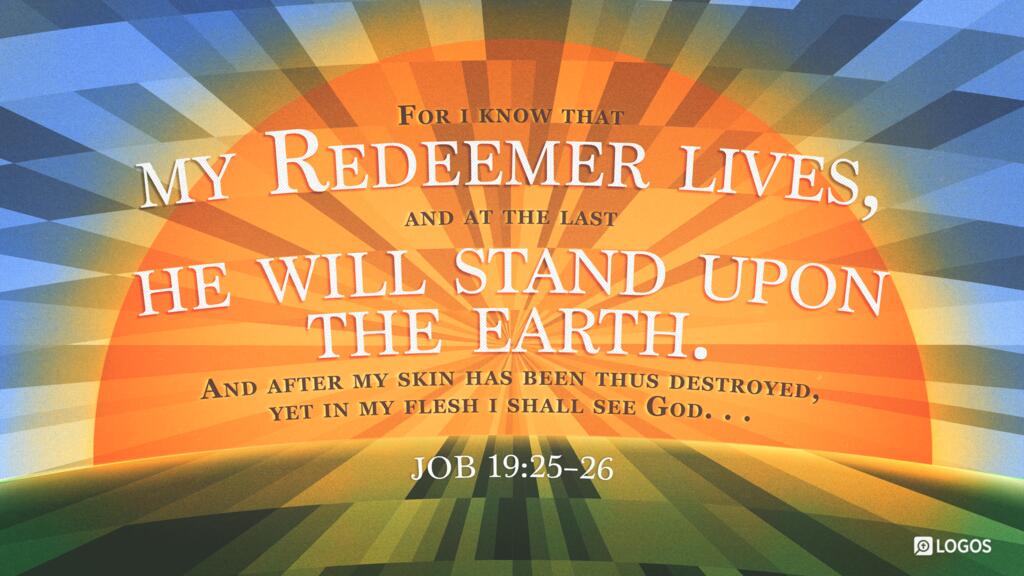
And after my skin has been thus destroyed,
yet in my flesh I shall see God,
Copyright 2001 Crossway Bibles
NIVNew International Version (2011)
And after my skin has been destroyed,
yet in my flesh I will see God;
Copyright 1973, 1978, 1984, 2011 Biblica, Inc.
CSBChristian Standard Bible
Even after my skin has been destroyed,
yet I will see God in my flesh.
Copyright 2017 Holman Bible Publishers
NLTNew Living Translation
And after my body has decayed,
yet in my body I will see God!
Holy Bible, New Living Translation, copyright © 1996, 2004, 2015 by Tyndale House Foundation. Used by permission of Tyndale House Publishers. All rights reserved.
LEBThe Lexham English Bible
And after my skin has been thus destroyed,
but from my flesh I will see God,
Copyright 2012 Lexham Press
KJV 1900King James Version
And though after my skin worms destroy this body,
Yet in my flesh shall I see God:
Public Domain