Luke 23:13–34
The Lexham English BibleOther versions
English
- LEB The Lexham English Bible
- DARBY 1890 Darby Bible
- ASV American Standard Version
- AV 1873 The Cambridge Paragraph Bible of the Authorized English Version
- CSB Christian Standard Bible
- D-R Douay-Rheims Bible
- ESV English Standard Version
- GW GOD’S WORD Translation
- GNB Good News Translation
- HCSB The Holman Christian Standard Bible
- KJV 1900 King James Version
- LSB Legacy Standard Bible
- MSG The Message: The Bible in Contemporary Language
- NET The NET Bible
- NASB95 New American Standard Bible (1995)
- NCV New Century Version
- NIrV New International Reader’s Version (1998)
- NIV New International Version (2011)
- NKJV The New King James Version
- NLT New Living Translation
- NRSVue New Revised Standard Version: Updated Edition
- RSV The Revised Standard Version
- RSVCE The Revised Standard Version, Catholic Edition
- YLT Young’s Literal Translation
Arabic
Czech
French
German
Greek
Hungarian
Italian
Korean
Latin
Portuguese
Russian
Simplified Chinese
Spanish
Traditional Chinese
Pilate Releases Barabbas
13So Pilate called together the chief priests and the rulers and the people 14and* said to them, “You brought me this man as one who was misleading the people, and behold, when I* examined him* before you, I found nothing in this man as basis for the accusation which you are makingc against him. 15But neither did Herod, because he sent him back to us. And behold, nothing deserving death has been doned by him. 16Therefore I will punish him and* release him.”* e 18But they all cried out in unison, saying, “Take this man away, and release for us Barabbas!” 19(who had been thrown in prison because of a certain insurrection that had taken place in the city, and for murder). 20And Pilate, wanting to release Jesus, addressed them*f again, 21but they kept crying out, saying, “Crucify! Crucify him!” 22So he said to them a third time, “Why? What wrong has this man done? I found no basis for an accusation deserving deathg in him. Therefore I will punish him and* release him.”* 23But they were urgent, demanding with loud cries that he be crucified. And their cries prevailed. 24And Pilate decided that their demand should be granted. 25And he released the one who had been thrown into prison because of insurrection and murder, whom they were asking for, but Jesus he handed over to their will.
Jesus Is Crucified
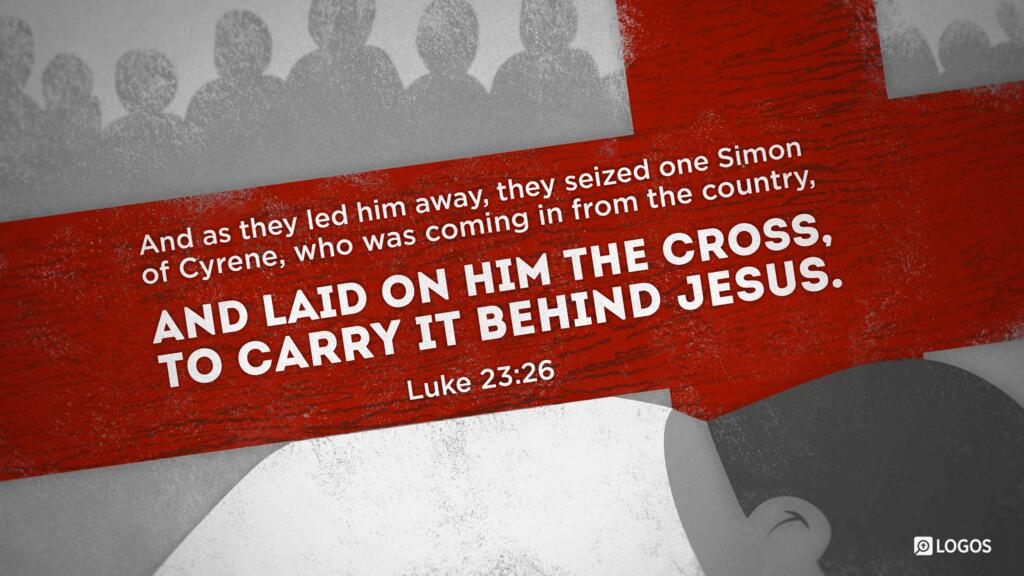
26And as they led him away, they seized Simon, a certain man of Cyrene, who was coming from the country, and* placed the cross on him, to carry it* behind Jesus. 27And a great crowd of the people were following him, and of women who were mourning and lamenting him. 28But turning to them, Jesus said, “Daughters of Jerusalem, do not weep for me, but weep for yourselves and for your children! 29For behold, days are coming in which they will say, ‘Blessed are the barren, and the wombs that did not give birth, and the breasts that did not nurse!’ 30Then they will begin to say to the mountains, ‘Fall on us!’ and to the hills, ‘Cover us!’ 31For if they do these things when the wood is green,h what will happen when it is dry?”i
32And two other criminals were also led away to be executed with him. 33And when they came to the place that is called “The Skull,” there they crucified him, and the criminals, the one on his right and the other on his left. 34⟦But Jesus said, “Father, forgive them, for they do not know what they are doing.”⟧j And they cast lots to divide his clothes.
Footnotes
- *Here “and” is supplied because the participle in the previous verse (“called together”) has been translated as a finite verb
- *Here “when” is supplied as a component of the participle (“examined”) which is understood as temporal
- *Here the direct object is supplied from context in the English translation
- cLiterally “you are accusing”
- dLiterally “is having been done”
- *Here “and” is supplied because the previous participle (“punish”) has been translated as a finite verb
- *Here the direct object is supplied from context in the English translation
- eMany of the most important Greek manuscripts lack v. 17, “Now he was obligated to release for them at the feast one person.”
- *Here the direct object is supplied from context in the English translation
- fSome manuscripts explicitly state “them”
- gLiterally “of death”
- *Here “and” is supplied because the previous participle (“punish”) has been translated as a finite verb
- *Here the direct object is supplied from context in the English translation
- *Here “and” is supplied because the previous participle (“seized”) has been translated as a finite verb
- *Here the direct object is supplied from context in the English translation
- hLiterally “in the green wood”
- iLiterally “in the dry”
- jMany important manuscripts lack v. 34a, “But Jesus said, ‘Father, forgive them, for they do not know what they are doing.’ ”
Copyright 2012 Lexham Press