Luke 23:13–34
The NET BibleOther versions
Jesus Brought Before the Crowd
23:13Then37 Pilate called together the chief priests, the38 rulers, and the people, 23:14and said to them, “You brought me this man as one who was misleading39 the people. When I examined him before you, I40 did not find this man guilty41 of anything you accused him of doing. 23:15Neither did Herod, for he sent him back to us. Look, he has done nothing42 deserving death.4323:16I will therefore have him flogged44 and release him.”45
23:18But they all shouted out together,46 “Take this man47 away! Release Barabbas for us!” 23:19(This48 was a man who had been thrown into prison for an insurrection49 started in the city, and for murder.)5023:20Pilate addressed them once again because he wanted51 to release Jesus. 23:21But they kept on shouting,52 “Crucify, crucify53 him!” 23:22A third time he said to them, “Why? What wrong has he done? I have found him guilty54 of no crime deserving death.55 I will therefore flog56 him and release him.” 23:23But they were insistent,57 demanding with loud shouts that he be crucified. And their shouts prevailed. 23:24So58 Pilate59 decided60 that their demand should be granted. 23:25He released the man they asked for, who had been thrown in prison for insurrection and murder. But he handed Jesus over61 to their will.62
The Crucifixion
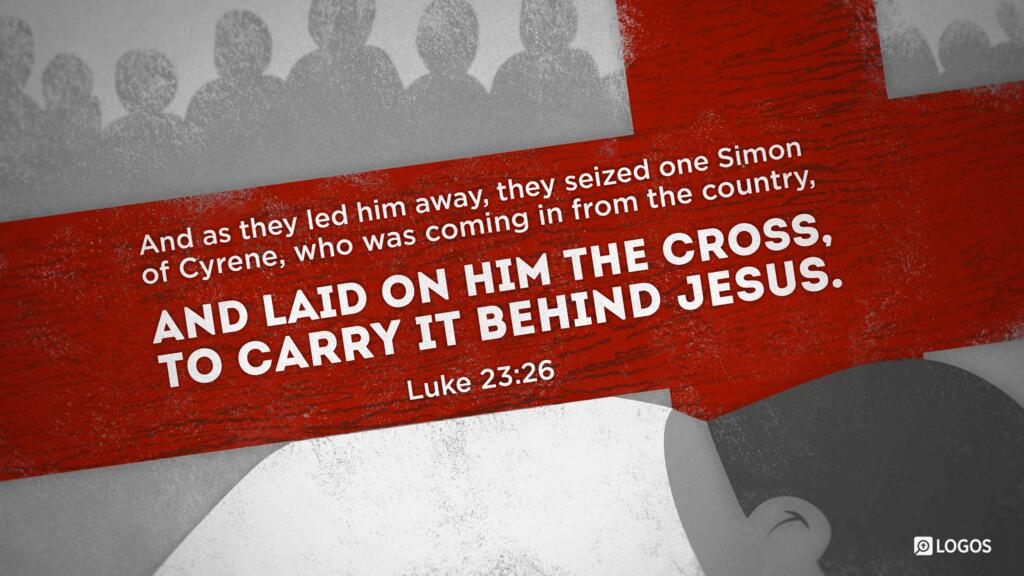
23:26As63 they led him away, they seized Simon of Cyrene,64 who was coming in from the country.65 They placed the cross on his back and made him carry it behind Jesus.6623:27A great number of the people followed him, among them women67 who were mourning68 and wailing for him. 23:28But Jesus turned to them and said, “Daughters of Jerusalem,69 do not weep for me, but weep for yourselves70 and for your children. 23:29For this is certain:71 The days are coming when they will say, ‘Blessed are the barren, the wombs that never bore children, and the breasts that never nursed!’7223:30Then they will begin to say to the mountains,73 ‘Fall on us!’ and to the hills, ‘Cover us!’7423:31For if such things are done75 when the wood is green, what will happen when it is dry?”76
23:32Two other criminals77 were also led away to be executed with him. 23:33So78 when they came to the place that is called “The Skull,”79 they crucified80 him there, along with the criminals, one on his right and one on his left. 23:34But Jesus said, “Father, forgive them, for they don’t know what they are doing.”81 Then82 they threw dice83 to divide his clothes.84
Footnotes
- 37 Here δέ (de) has been translated as “then” to indicate the implied sequence of events within the narrative.
- 38 Grk “and the,” but καί (kai) has not been translated since English normally uses a coordinating conjunction only between the last two elements in a series of three or more.
- 39 This term also appears in v. 2.
- 40 Grk “behold, I” A transitional use of ἰδού (idou) has not been translated here.
- 41 Grk “nothing did I find in this man by way of cause.” The reference to “nothing” is emphatic.
- 42 With the statement “he has done nothing,” Pilate makes another claim that Jesus is innocent of any crime worthy of death.
- 43 Grk “nothing deserving death has been done by him.” The passive construction has been translated as an active one in keeping with contemporary English style.
- 44 Or “scourged” ( παιδεύω 2.b.γ). This refers to a whipping Pilate ordered in an attempt to convince Jesus not to disturb the peace. It has been translated “flogged” to distinguish it from the more severe verberatio.
- 45 Many of the best , as well as some others (𝔓75 A B K L T 070 1241 sa), lack 23:17 “(Now he was obligated to release one individual for them at the feast.)” This verse appears to be a parenthetical note explaining the custom of releasing someone on amnesty at the feast. It appears in two different locations with variations in wording, which makes it look like a scribal addition. It is included in א (D following v. 19) W Θ Ψ f1, 13 𝔐 lat. The verse appears to be an explanatory gloss based on Matt 27:15 and Mark 15:6, not original in Luke. The present translation follows in omitting the verse number, a procedure also followed by a number of other modern translations.
- 46 Grk “together, saying.” The participle λέγοντες (legontes) is redundant and has not been translated here.
- 47 Grk “this one.” The reference to Jesus as “this man” is pejorative in this context.
- 48 Grk “who” (a continuation of the previous sentence).
- 49 Ironically, what Jesus was alleged to have done, started an insurrection, this man really did.
- 50 This is a parenthetical note by the author.
- 51 The account pictures a battle of wills—the people versus Pilate. Pilate is consistently portrayed in Luke’s account as wanting to release Jesus because he believed him to be innocent.
- 52 Grk “shouting, saying.” The participle λέγοντες (legontes) is redundant and has not been translated here.
- 53 This double present imperative is emphatic. Crucifixion was the cruelest form of punishment practiced by the Romans. Roman citizens could not normally undergo it. It was reserved for the worst crimes, like treason and evasion of due process in a capital case. The Roman historian Cicero called it “a cruel and disgusting penalty” (Against Verres 2.5.63–66 §§163–70); Josephus ( 7.6.4 [7.203]) called it the worst of deaths.
- 54 Grk “no cause of death I found in him.”
- 55 The refrain of innocence comes once again. Pilate tried to bring some sense of justice, believing Jesus had committed no crime deserving death.
- 56 Or “scourge” ( παιδεύω 2.b.γ). See the note on “flogged” in v. .
- 57 Though a different Greek term is used here ( ἐπίκειμαι), this remark is like 23:5.
- 58 Here καί (kai) has been translated as “so” to indicate the implied result of the crowd’s cries prevailing.
- 59 Finally Pilate gave in. He decided crucifying one Galilean teacher was better than facing a riot. Justice lost out in the process, because he did not follow his own verdict.
- 60 Although some translations render ἐπέκρινεν (epekrinen) here as “passed sentence” or “gave his verdict,” the point in context is not that Pilate sentenced Jesus to death here, but that finally, although convinced of Jesus’ innocence, he gave in to the crowd’s incessant demand to crucify an innocent man.
- 61 Or “delivered up.”
- 62 He handed Jesus over to their will. Here is where Luke places the major blame for Jesus’ death. It lies with the Jewish nation, especially the leadership, though in Acts 4:24–27 he will bring in the opposition of Herod, Pilate, and all people.
- 63 Here καί (kai) has not been translated because of differences between Greek and English style.
- 64 Jesus was beaten severely with a whip before this (the prelude to crucifixion, known to the Romans as verberatio, mentioned in Matt 27:26; Mark 15:15; John 19:1), so he would have been weak from trauma and loss of blood. Apparently he was unable to bear the cross himself, so Simon was conscripted to help. Cyrene was located in North Africa where Tripoli is today. Nothing more is known about this Simon. Mark 15:21 names him as father of two people apparently known to Mark’s audience.
- 65 Or perhaps, “was coming in from his field” outside the city ( ἀγρός 1).
- 66 Grk “they placed the cross on him to carry behind Jesus.”
- 67 The background of these women is disputed. Are they “official” mourners of Jesus’ death, appointed by custom to mourn death? If so, the mourning here would be more pro forma. However, the text seems to treat the mourning as sincere, so their tears and lamenting would have been genuine.
- 68 Or “who were beating their breasts,” implying a ritualized form of mourning employed in Jewish funerals. See the note on the term “women” earlier in this verse.
- 69 The title Daughters of Jerusalem portrays these women mourning as representatives of the nation. For the location of Jerusalem see ; ; ; ; ; ; ; ; .
- 70 Do not weep for me, but weep for yourselves. Judgment now comes on the nation (see Luke 19:41–44) for this judgment of Jesus. Ironically, they mourn the wrong person—they should be mourning for themselves.
- 71 Grk “For behold.”
- 72 Grk “Blessed are the barren, and the wombs that have not borne, and the breasts that have not nursed!” Normally barrenness is a sign of judgment, because birth would be seen as a sign of blessing. The reversal of imagery indicates that something was badly wrong.
- 73 The figure of crying out to the mountains ‘Fall on us!’ (appealing to creation itself to hide them from God’s wrath), means that a time will come when people will feel they are better off dead (Hos 10:8).
- 74 An allusion to Hos 10:8 (cf. Rev 6:16).
- 75 Grk “if they do such things.” The plural subject here is indefinite, so the active voice has been translated as a passive (see ).
- 76 The figure of the green wood and the dry has been variously understood. Most likely the picture compares the judgment on Jesus as the green (living) wood to the worse judgment that will surely come for the dry (dead) wood of the nation.
- 77 The text reads either “two other criminals” or “others, two criminals.” The first reading (found in 𝔓75 א B) could be read as describing Jesus as a criminal, while the second (found in A C D L W Θ Ψ 070 0250 f1, 13 33 𝔐) looks like an attempt to prevent this identification. The first reading, more difficult to explain from the other, is likely original. Jesus is numbered among the criminals (see Isa 53:12 and Luke 22:37).
- 78 Here καί (kai) has been translated as “so” to indicate the conclusion of the preceding material.
- 79 The place that is called ‘The Skull’ (known as Golgotha in Aramaic, cf. John 19:17) is north and just outside of Jerusalem. The hill on which it is located protruded much like a skull, giving the place its name. The Latin word for Greek κρανίον (kranion) is calvaria, from which the English word “Calvary” derives (cf. Luke 23:33 in the ).
- 80 See the note on crucify in .
- 81 Many important (𝔓75 א1 B D* W Θ 070 579 1241 sys sa) lack v. 34a. It is included in א*,2 (A) C D2 L Ψ 0250 f1, (13) 33 𝔐 lat syc,p,h. It also fits a major Lukan theme of forgiving the enemies (6:27–36), and it has a parallel in Stephen’s response in Acts 7:60. The lack of parallels in the other Gospels argues also for inclusion here. On the other hand, the fact of the parallel in Acts 7:60 may well have prompted early scribes to insert the saying in Luke’s Gospel alone. Further, there is the great difficulty of explaining why early and diverse witnesses lack the saying. A decision is difficult, but even those who regard the verse as inauthentic literarily often consider it to be authentic historically. For this reason it has been placed in single brackets in the translation.
- 82 Here δέ (de) has been translated as “then” to indicate the implied sequence of events within the narrative.
- 83 Grk “cast lots” (probably by using marked pebbles or broken pieces of pottery). A modern equivalent “threw dice” was chosen here because of its association with gambling.
- 84 An allusion to Ps 22:18, which identifies Jesus as the suffering innocent one.
The NET Bible First Edition, Copyright 1996-2005 by Biblical Studies Press