Luke 1:39–56
The Lexham English BibleOther versions
English
- LEB The Lexham English Bible
- DARBY 1890 Darby Bible
- ASV American Standard Version
- AV 1873 The Cambridge Paragraph Bible of the Authorized English Version
- CSB Christian Standard Bible
- D-R Douay-Rheims Bible
- ESV English Standard Version
- GW GOD’S WORD Translation
- GNB Good News Translation
- HCSB The Holman Christian Standard Bible
- KJV 1900 King James Version
- LSB Legacy Standard Bible
- MSG The Message: The Bible in Contemporary Language
- NET The NET Bible
- NASB95 New American Standard Bible (1995)
- NCV New Century Version
- NIrV New International Reader’s Version (1998)
- NIV New International Version (2011)
- NKJV The New King James Version
- NLT New Living Translation
- NRSVue New Revised Standard Version: Updated Edition
- RSV The Revised Standard Version
- RSVCE The Revised Standard Version, Catholic Edition
- YLT Young’s Literal Translation
Arabic
Czech
French
German
Greek
Hungarian
Italian
Korean
Latin
Portuguese
Russian
Simplified Chinese
Spanish
Traditional Chinese
Mary Visits Elizabeth
39Now in those days Mary set out and* traveled with haste into the hill country, to a town of Judah, 40and entered into the house of Zechariah, and greeted Elizabeth. 41And it happened that when Elizabeth heard the greeting of Mary, the baby in her womb leaped and Elizabeth was filled with the Holy Spirit. 42And she cried out with a loud shout and said,
“Blessed are you among women,
and blessed is the fruit of your womb!
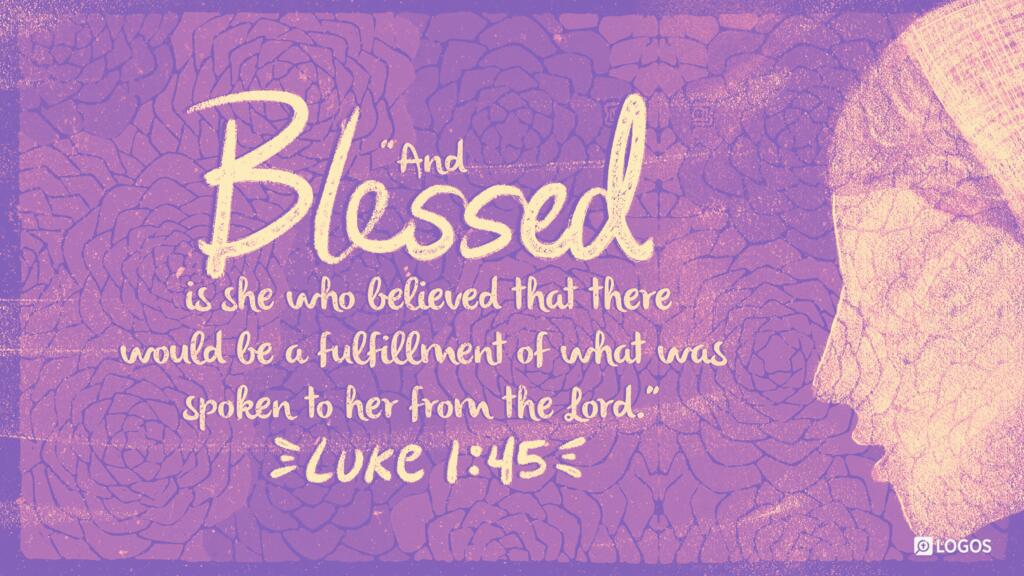
43And why is this granted to me, that the mother of my Lord should come to me? 44For behold, when the sound of your greeting came to my ears, the baby in my womb leaped for joy! 45And blessed is she who believed that there will be a fulfillment to what was spoken to her from the Lord!”
Mary’s Hymn of Praise to God
46And Mary said,
“My soul exalts the Lord,
47and my spirit has rejoiced greatly in God my Savior,
48because he has looked upon the humble state of his female slave,
for behold, from now on all generations will consider me blessed,
49because the Mighty One has done great things for me,
and holy is his name.
50And his mercy is for generation after generation
to those who fear him.
51He has done a mighty deed with his arm;
he has dispersed the proud in the thoughts of their hearts.
52He has brought down rulers from their thrones,
and has exalted the lowly.
53He has filled those who are hungry with good things,
and those who are rich he has sent away empty-handed.
54He has helped Israel his servant,
remembering his mercy,
55just as he spoke to our fathers,
to Abraham and to his descendants forever.”k
56And Mary stayed with her about three months, and returned to her home.
Footnotes
Copyright 2012 Lexham Press