John 1:29–42
The Lexham English BibleOther versions
English
- LEB The Lexham English Bible
- DARBY 1890 Darby Bible
- ASV American Standard Version
- AV 1873 The Cambridge Paragraph Bible of the Authorized English Version
- CSB Christian Standard Bible
- D-R Douay-Rheims Bible
- ESV English Standard Version
- GW GOD’S WORD Translation
- GNB Good News Translation
- HCSB The Holman Christian Standard Bible
- KJV 1900 King James Version
- LSB Legacy Standard Bible
- MSG The Message: The Bible in Contemporary Language
- NET The NET Bible
- NASB95 New American Standard Bible (1995)
- NCV New Century Version
- NIrV New International Reader’s Version (1998)
- NIV New International Version (2011)
- NKJV The New King James Version
- NLT New Living Translation
- NRSVue New Revised Standard Version: Updated Edition
- RSV The Revised Standard Version
- RSVCE The Revised Standard Version, Catholic Edition
- YLT Young’s Literal Translation
Arabic
Czech
French
German
Greek
Hungarian
Italian
Korean
Latin
Portuguese
Russian
Simplified Chinese
Spanish
Traditional Chinese
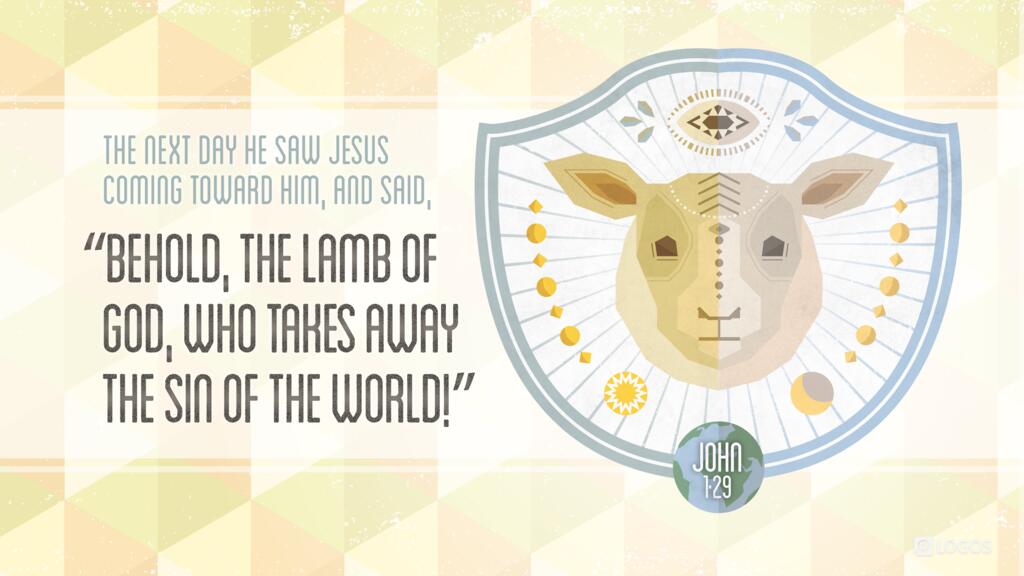
29On the next day he saw Jesus coming to him and said, “Look! The Lamb of God who takes away the sin of the world! 30This one is the one about whom I said, ‘After me is coming a man who is ahead of me, because he existed before me.’ 31And I did not know him, but in order that he could be revealed to Israel, because of this I came baptizing with water.”
32And John testified, saying, “I have seen the Spirit descending like a dove from heaven and remaining upon him. 33And I did not know him, but the one who sent me to baptize with water, that one said to me, ‘The one upon whom you see the Spirit descending and remaining upon him—this one is the one who baptizes with the Holy Spirit.’ 34And I have seen and testify that this one is the Chosen Onek of God.
Two of John’s Disciples Follow Jesus
35On the next day again John was standing there,* and two of his disciples, 36and looking at Jesus as he* was walking by, he said, “Look! The Lamb of God!” 37And the two disciples heard him speaking, and they followed Jesus. 38And Jesus, turning around and seeing them following him,* said to them, “What do you seek?” And they said to him, “Rabbi” (which means when* translated “Teacher”), “where are you staying?” 39He said to them, “Come and you will see!” So they came and saw where he was staying, and they stayed with him that day (it was about the tenth hour).
Andrew Declares Jesus to be the Messiah
40Andrew, the brother of Simon Peter, was one of the two who heard John and followed him. 41This one first found his own brother Simon and said to him, “We have found the Messiah!” (which is translated “Christ”). 42He brought him to Jesus. Looking at him, Jesus said, “You are Simon the son of John. You will be called Cephas” (which is interpreted “Peter”).
Footnotes
- kSome manuscripts have “the Son of God”
- *The word “there” is not in the Greek text but is implied
- *Here “as” is supplied as a component of the participle (“walking by”) which is understood as temporal
- *Here the direct object is supplied from context in the English translation
- *Here “when” is supplied as a component of the participle (“translated”) which is understood as temporal
Copyright 2012 Lexham Press