John 2:1–4:1
The Lexham English BibleOther versions
English
- LEB The Lexham English Bible
- DARBY 1890 Darby Bible
- ASV American Standard Version
- AV 1873 The Cambridge Paragraph Bible of the Authorized English Version
- CSB Christian Standard Bible
- D-R Douay-Rheims Bible
- ESV English Standard Version
- GW GOD’S WORD Translation
- GNB Good News Translation
- HCSB The Holman Christian Standard Bible
- KJV 1900 King James Version
- LSB Legacy Standard Bible
- MSG The Message: The Bible in Contemporary Language
- NET The NET Bible
- NASB95 New American Standard Bible (1995)
- NCV New Century Version
- NIrV New International Reader’s Version (1998)
- NIV New International Version (2011)
- NKJV The New King James Version
- NLT New Living Translation
- NRSVue New Revised Standard Version: Updated Edition
- RSV The Revised Standard Version
- RSVCE The Revised Standard Version, Catholic Edition
- YLT Young’s Literal Translation
Arabic
Czech
French
German
Greek
Hungarian
Italian
Korean
Latin
Portuguese
Russian
Simplified Chinese
Spanish
Traditional Chinese
The Wedding at Cana: Water Turned into Wine
2And on the third day, there was a wedding at Cana in Galilee, and the mother of Jesus was there. 2And both Jesus and his disciples were invited to the wedding. 3And when the* wine ran out, the mother of Jesus said to him, “They have no wine!” 4And Jesus said to her, “What does your concern have to do with me,a woman? My hour has not yet come.” 5His mother said to the servants, “Whatever he says to you, do it!”*
6Now six stone water jars were set there, in accordance with the ceremonial cleansing of the Jews, each holding two or three measures.b 7Jesus said to them, “Fill the water jars with water.” And they filled them to the brim. 8And he said to them, “Now draw some* out and take it* to the head steward. So they took it.* 9Now when the head steward tasted the water which had become wine and did not know where it was from—but the servants who had drawn the water knew—the head steward summoned the bridegroom 10and said to him, “Everyonec serves the good wine first, and whenever they are drunk, the inferior. You have kept the good wine until now!” 11This beginning of signs Jesus performed at Cana in Galilee, and revealed his glory, and his disciples believed in him.
Jesus’ First Journey to Jerusalem
12After this he went down to Capernaum, and his mother and brothersd and his disciples, and they stayed there a fewe days. 13And the Passover of the Jews was near, and Jesus went up to Jerusalem.
The Cleansing of the Temple
14And he found in the temple courts* those who were selling oxen and sheep and doves, and the money changers seated. 15And he made a whip of cords and* drove them* all out of the temple courts,* both the sheep and the oxen, and he poured out the coins of the money changers and overturned their* tables. 16And to the ones selling the doves he said, “Take these things away from here! Do not make my Father’s house a marketplace!”f 17His disciples remembered that it is written, “Zeal for your house will consume me.”g
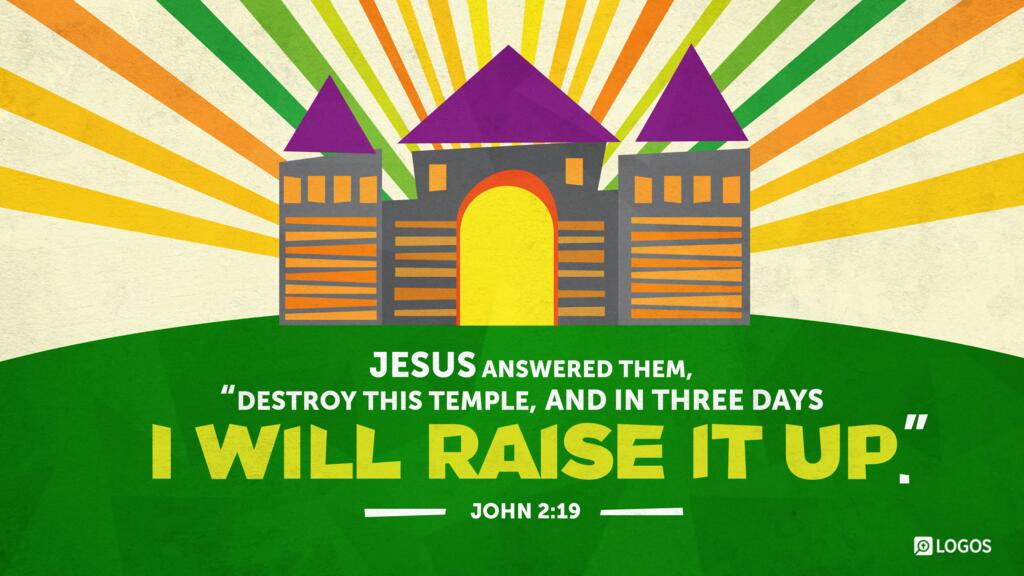
18So the Jews answered and said to him, “What sign do you show to us, because you are doing these things?” 19Jesus answered and said to them, “Destroy this temple, and in three days I will raise it up!” 20Then the Jews said, “This temple has been under constructionh forty-six years, and will you raise it up in three days?” 21But he was speaking about the temple of his body. 22So when he was raised from the dead, his disciples remembered that he had said this, and they believed the scripture and the saying that Jesus had spoken.
Jesus at the Passover
23Now while he was in Jerusalem at the Passover, during the feast, many believed in his name because they* saw his signs which he was doing. 24But Jesus himself did not entrust himself to them, because he knew all people,i 25and because he did not needj anyone to testifyk about man, for he himself knew what was in man.*
A Meeting with Nicodemus
3Now there was a man of the Pharisees whose name wasa Nicodemus, a ruler of the Jews. 2This man came to him at night and said to him, “Rabbi, we know that you are* a teacher who has come from God, for no one is able to perform these signs that you are performing unless God were with him.” 3Jesus answered and said to him, “Truly, truly I say to you, unless someone is born from above,b he is not able to see the kingdom of God.” 4Nicodemus said to him, “How can a man be born when he is an old man? He is not able to enter into his mother’s womb for the second time and be born, can he?”*
5Jesus answered, “Truly, truly I say to you, unless someone is born of water and spirit, he is not able to enter into the kingdom of God. 6What is born of the flesh is flesh, and what is born of the Spirit is spirit. 7Do not be astonished that I said to you, ‘It is necessary for you to be born from above.’c 8The wind blows wherever it wishes, and you hear the sound of it, but you do not know where it comes from and where it is going. So is everyone who is born of the Spirit.”
9Nicodemus answered and said to him, “How can these things be?” 10Jesus answered and said to him, “Are you the teacher of Israel, and you do not understand these things? 11Truly, truly I say to you, we speak what we know, and we testify about what we have seen, and you do not accept our testimony! 12If I tell you earthly things and you do not believe, how will you believe if I tell you heavenly things? 13And no one has ascended into heaven except the one who descended from heaven—the Son of Man. 14And just as Moses lifted up the snake in the wilderness,d thus it is necessary that the Son of Man be lifted up, 15so that everyone who believes in him will have eternal life.”e
God’s Love for the World
16For in this way God loved the world, so that he gave his one and only Son, in order that everyone who believes in him will not perish, but will have eternal life. 17For God did not send his Son into the world in order that he should judgef the world, but in order that the world should be saved through him. 18The one who believes in him is not judged,g but the one who does not believe has already been judged,h because he has not believed in the name of the one and only Son of God. 19And this is the judgment: that the light has come into the world, and people loved the darkness rather than the light, because their deeds were evil. 20For everyone who practices evil hates the light and does not come to the light, lest his deeds be exposed. 21But the one who practices the truth comes to the light, in order that his deeds may be revealed, that they are done in God.
Additional Testimony by John the Baptist About Jesus
22After these things Jesus and his disciples came into Judean territory, and there he spent time with them and was baptizing. 23Now John was also baptizing at Aenon near Salim, because water was plentiful there, and they were coming and were being baptized. 24(For John had not yet been thrown into prison.)
25So a dispute occurred on the part of John’s disciples with a Jewi concerning purification. 26And they came to John and said to him, “Rabbi, he who was with you on the other side of the Jordan, about whom you testified—look, this one is baptizing, and all are coming to him!”
27John answered and said, “A man can receive not one thing unless it is granted to him from heaven! 28You yourselves testify about me that I said, ‘I am not the Christ, but I am sent before that one.’ 29The one who has the bride is the bridegroom. But the friend of the bridegroom, who stands and hears him, rejoices greatlyj because of the bridegroom’s voice. So this joy of mine is complete. 30It is necessary for that one to increase, but for me to decrease.”
31The one who comes from above is over all. The one who is from the earth is from the earth and speaks from the earth; the one who comes from heaven is over all. 32What he has seen and heard, this he testifies, and no one accepts his testimony. 33The one who accepts his testimony has attested that God is true. 34For the one whom God sent speaks the words of God, for he does not give the Spirit by measure. 35The Father loves the Son and has given all things into his hand. 36The one who believes in the Son has eternal life, but the one who disobeys the Son will not see life—but the wrath of God remains on him.k
The Samaritan Woman at Jacob’s Well
4Now when Jesus knew that the Pharisees had heard that Jesus was making and baptizing more disciples than John
Footnotes
- *Here “when” is supplied as a component of the temporal genitive absolute participle (“ran out”)
- aLiterally “to me and to you”
- *Here the direct object is supplied from context in the English translation
- bA “measure” was about 9 gallons (40 liters)
- *Here the direct object is supplied from context in the English translation
- *Here the direct object is supplied from context in the English translation
- *Here the direct object is supplied from context in the English translation
- cLiterally “every man”
- dSome manuscripts have “his brothers”
- eLiterally “not many”
- *Here “courts” is supplied to distinguish this area from the interior of the temple building itself
- *Here “and” is supplied because the previous participle (“made”) has been translated as a finite verb
- *Here the direct object is supplied from context in the English translation
- *Here “courts” is supplied to distinguish this area from the interior of the temple building itself
- *Literally “the”; the Greek article is used here as a possessive pronoun
- fLiterally “a market house”; or “a house of merchants” (an allusion to Zech 14:21)
- gA quotation from Ps 69:9
- hThis translation of the aorist verb is based on a very close parallel in Ezra 5:16 (LXX), where it is clear from the following verb that the construction had not yet been completed
- *Here “because” is supplied as a component of the participle (“saw”) which is understood as causal
- iThe Greek term is masculine and thus refers to “all people” rather than “all things” (which would be neuter)
- jLiterally “have need that”
- kLiterally “should testify”
- *Here “man” has been retained rather than the generic “people” to maintain the connection with the following verse
- aLiterally “the name to him”
- *Here both the pronoun and verb are understood in Greek and are supplied in the translation
- bThe same Greek word can mean either “from above” or “again,” which allows for the misunderstanding by Nicodemus here; Jesus was speaking of new birth “from above,” while Nicodemus misunderstood him to mean a second physical birth
- *The negative construction in Greek anticipates a negative answer here, indicated in the translation by the phrase “can he”
- cThe same Greek word can mean either “from above” or “again” (see also v. 3)
- dAn allusion to Num 21:5–9
- eSome interpreters and Bible translations extend the quotation of Jesus’ words through v. 21
- fOr “he should condemn”
- gOr “condemned”
- hOr “been condemned”
- iSome significant early manuscripts read “the Jews”
- jLiterally “with joy”
- kSome interpreters and Bible translations extend the quotation of John the Baptist’s words through v. 36
Copyright 2012 Lexham Press