Proverbs 22:1–11
The NET BibleOther versions
English
- NET The NET Bible
- DARBY 1890 Darby Bible
- ASV American Standard Version
- AV 1873 The Cambridge Paragraph Bible of the Authorized English Version
- CSB Christian Standard Bible
- D-R Douay-Rheims Bible
- ESV English Standard Version
- GW GOD’S WORD Translation
- GNB Good News Translation
- HCSB The Holman Christian Standard Bible
- KJV 1900 King James Version
- LSB Legacy Standard Bible
- LEB The Lexham English Bible
- MSG The Message: The Bible in Contemporary Language
- NASB95 New American Standard Bible (1995)
- NCV New Century Version
- NIrV New International Reader’s Version (1998)
- NIV New International Version (2011)
- NKJV The New King James Version
- NLT New Living Translation
- NRSVue New Revised Standard Version: Updated Edition
- RSV The Revised Standard Version
- RSVCE The Revised Standard Version, Catholic Edition
- YLT Young’s Literal Translation
Arabic
Czech
French
German
Hebrew
Hungarian
Italian
Korean
Latin
Portuguese
Russian
Simplified Chinese
Spanish
Traditional Chinese
22:1A good name1 is to be chosen2 rather than great wealth,
good favor3 more than silver or gold.
22:2The rich and the poor meet together;4
the Lord is the creator of them both.5
22:3A shrewd person6 sees danger7 and hides himself,
but the naive keep right on going8 and suffer for it.9
22:4The reward10 for humility11 and fearing the Lord12
is riches and honor and life.
22:5Thorns and snares13 are in the path of the perverse,
but the one who guards himself keeps far from them.
22:6Train14 a child15 in the way that he should go,16
and when he is old he will not turn from it.17
22:7The rich rule over18 the poor,
and the borrower is servant19 to the lender.
22:8The one who sows20 iniquity will reap trouble,
and the rod of his fury21 will end.
22:9A generous person22 will be blessed,23
for he gives some of his food24 to the poor.
22:10Drive out the scorner25 and contention will leave;
strife and insults will cease.26
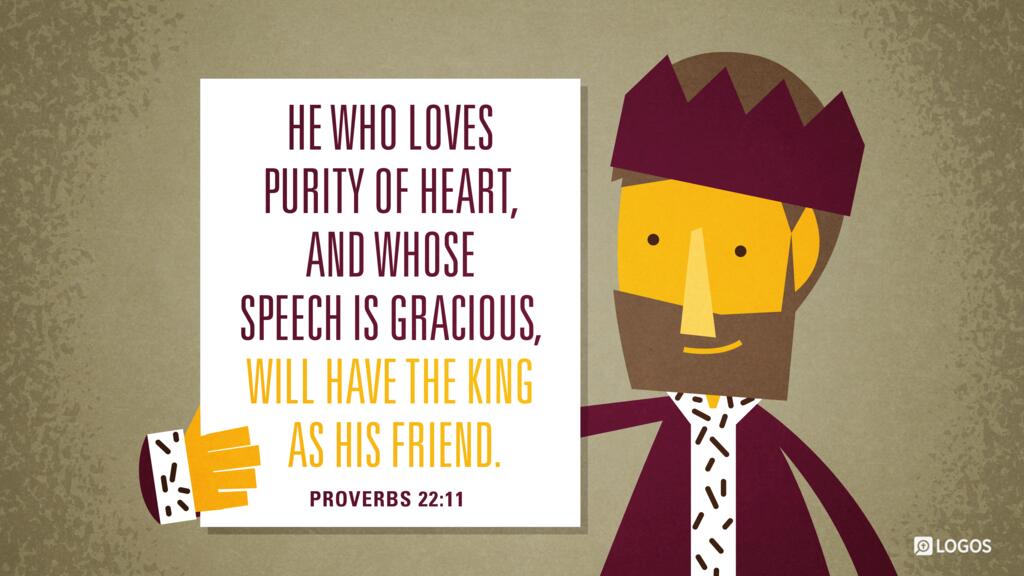
22:11The one who loves a pure heart27
and whose speech is gracious28—the king will be his friend.29
Footnotes
- 1 Heb “a name.” The idea of the name being “good” is implied; it has the connotation here of a reputation (cf. , , ).
- 2 “To be chosen rather than” is a translation of the Niphal participle with the comparative degree taken into consideration. Cf. “worth much more than.”
- 3 Heb “favor of goodness.” This is a somewhat difficult expression. Some English versions render the phrase “favor is better than silver or gold” (so , ) making it parallel to the first colon. But if “good” is retained as an attributive modifier, then it would mean one was well thought of, or one had engaging qualities (cf. “loving favor; “high esteem”). This fits with the idea of the reputation in the first colon, for a good name would bring with it the favor of others.
- 4 The form of the verb is the Niphal perfect of פָּגַשׁ (pagash); it means “to meet together [or, each other]” (cf. , ). The point is that rich and poor live side by side in this life, but they are both part of God’s creation (cf. , “have a common bond”). Some commentators have taken this to mean that they should live together because they are part of God’s creation; but the verb form will not sustain that meaning.
- 5 Heb “all.” The Lord is sovereign over both groups, that is, he has had the final say whether a person is rich or poor. People would do well to treat all people with respect, for God can as easily reduce the rich to poverty as raise up the poor to wealth.
- 6 The contrast is between the “shrewd” (prudent) person and the “simpleton.” The shrewd person knows where the dangers and pitfalls are in life and so can avoid them; the naive person is unwary, untrained, and gullible, unable to survive the dangers of the world and blundering into them.
- 7 Heb “evil,” a term that is broad enough to include (1) “sin” as well as (2) any form of “danger” (, , , ) or “trouble” (, ). The second option is more likely what is meant here: The naive simpleton does not see the danger to be avoided and so suffers for it.
- 8 Heb “go on”; the word “right” is supplied in the translation to clarify the meaning: The naive person, oblivious to impending danger, meets it head on (cf. “will walk right into it”).
- 9 The verb עָנַשׁ (’anash) means “to fine” specifically. In the Niphal stem it means “to be fined,” or more generally, “to be punished.” In this line the punishment is the consequence of blundering into trouble—they will pay for it.
- 10 The Hebrew term עֵקֶב (’eqev, “reward”) is related to the term meaning “heel”; it refers to the consequences or the reward that follows (akin to the English expression “on the heels of”).
- 11 “Humility” is used here in the religious sense of “piety”; it is appropriately joined with “the fear of the Lord.” Some commentators, however, make “the fear of the Lord” the first in the series of rewards for humility, but that arrangement is less likely here.
- 12 Heb “the fear of the Lord.” This is an objective genitive; the Lord is the object of the fear.
- 13 Because reading צִנִּים (tsinnim, “thorns”) does not make a very good match with “traps,” it has created some difficulty for interpreters. The word “thorns” may be obscure, but it is supported by the (“prickly plants”) and an apparent cognate “thorns” in Num 33:55 and Josh 23:13. But some (including the editors of ) suggest changing it to צַמִּים (tsammim, “traps” changing a ן [nun] to a ם [mem]). But 855 צַמִּים acknowledges that this word is a doubtful word, attested only a couple of times in Job (e.g., 18:9). W. McKane traces a development from the idea of צֵן (tsen, “basket; trap”) to support this change (Proverbs [], 565). The present translation (like many other English versions) has retained “thorns,” even though the parallelism with “traps” is not very good; as the harder reading it is preferred. The variant readings have little textual or philological support, and simplify the line. “Thorns and snares” represent the dangers and threats to life. They would be implied comparisons (hypocatastasis): As a path strewn with thorns and traps, life for the wicked will be filled with dangers and difficulties.
- 14 The verb חָנַךְ (khanakh) means “to train up; to dedicate” ( 335 ; חנך). The verb is used elsewhere to refer to dedicating a house (Deut 20:5; 1 Kgs 8:63; 2 Chr 7:5). The related noun חֲנֻכָה (khanukhah) means “dedication; consecration” ( 335 ; ), and is used in reference to the dedication or consecration of altars (Num 7:10; 2 Chr 7:9), the temple (Ps 30:1), and town walls (Neh 12:27). The related adjective חָנִיךְ (khanikh) describes “trained, tried, experienced” men ( 335 ; Gen 14:14). In the related cognate languages the verb has similar meanings: Aramaic “to train,” Ethiopic “to initiate,” and Arabic IV “to learn; to make experienced” ( ). This proverb pictures a child who is dedicated by parents to the Lord and morally trained to follow him. On the other hand, a popular expositional approach suggests that it means “to motivate.” This view is based on a cognate Arabic root II which (among many other things) refers to the practice of rubbing the palate of a newborn child with date juice or olive oil to motivate the child to suck. While this makes an interesting sermon illustration, it is highly unlikely that this concept was behind this Hebrew verb. The Arabic meaning is late and secondary—the Arabic term did not have this meaning until nearly a millennium after this proverb was written.
- 15 The term נַעַר (na’ar) is traditionally translated “child” here (so almost all English versions), but might mean “youth.” The noun can refer to a broad range of ages (see 654–55 ; ): infant (Exod 2:6), weaned child (1 Sam 1:24), young child (Jer 1:6), lad (Gen 22:12), adolescent (Gen 37:2), or young man of marriageable age (Gen 34:19). The context focuses on the child’s young, formative years. The Talmud says this would be up to the age of twenty-four.
- 16 The expression in Hebrew is עַל־פִּי דַּרְכּוֹ (’al-pi darko), which can be rendered “according to his way”; “Start a boy on the right road.” The expression “his way” is “the way he should go”; it reflects the point the book of Proverbs is making that there is a standard of life to which he must attain. Saadia, a Jewish scholar who lived a.d. 882–942, first suggested that this could mean the child should be trained according to his inclination or bent of mind. This may have some merit in practice, but it is not likely what the proverb had in mind. In the book of Proverbs there are only two ways that a person can go, the way of the wise or righteousness, and the way of the fool. One takes training, and the other does not. Ralbag, in fact, offered a satirical interpretation: “Train a child according to his evil inclinations (let him have his will) and he will continue in his evil way throughout life” (J. H. Greenstone, Proverbs, 234). C. H. Toy says the expression means “in accordance with the manner of life to which he is destined (Proverbs [], ). W. McKane says, “There is only one right way—the way of life—and the educational discipline which directs young men along this way is uniform” (Proverbs [], 564). This phrase does not describe the concept perpetuated by a modern psychological interpretation of the verse: Train a child according to his personality trait.
- 17 The expected consequence of such training is that it will last throughout life. The sages were confident of the character-forming quality of their training. However, proverbs are not universal truths. One can anticipate positive results from careful child-training—but there may be an occasional exception.
- 18 The proverb is making an observation on life. The synonymous parallelism matches “rule over” with “servant” to show how poverty makes people dependent on, or obligated to, others.
- 19 Or “slave” (so , , , , ). This may refer to the practice in Israel of people selling themselves into slavery to pay off debts (Exod 21:2–7).
- 20 The verse is making an implied comparison (a figure of speech known as hypocatastasis) between sowing and sinning. One who sins is like one who sows, for there will be a “harvest” or a return on the sin—trouble.
- 21 There is a variant reading in the ; instead of “the rod of his wrath” it reads “the punishment of his deeds.” C. H. Toy wishes to emend שֵׁבֶט (shevet) to שֶׁבֶר (shever), “the produce of his work” (Proverbs [], ). But the Hebrew text is not obscure, and שֶׁבֶר does not exactly mean “produce.” The expression “rod of his wrath” may not follow the imagery of 8a very closely, but it is nonetheless understandable. The “rod” is a symbol of power; “wrath” is a metonymy of cause indicating what wrath will do, and an objective genitive. The expression signifies that in reaping trouble for his sins this person will no longer be able to unleash his fury on others. The adds: “A man who is cheerful and a giver God blesses” (e.g., 2 Cor 9:7).
- 22 Heb “good of eye.” This expression is an attributed genitive meaning “bountiful of eye” (cf. , “He that hath a bountiful eye”). This is the opposite of the “evil eye” which is covetous and wicked. The “eye” is a metonymy representing looking well to people’s needs. So this refers to the generous person (cf. , , , ).
- 23 The form יְבֹרָךְ (yévorakh) is a Pual imperfect (here in pause) from בָּרַךְ (barakh); the word means “blessed” in the sense of “enriched,” implying there is a practical reward for being generous to the poor.
- 24 It is from his own food that he gives to the poor. Of the many observations that could be made, it is worth noting that in blessing this kind of person God is in fact providing for the poor, because out of his blessing he will surely continue to share more.
- 25 This proverb, written in loose synonymous parallelism, instructs that the scorner should be removed because he causes strife. The “scorner” is לֵץ (lets), the one the book of Proverbs says cannot be changed with discipline or correction, but despises and disrupts anything that is morally or socially constructive.
- 26 The freely adds “when he sits in council (ἐν συνεδρίῳ, ejn sunedriō), he insults everyone.” The does not suggest that the setting is in a court of law; so the addition is highly unlikely.
- 27 The “heart” is a metonymy of subject; it represents the intentions and choices that are made. “Pure of heart” uses “heart” as a genitive of specification. The expression refers to someone who has honest and clear intentions.
- 28 Heb “grace of his lips” (so , ). The “lips” are a metonymy of cause representing what is said; it also functions as a genitive of specification. This individual is gracious or kind in what he says; thus the verse is commending honest intentions and gracious words.
- 29 The syntax of the line is somewhat difficult, because “grace of his lips” seems to be intruding on the point of the verse with little explanation. Therefore the rendered it “The Lord loves the pure in heart; all who are blameless in their ways are acceptable to him.” This has very little correspondence with the Hebrew; nevertheless commentators attempt to reconstruct the verse using it, and the follows the first clause of the here. Some have suggested taking “king” as the subject of the whole verse (“the king loves …”), but this is forced.
The NET Bible First Edition, Copyright 1996-2005 by Biblical Studies Press
In other versions
ESVEnglish Standard Version
A good name is to be chosen rather than great riches,
and favor is better than silver or gold.
The rich and the poor meet together;
the Lord is the Maker of them all.
The prudent sees danger and hides himself,
but the simple go on and suffer for it.
The reward for humility and fear of the Lord
is riches and honor and life.
Thorns and snares are in the way of the crooked;
whoever guards his soul will keep far from them.
Train up a child in the way he should go;
even when he is old he will not depart from it.
The rich rules over the poor,
and the borrower is the slave of the lender.
Whoever sows injustice will reap calamity,
and the rod of his fury will fail.
Whoever has a bountiful eye will be blessed,
for he shares his bread with the poor.
Drive out a scoffer, and strife will go out,
and quarreling and abuse will cease.
He who loves purity of heart,
and whose speech is gracious, will have the king as his friend.
Copyright 2001 Crossway Bibles
NIVNew International Version (2011)
A good name is more desirable than great riches;
to be esteemed is better than silver or gold.
Rich and poor have this in common:
The Lord is the Maker of them all.
The prudent see danger and take refuge,
but the simple keep going and pay the penalty.
Humility is the fear of the Lord;
its wages are riches and honor and life.
In the paths of the wicked are snares and pitfalls,
but those who would preserve their life stay far from them.
Start children off on the way they should go,
and even when they are old they will not turn from it.
The rich rule over the poor,
and the borrower is slave to the lender.
Whoever sows injustice reaps calamity,
and the rod they wield in fury will be broken.
The generous will themselves be blessed,
for they share their food with the poor.
Drive out the mocker, and out goes strife;
quarrels and insults are ended.
One who loves a pure heart and who speaks with grace
will have the king for a friend.
Copyright 1973, 1978, 1984, 2011 Biblica, Inc.
CSBChristian Standard Bible
A good name is to be chosen over great wealth;
favor is better than silver and gold.
Rich and poor have this in common:
the Lord makes them all.
A sensible person sees danger and takes cover,
but the inexperienced keep going and are punished.
Humility, the fear of the Lord,
results in wealth, honor, and life.
There are thorns and snares on the way of the crooked;
the one who guards himself stays far from them.
Start a youth out on his way;
even when he grows old he will not depart from it.
The rich rule over the poor,
and the borrower is a slave to the lender.
The one who sows injustice will reap disaster,
and the rod of his fury will be destroyed.
A generous person will be blessed,
for he shares his food with the poor.
Drive out a mocker, and conflict goes too;
then quarreling and dishonor will cease.
The one who loves a pure heart
and gracious lips—the king is his friend.
Copyright 2017 Holman Bible Publishers
NLTNew Living Translation
Choose a good reputation over great riches;
being held in high esteem is better than silver or gold.
The rich and poor have this in common:
The Lord made them both.
A prudent person foresees danger and takes precautions.
The simpleton goes blindly on and suffers the consequences.
True humility and fear of the Lord
lead to riches, honor, and long life.
Corrupt people walk a thorny, treacherous road;
whoever values life will avoid it.
Direct your children onto the right path,
and when they are older, they will not leave it.
Just as the rich rule the poor,
so the borrower is servant to the lender.
Those who plant injustice will harvest disaster,
and their reign of terror will come to an end.
Blessed are those who are generous,
because they feed the poor.
Throw out the mocker, and fighting goes, too.
Quarrels and insults will disappear.
Whoever loves a pure heart and gracious speech
will have the king as a friend.
Holy Bible, New Living Translation, copyright © 1996, 2004, 2015 by Tyndale House Foundation. Used by permission of Tyndale House Publishers. All rights reserved.
LEBThe Lexham English Bible
A reputation is to be chosen rather than great riches;
favor is better than silver and gold.
Rich and poor have much in common;
Yahweh is the maker of all of them.
The clever sees danger and hides,
but the simple go on and suffer.
The reward of humility is the fear of Yahweh—
wealth and honor and life.
Thorns and snares are in the way of the perverse;
he who guards himself will keep away from them.
Train the child concerning his way;
even when he is old, he will not stray from it.
The rich will rule over the poor,
and the borrower is a slave of the lender.
He who sows injustice will reap calamity,
and the rod of his anger will fail.
He who is generous will be blessed,
for he gives to the poor from his own bread.
Drive out a scoffer and strife will go out;
quarrel and abuse will cease.
He who loves purity of heart
and has gracious speech, his friend is the king.
Copyright 2012 Lexham Press
KJV 1900King James Version
A good name is rather to be chosen than great riches,
And loving favour rather than silver and gold.
The rich and poor meet together:
The Lord is the maker of them all.
A prudent man foreseeth the evil, and hideth himself:
But the simple pass on, and are punished.
By humility and the fear of the Lord
Are riches, and honour, and life.
Thorns and snares are in the way of the froward:
He that doth keep his soul shall be far from them.
Train up a child in the way he should go:
And when he is old, he will not depart from it.
The rich ruleth over the poor,
And the borrower is servant to the lender.
He that soweth iniquity shall reap vanity:
And the rod of his anger shall fail.
He that hath a bountiful eye shall be blessed;
For he giveth of his bread to the poor.
Cast out the scorner, and contention shall go out;
Yea, strife and reproach shall cease.
He that loveth pureness of heart,
For the grace of his lips the king shall be his friend.
Public Domain