Proverbs 15:15–30
The NET BibleOther versions
English
- NET The NET Bible
- DARBY 1890 Darby Bible
- ASV American Standard Version
- AV 1873 The Cambridge Paragraph Bible of the Authorized English Version
- CSB Christian Standard Bible
- D-R Douay-Rheims Bible
- ESV English Standard Version
- GW GOD’S WORD Translation
- GNB Good News Translation
- HCSB The Holman Christian Standard Bible
- KJV 1900 King James Version
- LSB Legacy Standard Bible
- LEB The Lexham English Bible
- MSG The Message: The Bible in Contemporary Language
- NASB95 New American Standard Bible (1995)
- NCV New Century Version
- NIrV New International Reader’s Version (1998)
- NIV New International Version (2011)
- NKJV The New King James Version
- NLT New Living Translation
- NRSVue New Revised Standard Version: Updated Edition
- RSV The Revised Standard Version
- RSVCE The Revised Standard Version, Catholic Edition
- YLT Young’s Literal Translation
Arabic
Czech
French
German
Hebrew
Hungarian
Italian
Korean
Latin
Portuguese
Russian
Simplified Chinese
Spanish
Traditional Chinese
15:15All the days39 of the afflicted40 are bad,41
but one with42 a cheerful heart has a continual feast.43
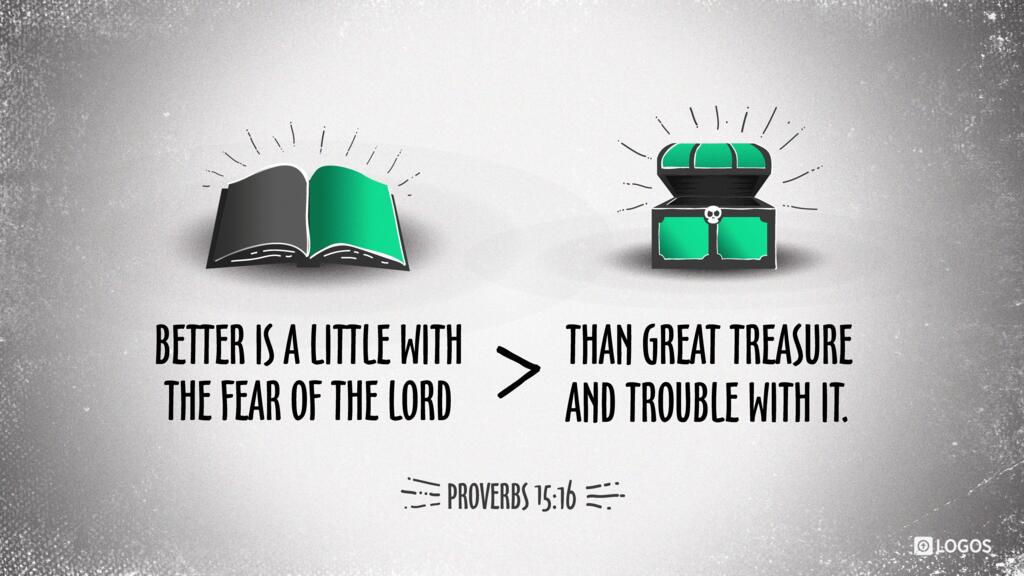
15:16Better44 is little with the fear of the Lord
than great wealth and turmoil45 with it.46
15:17Better a meal of vegetables where there is love47
than a fattened ox where there is hatred.48
15:18A quick-tempered person49 stirs up dissension,
but one who is slow to anger50 calms51 a quarrel.52
15:19The way of the sluggard is like a hedge of thorns,53
but the path of the upright is like54 a highway.55
15:20A wise child56 brings joy to his father,
but a foolish person57 despises58 his mother.
15:21Folly is a joy to one who lacks sense,59
but one who has understanding60 follows an upright course.61
15:22Plans fail62 when there is no counsel,
but with abundant advisers they are established.63
15:23A person has joy64 in giving an appropriate answer,65
and a word at the right time66—how good it is!
15:24The path of life is upward67 for the wise person,68
to69 keep him from going downward to Sheol.70
15:25The Lord tears down the house of the proud,71
but he maintains the boundaries of the widow.72
15:26The Lord abhors73 the plans74 of the wicked,75
but pleasant words76 are pure.77
15:27The one who is greedy for gain78 troubles79 his household,80
but whoever hates bribes81 will live.
15:28The heart of the righteous considers82 how83 to answer,84
but the mouth of the wicked pours out evil things.85
15:29The Lord is far86 from the wicked,
but he hears87 the prayer of the righteous.88
15:30A bright look89 brings joy to the heart,
and good news gives health to the body.90
Footnotes
- 39 The “days” represent what happens on those days (metonymy of subject).
- 40 The contrast is between the “afflicted” and the “good of heart” (a genitive of specification, “cheerful/healthy heart/spirit/attitude”). The parallelism suggests that the afflicted is one afflicted within his spirit, for the proverb is promoting a healthy frame of mind.
- 41 Or “evil”; or “catastrophic.”
- 42 “one with” is supplied.
- 43 The image of a continual feast signifies the enjoyment of what life offers (cf. “happy people … enjoy life”). The figure is a hypocatastasis; among its several implications are joy, fulfillment, abundance, pleasure.
- 44 One of the frequent characteristics of wisdom literature is the “better” saying; it is a comparison of different but similar things to determine which is to be preferred. These two verses focus on spiritual things being better than troubled material things.
- 45 Turmoil refers to anxiety; the fear of the Lord alleviates anxiety, for it brings with it contentment and confidence.
- 46 Not all wealth has turmoil with it. But the proverb is focusing on the comparison of two things—fear of the Lord with little and wealth with turmoil. Between these two, the former is definitely better.
- 47 Heb “and love there.” This clause is a circumstantial clause introduced with vav, that becomes “where there is love.” The same construction is used in the second colon.
- 48 Again the saying concerns troublesome wealth: Loving relationships with simple food are better than a feast where there is hatred. The ideal, of course, would be loving family and friends with a great meal in addition, but this proverb is only comparing two things.
- 49 Heb “a man of wrath”; , “a wrathful man.” The term “wrath” functions as an attributive genitive: “an angry person.” He is contrasted with the “slow of anger,” so he is a “quick-tempered person” (cf. “a hothead”).
- 50 Heb “slow of anger.” The noun “anger” functions as a genitive of specification: slow in reference to anger, that is, slow to get angry, patient.
- 51 The Hiphil verb יַשְׁקִיט (yashqit) means “to cause quietness; to pacify; to allay” the strife or quarrel (cf. “allays discord”). This type of person goes out of his way to keep things calm and minimize contention; his opposite thrives on disagreement and dispute.
- 52 The fact that רִיב (riv) is used for “quarrel; strife” strongly implies that the setting is the courtroom or other legal setting (the gates of the city). The hot-headed person is eager to turn every disagreement into a legal case.
- 53 Heb “like an overgrowth”; “overgrown with thorns”; cf. “like walking in a thorn patch.” The point of the simile is that the path of life taken by the lazy person has many obstacles that are painful—it is like trying to break through a hedge of thorns. The has “strewn with thorns.”
- 54 The comparative “like” does not appear in the Hebrew text, but is implied by the metaphor; it is supplied for the sake of clarity.
- 55 The contrast to the “thorny way” is the highway, the Hebrew word signifying a well built-up road (סָלַל, salal, “to heap up”). The upright have no reason to swerve, duck, or detour, but may expect “clear sailing.” Other passages pair these two concepts, e.g., Prov 6:10; 10:26; 28:19.
- 56 Heb “son.”
- 57 Heb “a fool of a man,” a genitive of specification.
- 58 The proverb is almost the same as 10:1, except that “despises” replaces “grief.” This adds the idea of the callousness of the one who inflicts grief on his mother (D. Kidner, Proverbs [], ).
- 59 The Hebrew text reads לַחֲסַר־לֵב (lakhasar-lev, “to one who lacks heart”). The Hebrew term “heart” represents the mind, the place where proper decisions are made (cf. “judgment”). The one who has not developed this ability to make proper choices finds great delight in folly.
- 60 Heb “a man of understanding” (so , ); “a sensible person.”
- 61 The Hebrew construction is יְיַשֶּׁר־לָכֶת (yéyasher-lakhet, “makes straight [to] go”). This is a verbal hendiadys, in which the first verb, the Piel imperfect, becomes adverbial, and the second form, the infinitive construct of הָלַךְ, halakh, becomes the main verb: “goes straight ahead” (cf. ).
- 62 Heb “go wrong” (so , ). The verb is the Hiphil infinitive absolute from פָּרַר, parar, which means “to break; to frustrate; to go wrong” ( I פרר 2). The plans are made ineffectual or are frustrated when there is insufficient counsel.
- 63 The proverb says essentially the same thing as 11:14, but differently.
- 64 Heb “joy to the man” or “the man has joy.”
- 65 Heb “in the answer of his mouth” (so ); “in an apt answer.” The term “mouth” is a metonymy of cause for what he says. But because the parallelism is loosely synonymous, the answer given here must be equal to the good word spoken in season. So it is an answer that is proper or fitting.
- 66 Heb “in its season.” To say the right thing at the right time is useful; to say the right thing at the wrong time is counterproductive.
- 67 There is disagreement over the meaning of the term translated “upward.” The verse is usually taken to mean that “upward” is a reference to physical life and well-being (cf. ), and “going down to Sheol” is a reference to physical death, that is, the grave, because the concept of immortality is said not to appear in the book of Proverbs. The proverb then would mean that the wise live long and healthy lives. But W. McKane argues (correctly) that “upwards” in contrast to Sheol, does not fit the ways of describing the worldly pattern of conduct and that it is only intelligible if taken as a reference to immortality (Proverbs [], 480). The translations “upwards” and “downwards” are not found in the . This has led some commentators to speculate that these terms were not found in the original, but were added later, after the idea of immortality became prominent. However, this is mere speculation.
- 68 Heb “to the wise [man],” because the form is masculine.
- 69 The term לְמַעַן (lema’an, “in order to”) introduces a purpose clause; the path leads upward in order to turn the wise away from Sheol.
- 70 Heb “to turn from Sheol downward”; cf. “the nether world below.”
- 71 The “proud” have to be understood here in contrast to the widow, and their “house” has to be interpreted in contrast to the widow’s territory. The implication may be that the “proud” make their gain from the needy, and so God will set the balance right.
- 72 The Lord administers justice in his time. The Lord champions the widow, the orphan, the poor, and the needy. These people were often the prey of the proud, who would take and devour their houses and lands (e.g., 1 Kgs 21; Prov 16:19; Isa 5:8–10).
- 73 Heb “an abomination of the Lord.” The term יְהוָה (yéhvah, “the Lord”) functions as a subjective genitive: “the Lord abhors.”
- 74 The noun מַחְשְׁבוֹת (makhshévot) means “thoughts” (so , , ), from the verb חָשַׁב (khashav, “to think; to reckon; to devise”). So these are intentions, what is being planned (cf. “schemes”).
- 75 The word רַע (“evil; wicked”) is a genitive of source or subjective genitive, meaning the plans that the wicked devise—“wicked plans.”
- 76 The contrast is between the “thoughts” and the “words.” The thoughts that are designed to hurt people the Lord hates; words that are pleasant (נֹעַם, no’am), however, are pure (to him). What is pleasant is delightful, lovely, enjoyable.
- 77 The simply has “but pleasant words are pure” (Heb “but pure [plural] are the words of pleasantness”). Some English versions add “to him” to make the connection to the first part (cf. , ). The has: “the sayings of the pure are held in honor.” The has: “pure speech will be confirmed by him as very beautiful.” The has paraphrased here: “but those of the pure are pleasing to him.”
- 78 Heb “the one who gains.” The phrase בּוֹצֵעַ בָּצַע (botseakh batsa’) is a participle followed by its cognate accusative. This refers to a person who is always making the big deal, getting the larger cut, or in a hurry to get rich. The verb, though, makes it clear that the gaining of a profit is by violence and usually unjust, since the root has the idea of “cut off; break off; gain by violence.” The line is contrasted with hating bribes, and so the gain in this line may be through bribery.
- 79 The participle “troubles” (עֹכֵר, ’okher) can have the connotation of making things difficult for the family, or completely ruining the family (cf. ). In Josh 7:1 Achan took some of the “banned things” and was put to death: Because he “troubled Israel,” the Lord would “trouble” him (take his life, Josh 7:25).
- 80 Heb “his house.”
- 81 Heb “gifts” (so ). Gifts can be harmless enough, but in a setting like this the idea is that the “gift” is in exchange for some “profit [or, gain].” Therefore they are bribes (cf. , , , , , ), and to be hated or rejected. Abram, for example, would not take anything that the king of Sodom had to offer, “lest [he] say, “I have made Abram rich” (Gen 14:22–24).
- 82 The verb יֶהְגֶּה (yehgeh) means “to muse; to meditate; to consider; to study.” It also involves planning, such as with the wicked “planning” a vain thing (Ps 2:1, which is contrasted with the righteous who “meditate” in the law [1:2]).
- 83 The word “how” is supplied in the translation for stylistic reasons.
- 84 The reads: “the hearts of the righteous meditate faithfulness.” The advice of the proverb is to say less but better things. The wise—here called the righteous—are cautious in how they respond to others. They think about it (heart = mind) before speaking.
- 85 The form is plural. What they say (the “mouth” is a metonymy of cause) is any range of harmful things.
- 86 To say that the Lord is “far” from the wicked is to say that he has made himself unavailable to their appeal—he does not answer them. This motif is used by David throughout Psalm 22 for the problem of unanswered prayer—“Why are you far off?”
- 87 The verb “hear” (שָׁמַע, shama’) has more of the sense of “respond to” in this context. If one “listens to the voice of the Lord,” for example, it means that he obeys the Lord. If one wishes God to “hear his prayer,” it means he wishes God to answer it.
- 88 God’s response to prayer is determined by the righteousness of the one who prays. A prayer of repentance by the wicked is an exception, for by it they would become the righteous (C. H. Toy, Proverbs [], ).
- 89 The has “the eye that sees beautiful things.” D. W. Thomas suggests pointing מְאוֹר (mé’or) as a Hophal participle, “a fine sight cheers the mind” (“Textual and Philological Notes,” 205). But little is to be gained from this change. Heb “light of the eyes” (so , ). The expression may indicate the gleam in the eyes of the one who tells the good news, as the parallel clause suggests.
- 90 Heb “makes fat the bones”; “invigorates the bones.” The word “bones” is a metonymy of subject, the bones representing the whole body. The idea of “making fat” signifies by comparison (hypocatastasis) with fat things that the body will be healthy and prosperous (e.g., Prov 17:22; 25:25; Gen 45:27–28; and Isa 52:7–8). Good news makes the person feel good in body and soul.
The NET Bible First Edition, Copyright 1996-2005 by Biblical Studies Press