Luke 23:26–49
The NET BibleOther versions
English
- NET The NET Bible
- DARBY 1890 Darby Bible
- ASV American Standard Version
- AV 1873 The Cambridge Paragraph Bible of the Authorized English Version
- CSB Christian Standard Bible
- D-R Douay-Rheims Bible
- ESV English Standard Version
- GW GOD’S WORD Translation
- GNB Good News Translation
- HCSB The Holman Christian Standard Bible
- KJV 1900 King James Version
- LSB Legacy Standard Bible
- LEB The Lexham English Bible
- MSG The Message: The Bible in Contemporary Language
- NASB95 New American Standard Bible (1995)
- NCV New Century Version
- NIrV New International Reader’s Version (1998)
- NIV New International Version (2011)
- NKJV The New King James Version
- NLT New Living Translation
- NRSVue New Revised Standard Version: Updated Edition
- RSV The Revised Standard Version
- RSVCE The Revised Standard Version, Catholic Edition
- YLT Young’s Literal Translation
Arabic
Czech
French
German
Greek
Hungarian
Italian
Korean
Latin
Portuguese
Russian
Simplified Chinese
Spanish
Traditional Chinese
The Crucifixion
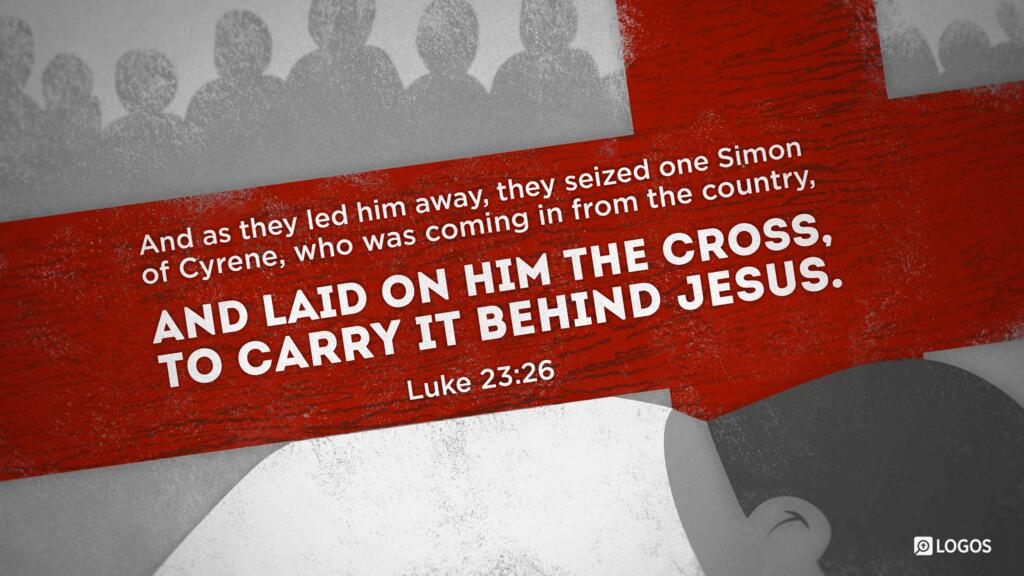
23:26As63 they led him away, they seized Simon of Cyrene,64 who was coming in from the country.65 They placed the cross on his back and made him carry it behind Jesus.6623:27A great number of the people followed him, among them women67 who were mourning68 and wailing for him. 23:28But Jesus turned to them and said, “Daughters of Jerusalem,69 do not weep for me, but weep for yourselves70 and for your children. 23:29For this is certain:71 The days are coming when they will say, ‘Blessed are the barren, the wombs that never bore children, and the breasts that never nursed!’7223:30Then they will begin to say to the mountains,73 ‘Fall on us!’ and to the hills, ‘Cover us!’7423:31For if such things are done75 when the wood is green, what will happen when it is dry?”76
23:32Two other criminals77 were also led away to be executed with him. 23:33So78 when they came to the place that is called “The Skull,”79 they crucified80 him there, along with the criminals, one on his right and one on his left. 23:34But Jesus said, “Father, forgive them, for they don’t know what they are doing.”81 Then82 they threw dice83 to divide his clothes.8423:35The people also stood there watching, but the rulers ridiculed85 him, saying, “He saved others. Let him save86 himself if87 he is the Christ88 of God, his chosen one!” 23:36The soldiers also mocked him, coming up and offering him sour wine,8923:37and saying, “If90 you are the king of the Jews, save yourself!” 23:38There was also an inscription91 over him, “This is the king of the Jews.”
23:39One of the criminals who was hanging there railed at him, saying, “Aren’t92 you the Christ?93 Save yourself and us!” 23:40But the other rebuked him, saying,94 “Don’t95 you fear God, since you are under the same sentence of condemnation?9623:41And we rightly so, for we are getting what we deserve for what we did, but this man has done nothing97 wrong.” 23:42Then98 he said, “Jesus, remember me99 when you come in100 your kingdom.” 23:43And Jesus101 said to him, “I tell you the truth,102 today103 you will be with me in paradise.”104
23:44It was now105 about noon,106 and darkness came over the whole land until three in the afternoon,10723:45because the sun’s light failed.108 The temple curtain109 was torn in two. 23:46Then Jesus, calling out with a loud voice, said, “Father, into your hands I commit my spirit!”110 And after he said this he breathed his last.
23:47Now when the centurion111 saw what had happened, he praised God and said, “Certainly this man was innocent!”11223:48And all the crowds that had assembled for this spectacle, when they saw what had taken place, returned home beating their breasts.11323:49And all those who knew Jesus114 stood at a distance, and the women who had followed him from Galilee saw115 these things.
Footnotes
- 63 Here καί (kai) has not been translated because of differences between Greek and English style.
- 64 Jesus was beaten severely with a whip before this (the prelude to crucifixion, known to the Romans as verberatio, mentioned in Matt 27:26; Mark 15:15; John 19:1), so he would have been weak from trauma and loss of blood. Apparently he was unable to bear the cross himself, so Simon was conscripted to help. Cyrene was located in North Africa where Tripoli is today. Nothing more is known about this Simon. Mark 15:21 names him as father of two people apparently known to Mark’s audience.
- 65 Or perhaps, “was coming in from his field” outside the city ( ἀγρός 1).
- 66 Grk “they placed the cross on him to carry behind Jesus.”
- 67 The background of these women is disputed. Are they “official” mourners of Jesus’ death, appointed by custom to mourn death? If so, the mourning here would be more pro forma. However, the text seems to treat the mourning as sincere, so their tears and lamenting would have been genuine.
- 68 Or “who were beating their breasts,” implying a ritualized form of mourning employed in Jewish funerals. See the note on the term “women” earlier in this verse.
- 69 The title Daughters of Jerusalem portrays these women mourning as representatives of the nation. For the location of Jerusalem see ; ; ; ; ; ; ; ; .
- 70 Do not weep for me, but weep for yourselves. Judgment now comes on the nation (see Luke 19:41–44) for this judgment of Jesus. Ironically, they mourn the wrong person—they should be mourning for themselves.
- 71 Grk “For behold.”
- 72 Grk “Blessed are the barren, and the wombs that have not borne, and the breasts that have not nursed!” Normally barrenness is a sign of judgment, because birth would be seen as a sign of blessing. The reversal of imagery indicates that something was badly wrong.
- 73 The figure of crying out to the mountains ‘Fall on us!’ (appealing to creation itself to hide them from God’s wrath), means that a time will come when people will feel they are better off dead (Hos 10:8).
- 74 An allusion to Hos 10:8 (cf. Rev 6:16).
- 75 Grk “if they do such things.” The plural subject here is indefinite, so the active voice has been translated as a passive (see ).
- 76 The figure of the green wood and the dry has been variously understood. Most likely the picture compares the judgment on Jesus as the green (living) wood to the worse judgment that will surely come for the dry (dead) wood of the nation.
- 77 The text reads either “two other criminals” or “others, two criminals.” The first reading (found in 𝔓75 א B) could be read as describing Jesus as a criminal, while the second (found in A C D L W Θ Ψ 070 0250 f1, 13 33 𝔐) looks like an attempt to prevent this identification. The first reading, more difficult to explain from the other, is likely original. Jesus is numbered among the criminals (see Isa 53:12 and Luke 22:37).
- 78 Here καί (kai) has been translated as “so” to indicate the conclusion of the preceding material.
- 79 The place that is called ‘The Skull’ (known as Golgotha in Aramaic, cf. John 19:17) is north and just outside of Jerusalem. The hill on which it is located protruded much like a skull, giving the place its name. The Latin word for Greek κρανίον (kranion) is calvaria, from which the English word “Calvary” derives (cf. Luke 23:33 in the ).
- 80 See the note on crucify in .
- 81 Many important (𝔓75 א1 B D* W Θ 070 579 1241 sys sa) lack v. 34a. It is included in א*,2 (A) C D2 L Ψ 0250 f1, (13) 33 𝔐 lat syc,p,h. It also fits a major Lukan theme of forgiving the enemies (6:27–36), and it has a parallel in Stephen’s response in Acts 7:60. The lack of parallels in the other Gospels argues also for inclusion here. On the other hand, the fact of the parallel in Acts 7:60 may well have prompted early scribes to insert the saying in Luke’s Gospel alone. Further, there is the great difficulty of explaining why early and diverse witnesses lack the saying. A decision is difficult, but even those who regard the verse as inauthentic literarily often consider it to be authentic historically. For this reason it has been placed in single brackets in the translation.
- 82 Here δέ (de) has been translated as “then” to indicate the implied sequence of events within the narrative.
- 83 Grk “cast lots” (probably by using marked pebbles or broken pieces of pottery). A modern equivalent “threw dice” was chosen here because of its association with gambling.
- 84 An allusion to Ps 22:18, which identifies Jesus as the suffering innocent one.
- 85 A figurative extension of the literal meaning “to turn one’s nose up at someone”; here “ridicule, sneer at, show contempt for” (L&N 33.409).
- 86 The irony in the statement Let him save himself is that salvation did come, but later, not while on the cross.
- 87 This is a first class condition in the Greek text.
- 88 Or “Messiah”; both “Christ” (Greek) and “Messiah” (Hebrew and Aramaic) mean “one who has been anointed.” See the note on Christ in .
- 89 Sour wine was cheap wine, called in Latin posca, and referred to a cheap vinegar wine diluted heavily with water. It was the drink of slaves and soldiers, and the soldiers who had performed the crucifixion, who had some on hand, now used it to taunt Jesus further.
- 90 This is also a first class condition in the Greek text.
- 91 Mention of the inscription is an important detail, because the inscription would normally give the reason for the execution. It shows that Jesus was executed for claiming to be a king. It was also probably written with irony from the executioners’ point of view.
- 92 Most (A C3 W Θ Ψ f1, 13 33 𝔐 lat) read εἰ σὺ εἶ (ei su ei, “If you are”) here, while οὐχὶ σὺ εἶ (ouchi su ei, “Are you not”) is found in overall better and earlier witnesses (𝔓75 א B C* L 070 1241 it). The “if” clause reading creates a parallel with the earlier taunts (vv. 35, 37), and thus is most likely a motivated reading. The question in Greek expects a positive reply and is also phrased with irony.
- 93 Or “Messiah”; both “Christ” (Greek) and “Messiah” (Hebrew and Aramaic) mean “one who has been anointed.” See the note on Christ in .
- 94 Grk “But answering, the other rebuking him, said.” This is somewhat redundant and has been simplified in the translation.
- 95 The particle used here (οὐδέ, oude), which expects a positive reply, makes this a rebuke—“You should fear God and not speak!”
- 96 The words “of condemnation” are not in the Greek text, but are implied.
- 97 This man has done nothing wrong is yet another declaration that Jesus was innocent of any crime.
- 98 Here καί (kai) has been translated as “then” to indicate the implied sequence of events within the narrative.
- 99 Jesus, remember me is a statement of faith from the cross, as Jesus saves another even while he himself is dying. This man’s faith had shown itself when he rebuked the other thief. He hoped to be with Jesus sometime in the future in the kingdom.
- 100 The alternate readings of some make the reference to Jesus’ coming clearer. “Into your kingdom”—with εἰς τὴν βασιλείαν (eis tēn basileian), read by 𝔓75 B L—is a reference to his entering into God’s presence at the right hand. “In your kingdom”—with ἐν τῇ βασιλείᾳ (en tē basileia), read by א A C*,2 W Θ Ψ 070 f1, 13 33 𝔐 lat sy—looks at his return. It could be argued that the reading with εἰς is more in keeping with Luke’s theology elsewhere, but the contrast with Jesus’ reply, “Today,” slightly favors the reading “in your kingdom.” Codex Bezae (D), in place of this short interchange between the criminal and Jesus, reads “Then he turned to the Lord and said to him, ‘Remember me in the day of your coming.’ Then the Lord said in reply to [him], ‘Take courage; today you will be with me in paradise.’ ” This reading emphasizes the future aspect of the coming of Christ; it has virtually no support in any other .
- 101 Grk “he.”
- 102 Grk “Truly (ἀμήν, amēn), I say to you.”
- 103 Jesus gives more than the criminal asked for, because the blessing will come today, not in the future. He will be among the righteous. See the note on today in .
- 104 In the NT, paradise is mentioned three times. Here it refers to the abode of the righteous dead. In Rev 2:7 it refers to the restoration of Edenic paradise predicted in Isa 51:3 and Ezek 36:35. In 2 Cor 12:4 it probably refers to the “third heaven” (2 Cor 12:2) as the place where God dwells.
- 105 Grk “And it was.” Here καί (kai) has been translated as “now” to indicate the transition to a new topic.
- 106 Grk “the sixth hour.”
- 107 Grk “until the ninth hour.”
- 108 The wording “the sun’s light failed” is a translation of τοῦ ἡλίου ἐκλιπόντος/ ἐκλείποντος (tou hēliou eklipontos/ ekleipontos), a reading found in the earliest and best witnesses (among them 𝔓75 א B C*vid L 070 579 2542 ) as well as several ancient versions. The majority of (A C3 [D] W Θ Ψ f1, 13 𝔐 lat sy) have the flatter, less dramatic term, “the sun was darkened” (ἐσκοτίσθη, eskotisthe), a reading that avoids the problem of implying an eclipse (see below). This alternative thus looks secondary because it is a more common word and less likely to be misunderstood as referring to a solar eclipse. That it appears in later witnesses rather than the earliest ones adds confirmatory testimony to its inauthentic character. This imagery has parallels to the Day of the Lord: Joel 2:10; Amos 8:9; Zeph 1:15. Some students of the NT see in Luke’s statement the sun’s light failed (eklipontos) an obvious blunder in his otherwise meticulous historical accuracy. The reason for claiming such an error on the author’s part is due to an understanding of the verb as indicating a solar eclipse when such would be an astronomical impossibility during a full moon. There are generally two ways to resolve this difficulty: (a) adopt a different reading (“the sun was darkened”) that smoothes over the problem (discussed in the problem above), or (b) understand the verb eklipontos in a general way (such as “the sun’s light failed”) rather than as a technical term, “the sun was eclipsed.” The problem with the first solution is that it is too convenient, for the Christian scribes who, over the centuries, copied Luke’s Gospel would have thought the same thing. That is, they too would have sensed a problem in the wording and felt that some earlier scribe had incorrectly written down what Luke penned. The fact that the reading “was darkened” shows up in the later and generally inferior witnesses does not bolster one’s confidence that this is the right solution. But second solution, if taken to its logical conclusion, proves too much for it would nullify the argument against the first solution: If the term did not refer to an eclipse, then why would scribes feel compelled to change it to a more general term? The solution to the problem is that ekleipo did in fact sometimes refer to an eclipse, but it did not always do so. ( ἐκλείπω notes that the verb is used in Hellenistic Greek “Of the sun cease to shine.” In it is argued that “it seems more than doubtful that in Lk 2345 any reference is intended to an eclipse. To find such a reference is to involve the Evangelist in a needless blunder, as an eclipse is impossible at full moon, and to run counter to his general usage of the verb = ‘fail’ …” [p. 195]. They enlist Luke 16:9; 22:32; and Heb 1:12 for the general meaning “fail,” and further cite several contemporaneous examples from papyri of this meaning [195–96]) Thus, the very fact that the verb can refer to an eclipse would be a sufficient basis for later scribes altering the text out of pious motives; conversely, the very fact that the verb does not always refer to an eclipse and, in fact, does not normally do so, is enough of a basis to exonerate Luke of wholly uncharacteristic carelessness.
- 109 The referent of this term, καταπέτασμα (katapetasma), is not entirely clear. It could refer to the curtain separating the holy of holies from the holy place (Josephus, 5.5.5 [5.219]), or it could refer to one at the entrance of the temple court (Josephus, 5.5.4 [5.212]). Many argue that the inner curtain is meant because another term, κάλυμμα (kalumma), is also used for the outer curtain. Others see a reference to the outer curtain as more likely because of the public nature of this sign. Either way, the symbolism means that access to God has been opened up. It also pictures a judgment that includes the sacrifices.
- 110 A quotation from Ps 31:5. It is a psalm of trust. The righteous, innocent sufferer trusts in God. Luke does not have the cry of pain from Ps 22:1 (cf. Matt 27:46; Mark 15:34), but notes Jesus’ trust instead.
- 111 See the note on the word centurion in .
- 112 Or “righteous.” It is hard to know whether “innocent” or “righteous” is intended, as the Greek term used can mean either, and both make good sense in this context. Luke has been emphasizing Jesus as innocent, so that is slightly more likely here. Of course, one idea entails the other. Here is a fourth figure who said that Jesus was innocent in this chapter (Pilate, Herod, a criminal, and now a centurion).
- 113 Some apparently regretted what had taken place. Beating their breasts was a sign of lamentation.
- 114 Grk “him”; the referent (Jesus) has been specified in the translation for clarity.
- 115 Technically the participle ὁρῶσαι (horōsai) modifies only γυναῖκες (gunaikes) since both are feminine plural nominative, although many modern translations refer this as well to the group of those who knew Jesus mentioned in the first part of the verse. These events had a wide array of witnesses.
The NET Bible First Edition, Copyright 1996-2005 by Biblical Studies Press