Proverbs 3:5–12
The NET BibleOther versions
English
- NET The NET Bible
- DARBY 1890 Darby Bible
- ASV American Standard Version
- AV 1873 The Cambridge Paragraph Bible of the Authorized English Version
- CSB Christian Standard Bible
- D-R Douay-Rheims Bible
- ESV English Standard Version
- GW GOD’S WORD Translation
- GNB Good News Translation
- HCSB The Holman Christian Standard Bible
- KJV 1900 King James Version
- LSB Legacy Standard Bible
- LEB The Lexham English Bible
- MSG The Message: The Bible in Contemporary Language
- NASB95 New American Standard Bible (1995)
- NCV New Century Version
- NIrV New International Reader’s Version (1998)
- NIV New International Version (2011)
- NKJV The New King James Version
- NLT New Living Translation
- NRSVue New Revised Standard Version: Updated Edition
- RSV The Revised Standard Version
- RSVCE The Revised Standard Version, Catholic Edition
- TNIV Today’s New International Version
- YLT Young’s Literal Translation
Arabic
Czech
French
German
Hebrew
Hungarian
Italian
Korean
Latin
Portuguese
Russian
Simplified Chinese
Spanish
Traditional Chinese
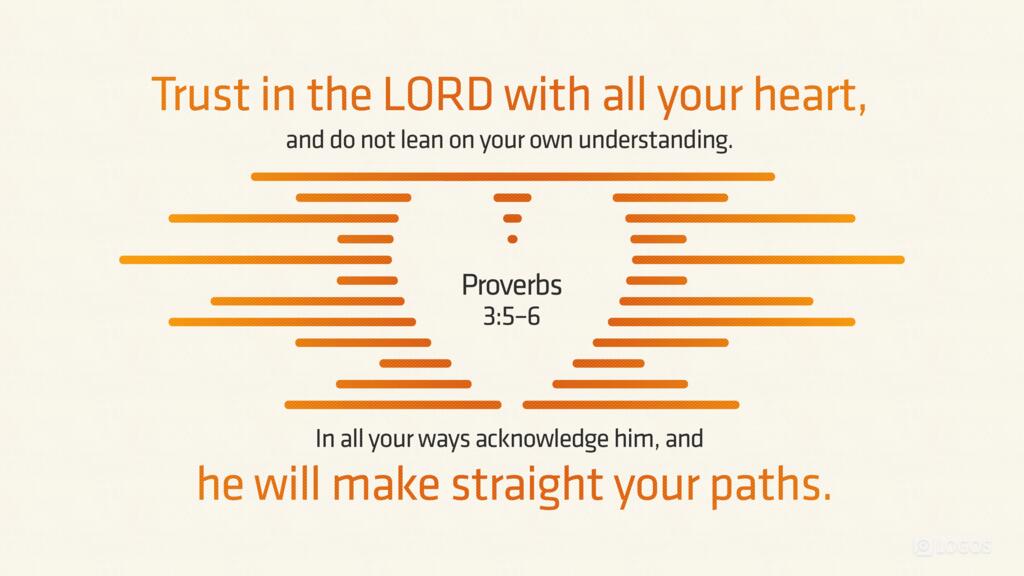
3:5Trust11 in the Lord with all your heart,12
and do not rely13 on your own understanding.14
3:6Acknowledge15 him in all your ways,16
and he will make your paths straight.17
3:7Do not be wise in your own estimation;18
fear the Lord and turn away from evil.19
3:8This will bring20 healing to your body,21
and refreshment22 to your inner self.23
3:9Honor24 the Lord from your wealth
and from the first fruits of all your crops;25
3:10then your barns will be filled completely,26
and your vats27 will overflow28 with new wine.
3:11My child, do not despise discipline from the Lord,29
and do not loathe30 his rebuke.
3:12For the Lord disciplines31 those he loves,
just as a father32 disciplines33 the son in whom he delights.
Footnotes
- 11 The word בְּטַח (bétakh, “trust”) is used in the OT in (1) literal physical sense: to physically lean upon something for support and (2) figurative sense: to rely upon someone or something for help or protection ( 105 I בְּטַח; I בטח). The verb is often used with false securities, people trusting in things that prove to be worthless. But here the object of the secure trust is the Lord who is a reliable object of confidence.
- 12 The “heart” functions as a metonymy of subject encompassing mind, emotions and will ( 524 לֵב 2).
- 13 Heb “do not lean.” The verb שָׁעַן (sha’an, “to lean; to rely”) is used in (1) literal physical sense of leaning upon something for support and (2) figurative sense of relying upon someone or something for help or protection ( 1043 ). Here it functions figuratively (hypocatastasis: implied comparison); relying on one’s own understanding is compared to leaning on something that is unreliable for support (e.g., Isa 10:20).
- 14 Heb “your understanding.” The term בִּינָה (binah, “understanding”) is used elsewhere in this book of insight given by God from the instructions in Proverbs (Prov 2:3; 7:4; 8:14; 9:6, 10; 23:23). Here it refers to inherent human understanding that functions in relative ignorance unless supplemented by divine wisdom (Job 28:12–28; 39:26). The reflexive pronoun “own” is supplied in the translation to clarify this point. It is dangerous for a person to rely upon mere human wisdom (Prov 14:12; 16:25).
- 15 Heb “know him.” The verb יָדַע (yadah, “to know”) includes mental awareness of who God is and the consequential submission to his lordship. To know him is to obey him. The sage is calling for a life of trust and obedience in which the disciple sees the Lord in every event and relies on him. To acknowledge the Lord in every event means trusting and obeying him for guidance in right conduct.
- 16 The term דֶרֶךְ (derekh, “way”) is figurative (hypocatastasis: implied comparison) referring to a person’s course of life, actions and undertakings (Prov 2:8; 3:6, 23; 11:5; 20:24; 29:27; 31:3; 203 5; cf. “in everything you do”; , “in all you do”). This is a call for total commitment in trust for obedience in all things.
- 17 The verb יָשָׁר (yashar) means “to make smooth; to make straight” ( 444 ). This phrase means “to make the way free from obstacles,” that is, to make it successful (e.g., Isa 40:3). The straight, even road is the right road; God will make the way smooth for the believer.
- 18 Heb “in your own eyes” (so , , ); “Don’t be impressed with your own wisdom.”
- 19 The second colon clarifies the first. If one fears the Lord and turns away from evil, then he is depending on the Lord and not wise in his own eyes. There is a higher source of wisdom than human insight.
- 20 Heb “it will be.” The form is Qal jussive of הָיָה (hayah) and is one of the rare uses of the volitive to express purpose or result, even though there is no vav prefixed to it. This indicates that v. 8 is the outcome of v. 7. If a person trusts in the Lord and fears him (vv. 5–7), God will bless him (v. 8).
- 21 Heb “your navel” (cf. , ). reads שָׁרֶּךָ (sharrekha, “your navel”) which functions as a synecdoche of part (= navel) for the whole (= body), meaning “your body” ( 1057 שׂר). The geminate noun שֹׂר (sor, “navel; navel-string [= umbilical cord]”) occurs only two other times in OT (Ezek 16:4; Song 7:3). The reads τῷ σώματί σου (tō sōmati sou, “your body”). So the editors suggest emending to the more commonly used terms בְּשָׂרֶךָ (bésarekha, “your flesh”) or שְׁאֵרֶךָ (shé’erekha, “your body”). But this kind of emendation runs counter to the canons of textual criticism; normally the more difficult reading or rarer term is preferred as original rather than a smooth reading or common term. Since “navel” occurs only twice elsewhere, it is difficult to imagine that it would have been confused for these two more common terms and that a scribe would mistakenly write “your navel” instead. If “your navel” is a synecdoche for “your body,” the is not pointing to a different textual tradition but is merely interpreting accordingly. In similar fashion, the English versions which read “your body” are not rejecting the reading; they are merely interpreting the term as a figure (synecdoche) for “your body.”
- 22 Heb “drink.” The noun שִׁקּוּי (shiqquy, “drink”) is a figure: metonymy of cause (= drink) for the effect (= refreshment); see 1052 Just as a drink of water would bring physical refreshment to one’s body, trusting in God and turning away from evil will bring emotional refreshment to one’s soul.
- 23 Heb “your bones.” The term עַצְמוֹתֶיךָ (’atsmotekha, “your bones”) functions as a synecdoche of part (= bones) for the whole person (= physical and moral aspects); cf. Pss 6:3; 35:10; Prov 3:8; 14:30: 15:30; 16:24; Isa 66:14 and 782 עֶצֶם 1.d. Scripture often uses the body to describe the inner person (A. R. Johnson, The Vitality of the Individual in the Thought of Ancient Israel, 67–8).
- 24 The imperative כַּבֵּד (kabbed, “honor”) functions as a command, instruction, counsel or exhortation. To honor God means to give him the rightful place of authority by rendering to him gifts of tribute. One way to acknowledge God in one’s ways (v. 6) is to honor him with one’s wealth (v. 9).
- 25 Heb “produce.” The noun תְּבוּאָה (tévu’ah) has a two-fold range of meaning: (1) “product; yield” of the earth (= crops; harvest) and (2) “income; revenue” in general ( 100 ). The imagery in vv. 9–10 is agricultural; however, all Israelites—not just farmers—were expected to give the best portion (= first fruits) of their income to Lord.
- 26 Heb “with plenty” (so , , ); “to overflowing.” The noun שָׂבָע (sava’, “plenty; satiety”) functions as an adverbial accusative of manner or contents: “completely.”
- 27 This pictures the process of pressing grapes in which the upper receptacle is filled with grapes and the lower one catches the juice. The harvest of grapes will be so plentiful that the lower vat will overflow with grape juice. The pictures in v. 10 are metonymies of effect for cause (= the great harvest that God will provide when they honor him).
- 28 Heb “burst open.” The verb פָּרַץ (parats, “to burst open”) functions as hyperbole here to emphasize the fullness of the wine vats ( 829 9).
- 29 Heb “the discipline of the Lord.”
- 30 The verb קוּץ (quts) has a two-fold range of meaning: (1) “to feel a loathing; to abhor” and (2) “to feel a sickening dread” ( 880 ). The parallelism with “do not despise” suggests the former nuance here. The common response to suffering is to loathe it; however, the righteous understand that it refines one’s moral character and that it is a means to the blessing.
- 31 Heb “chastens.” The verb יָכַח (yakhakh) here means “to chasten; to punish” ( יכח 1) or “to correct; to rebuke” ( 407 6). The context suggests some kind of corporeal discipline rather than mere verbal rebuke or cognitive correction. This verse is quoted in Heb 12:5–6 to show that suffering in the service of the Lord is a sign of membership in the covenant community (i.e., sonship).
- 32 reads וּכְאָב (ukh’av, “and like a father”) but the reflects the Hiphil verb וְיַכְאִב (véyakh’iv, “and scourges every son he receives”). Both readings fit the parallelism; however, it is unnecessary to emend which makes perfectly good sense. The fact that the writer of Hebrews quotes this passage from the and it became part of the inspired NT text does not mean that the reflects the original Hebrew reading here.
- 33 The verb “disciplines” does not appear in the Hebrew text, but is implied by the parallelism; it is supplied in the translation for the sake of clarity.
The NET Bible First Edition, Copyright 1996-2005 by Biblical Studies Press
In other versions
ESVEnglish Standard Version
Trust in the Lord with all your heart,
and do not lean on your own understanding.
In all your ways acknowledge him,
and he will make straight your paths.
Be not wise in your own eyes;
fear the Lord, and turn away from evil.
It will be healing to your flesh
and refreshment to your bones.
Honor the Lord with your wealth
and with the firstfruits of all your produce;
then your barns will be filled with plenty,
and your vats will be bursting with wine.
My son, do not despise the Lord’s discipline
or be weary of his reproof,
for the Lord reproves him whom he loves,
as a father the son in whom he delights.
Copyright 2001 Crossway Bibles
NIVNew International Version (2011)
Trust in the Lord with all your heart
and lean not on your own understanding;
in all your ways submit to him,
and he will make your paths straight.
Do not be wise in your own eyes;
fear the Lord and shun evil.
This will bring health to your body
and nourishment to your bones.
Honor the Lord with your wealth,
with the firstfruits of all your crops;
then your barns will be filled to overflowing,
and your vats will brim over with new wine.
My son, do not despise the Lord’s discipline,
and do not resent his rebuke,
because the Lord disciplines those he loves,
as a father the son he delights in.
Copyright 1973, 1978, 1984, 2011 Biblica, Inc.
CSBChristian Standard Bible
Trust in the Lord with all your heart,
and do not rely on your own understanding;
in all your ways know him,
and he will make your paths straight.
Don’t be wise in your own eyes;
fear the Lord and turn away from evil.
This will be healing for your body
and strengthening for your bones.
Honor the Lord with your possessions
and with the first produce of your entire harvest;
then your barns will be completely filled,
and your vats will overflow with new wine.
Do not despise the Lord’s instruction, my son,
and do not loathe his discipline;
for the Lord disciplines the one he loves,
just as a father disciplines the son in whom he delights.
Copyright 2017 Holman Bible Publishers
NLTNew Living Translation
Trust in the Lord with all your heart;
do not depend on your own understanding.
Seek his will in all you do,
and he will show you which path to take.
Don’t be impressed with your own wisdom.
Instead, fear the Lord and turn away from evil.
Then you will have healing for your body
and strength for your bones.
Honor the Lord with your wealth
and with the best part of everything you produce.
Then he will fill your barns with grain,
and your vats will overflow with good wine.
My child, don’t reject the Lord’s discipline,
and don’t be upset when he corrects you.
For the Lord corrects those he loves,
just as a father corrects a child in whom he delights.
Holy Bible, New Living Translation, copyright © 1996, 2004, 2015 by Tyndale House Foundation. Used by permission of Tyndale House Publishers. All rights reserved.
LEBThe Lexham English Bible
Trust Yahweh with all your heart;
do not lean toward your own understanding.
In all your ways acknowledge him,
and he will straighten your paths.
Do not be wise in your own eyes;
fear Yahweh and retreat from evil.
There shall be healing for your flesh,
and refreshment for your body.
Honor Yahweh from your substance,
and from the firstfruits of all that will come to you,
and your barns shall be full of plenty,
and your vats shall burst with new wine.
Do not despise the discipline of Yahweh, my child.
Do not be weary of his reproof
because whomever Yahweh will love, he will rebuke,
as a father delights in his son.
Copyright 2012 Lexham Press
KJV 1900King James Version
Trust in the Lord with all thine heart;
And lean not unto thine own understanding.
In all thy ways acknowledge him,
And he shall direct thy paths.
Be not wise in thine own eyes:
Fear the Lord, and depart from evil.
It shall be health to thy navel,
And marrow to thy bones.
Honour the Lord with thy substance,
And with the firstfruits of all thine increase:
So shall thy barns be filled with plenty,
And thy presses shall burst out with new wine.
My son, despise not the chastening of the Lord;
Neither be weary of his correction:
For whom the Lord loveth he correcteth;
Even as a father the son in whom he delighteth.
Public Domain