Proverbs 3:5–7
The NET BibleOther versions
English
- NET The NET Bible
- DARBY 1890 Darby Bible
- ASV American Standard Version
- AV 1873 The Cambridge Paragraph Bible of the Authorized English Version
- CSB Christian Standard Bible
- D-R Douay-Rheims Bible
- ESV English Standard Version
- GW GOD’S WORD Translation
- GNB Good News Translation
- HCSB The Holman Christian Standard Bible
- KJV 1900 King James Version
- LSB Legacy Standard Bible
- LEB The Lexham English Bible
- MSG The Message: The Bible in Contemporary Language
- NASB95 New American Standard Bible (1995)
- NCV New Century Version
- NIrV New International Reader’s Version (1998)
- NIV New International Version (2011)
- NKJV The New King James Version
- NLT New Living Translation
- NRSVue New Revised Standard Version: Updated Edition
- RSV The Revised Standard Version
- RSVCE The Revised Standard Version, Catholic Edition
- TNIV Today’s New International Version
- YLT Young’s Literal Translation
Arabic
Czech
French
German
Hebrew
Hungarian
Italian
Korean
Latin
Portuguese
Russian
Simplified Chinese
Spanish
Traditional Chinese
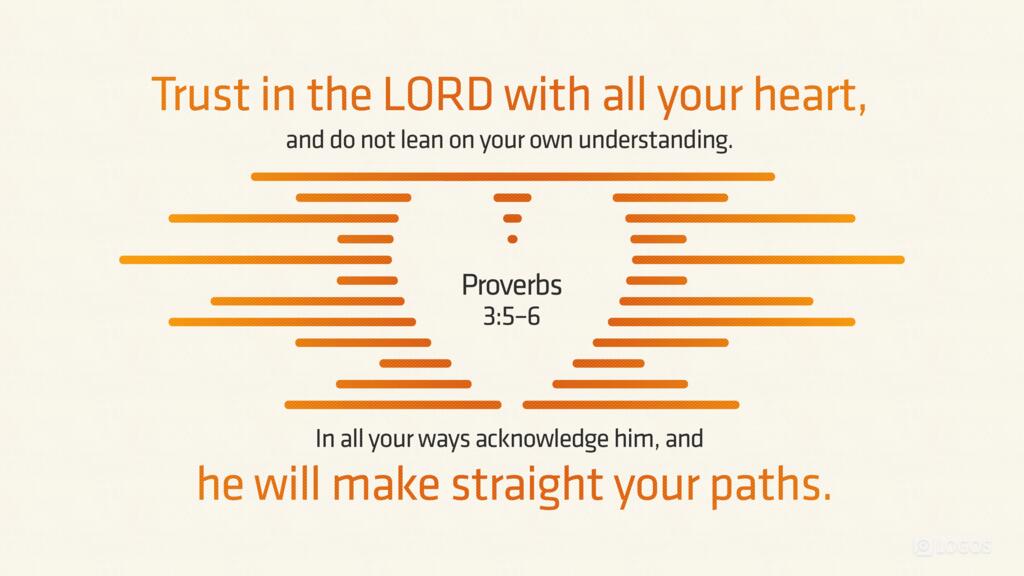
3:5Trust11 in the Lord with all your heart,12
and do not rely13 on your own understanding.14
3:6Acknowledge15 him in all your ways,16
and he will make your paths straight.17
3:7Do not be wise in your own estimation;18
fear the Lord and turn away from evil.19
Footnotes
- 11 The word בְּטַח (bétakh, “trust”) is used in the OT in (1) literal physical sense: to physically lean upon something for support and (2) figurative sense: to rely upon someone or something for help or protection ( 105 I בְּטַח; I בטח). The verb is often used with false securities, people trusting in things that prove to be worthless. But here the object of the secure trust is the Lord who is a reliable object of confidence.
- 12 The “heart” functions as a metonymy of subject encompassing mind, emotions and will ( 524 לֵב 2).
- 13 Heb “do not lean.” The verb שָׁעַן (sha’an, “to lean; to rely”) is used in (1) literal physical sense of leaning upon something for support and (2) figurative sense of relying upon someone or something for help or protection ( 1043 ). Here it functions figuratively (hypocatastasis: implied comparison); relying on one’s own understanding is compared to leaning on something that is unreliable for support (e.g., Isa 10:20).
- 14 Heb “your understanding.” The term בִּינָה (binah, “understanding”) is used elsewhere in this book of insight given by God from the instructions in Proverbs (Prov 2:3; 7:4; 8:14; 9:6, 10; 23:23). Here it refers to inherent human understanding that functions in relative ignorance unless supplemented by divine wisdom (Job 28:12–28; 39:26). The reflexive pronoun “own” is supplied in the translation to clarify this point. It is dangerous for a person to rely upon mere human wisdom (Prov 14:12; 16:25).
- 15 Heb “know him.” The verb יָדַע (yadah, “to know”) includes mental awareness of who God is and the consequential submission to his lordship. To know him is to obey him. The sage is calling for a life of trust and obedience in which the disciple sees the Lord in every event and relies on him. To acknowledge the Lord in every event means trusting and obeying him for guidance in right conduct.
- 16 The term דֶרֶךְ (derekh, “way”) is figurative (hypocatastasis: implied comparison) referring to a person’s course of life, actions and undertakings (Prov 2:8; 3:6, 23; 11:5; 20:24; 29:27; 31:3; 203 5; cf. “in everything you do”; , “in all you do”). This is a call for total commitment in trust for obedience in all things.
- 17 The verb יָשָׁר (yashar) means “to make smooth; to make straight” ( 444 ). This phrase means “to make the way free from obstacles,” that is, to make it successful (e.g., Isa 40:3). The straight, even road is the right road; God will make the way smooth for the believer.
- 18 Heb “in your own eyes” (so , , ); “Don’t be impressed with your own wisdom.”
- 19 The second colon clarifies the first. If one fears the Lord and turns away from evil, then he is depending on the Lord and not wise in his own eyes. There is a higher source of wisdom than human insight.
The NET Bible First Edition, Copyright 1996-2005 by Biblical Studies Press
In other versions
ESVEnglish Standard Version
Trust in the Lord with all your heart,
and do not lean on your own understanding.
In all your ways acknowledge him,
and he will make straight your paths.
Be not wise in your own eyes;
fear the Lord, and turn away from evil.
Copyright 2001 Crossway Bibles
NIVNew International Version (2011)
Trust in the Lord with all your heart
and lean not on your own understanding;
in all your ways submit to him,
and he will make your paths straight.
Do not be wise in your own eyes;
fear the Lord and shun evil.
Copyright 1973, 1978, 1984, 2011 Biblica, Inc.
CSBChristian Standard Bible
Trust in the Lord with all your heart,
and do not rely on your own understanding;
in all your ways know him,
and he will make your paths straight.
Don’t be wise in your own eyes;
fear the Lord and turn away from evil.
Copyright 2017 Holman Bible Publishers
NLTNew Living Translation
Trust in the Lord with all your heart;
do not depend on your own understanding.
Seek his will in all you do,
and he will show you which path to take.
Don’t be impressed with your own wisdom.
Instead, fear the Lord and turn away from evil.
Holy Bible, New Living Translation, copyright © 1996, 2004, 2015 by Tyndale House Foundation. Used by permission of Tyndale House Publishers. All rights reserved.
LEBThe Lexham English Bible
Trust Yahweh with all your heart;
do not lean toward your own understanding.
In all your ways acknowledge him,
and he will straighten your paths.
Do not be wise in your own eyes;
fear Yahweh and retreat from evil.
Copyright 2012 Lexham Press
KJV 1900King James Version
Trust in the Lord with all thine heart;
And lean not unto thine own understanding.
In all thy ways acknowledge him,
And he shall direct thy paths.
Be not wise in thine own eyes:
Fear the Lord, and depart from evil.
Public Domain