Matthew 17:1–13
The NET BibleOther versions
English
- NET The NET Bible
- DARBY 1890 Darby Bible
- ASV American Standard Version
- AV 1873 The Cambridge Paragraph Bible of the Authorized English Version
- CSB Christian Standard Bible
- D-R Douay-Rheims Bible
- ESV English Standard Version
- GW GOD’S WORD Translation
- GNB Good News Translation
- HCSB The Holman Christian Standard Bible
- KJV 1900 King James Version
- LSB Legacy Standard Bible
- LEB The Lexham English Bible
- MSG The Message: The Bible in Contemporary Language
- NASB95 New American Standard Bible (1995)
- NCV New Century Version
- NIrV New International Reader’s Version (1998)
- NIV New International Version (2011)
- NKJV The New King James Version
- NLT New Living Translation
- NRSVue New Revised Standard Version: Updated Edition
- RSV The Revised Standard Version
- RSVCE The Revised Standard Version, Catholic Edition
- TNIV Today’s New International Version
- YLT Young’s Literal Translation
Arabic
Czech
French
German
Greek
Hungarian
Italian
Korean
Latin
Portuguese
Russian
Simplified Chinese
Spanish
Traditional Chinese
The Transfiguration
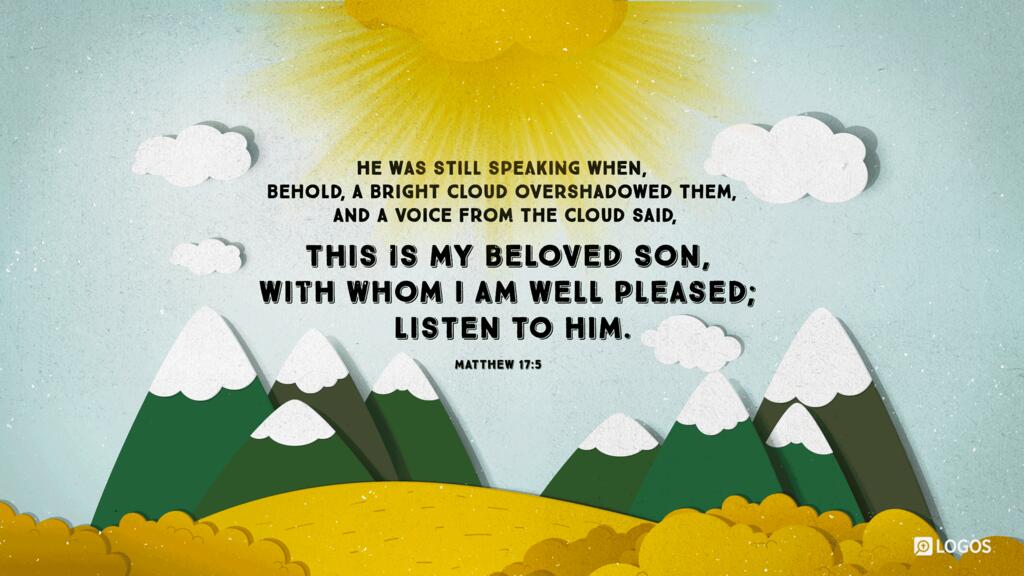
17:1Six days later1 Jesus took with him Peter, James, and John the brother of James,2 and led them privately up a high mountain. 17:2And he was transfigured before them.3 His4 face shone like the sun, and his clothes became white as light. 17:3Then Moses5 and Elijah6 also appeared before them, talking with him. 17:4So7 Peter said8 to Jesus, “Lord, it is good for us to be here. If you want, I will make9 three shelters10—one for you, one for Moses, and one for Elijah.” 17:5While he was still speaking, a11 bright cloud12 overshadowed13 them, and a voice from the cloud said,14 “This is my one dear Son,15 in whom I take great delight. Listen to him!”1617:6When the disciples heard this, they were overwhelmed with fear and threw themselves down with their faces to the ground.1717:7But Jesus came and touched them. “Get up,” he said. “Do not be afraid.” 17:8When18 they looked up, all they saw was Jesus alone.
17:9As they were coming down from the mountain, Jesus commanded them,19 “Do not tell anyone about the vision until the Son of Man is raised from the dead.” 17:10The disciples asked him,20 “Why then do the experts in the law21 say that Elijah must come first?” 17:11He22 answered, “Elijah does indeed come first and will restore all things. 17:12And I tell you that Elijah has already come. Yet they did not recognize him, but did to him whatever they wanted. In23 the same way, the Son of Man will suffer at their hands.” 17:13Then the disciples understood that he was speaking to them about John the Baptist.
Footnotes
- 1 Grk “And after six days.”
- 2 Grk “John his brother” with “his” referring to James.
- 3 In 1st century Judaism and in the NT, there was the belief that the righteous get new, glorified bodies in order to enter heaven (1 Cor 15:42–49; 2 Cor 5:1–10). This transformation means the righteous will share the glory of God. One recalls the way Moses shared the Lord’s glory after his visit to the mountain in Exod 34. So the disciples saw Jesus transfigured, and they were getting a sneak preview of the great glory that Jesus would have (only his glory is more inherent to him as one who shares in the rule of the kingdom).
- 4 Here καί (kai) has not been translated.
- 5 Grk “And behold, Moses.” The Greek word ἰδού (idou) has not been translated because it has no exact English equivalent here, but adds interest and emphasis ( 1).
- 6 Commentators and scholars discuss why Moses and Elijah are present. The most likely explanation is that Moses represents the prophetic office (Acts 3:18–22) and Elijah pictures the presence of the last days (Mal 4:5–6), the prophet of the eschaton (the end times).
- 7 Here δέ (de) has been translated as “so” to indicate that the appearance of Moses and Elijah prompted Peter’s comment.
- 8 Grk “Peter answering said.” This construction is somewhat redundant and has been simplified in the translation.
- 9 Instead of the singular future indicative ποιήσω (poiēsō, “I will make”), most witnesses (C3 D L W Θ [Φ] 0281 f[1],13 33 𝔐 lat sy co) have the plural aorist subjunctive ποιήσωμεν (poiēsōmen, “let us make”). But since ποιήσωμεν is the reading found in the parallel accounts in Mark and Luke, it is almost surely a motivated reading. Further, the earliest and best witnesses, as well as a few others (א B C* 700 ) have ποιήσω. It is thus more likely that the singular verb is authentic.
- 10 Or “booths,” “dwellings” (referring to the temporary booths constructed in the celebration of the feast of Tabernacles). Peter apparently wanted to celebrate the feast of Tabernacles or Booths that looked forward to the end and wanted to treat Moses, Elijah, and Jesus as equals by making three shelters (one for each). It was actually a way of expressing honor to Jesus, but the next verse makes it clear that it was not enough honor.
- 11 Grk “behold, a.” The Greek word ἰδού (idou) has not been translated here or in the following clause because it has no exact English equivalent here, but adds interest and emphasis ( 1).
- 12 This cloud is the cloud of God’s presence and the voice is his as well.
- 13 Or “surrounded.”
- 14 Grk “behold, a voice from the cloud, saying.” This is an incomplete sentence in Greek which portrays intensity and emotion. The participle λέγουσα (legousa) was translated as a finite verb in keeping with English style.
- 15 Grk “my beloved Son,” or “my Son, the beloved [one].” The force of ἀγαπητός (agapētos) is often “pertaining to one who is the only one of his or her class, but at the same time is particularly loved and cherished” (L&N 58.53; cf. also 1).
- 16 The expression listen to him comes from Deut 18:15 and makes two points: 1) Jesus is a prophet like Moses, a leader-prophet, and 2) they have much yet to learn from him.
- 17 Grk “they fell down on their faces.” πίπτω 1.b.α.ב. has “fall down, throw oneself to the ground as a sign of devotion, before high-ranking persons or divine beings.”
- 18 Here δέ (de) has not been translated.
- 19 Grk “Jesus commanded them, saying.” The participle λέγων (legōn) is redundant and has not been translated.
- 20 Grk “asked him, saying.” The participle λέγοντες (legontes) is redundant and has not been translated.
- 21 Or “do the scribes.” See the note on the phrase “experts in the law” in .
- 22 Grk “And answering, he said.” This has been simplified in the translation.
- 23 Here καί (kai) has not been translated.
The NET Bible First Edition, Copyright 1996-2005 by Biblical Studies Press