Matthew 17:1–13
The Lexham English BibleOther versions
English
- LEB The Lexham English Bible
- DARBY 1890 Darby Bible
- ASV American Standard Version
- AV 1873 The Cambridge Paragraph Bible of the Authorized English Version
- CSB Christian Standard Bible
- D-R Douay-Rheims Bible
- ESV English Standard Version
- GW GOD’S WORD Translation
- GNB Good News Translation
- HCSB The Holman Christian Standard Bible
- KJV 1900 King James Version
- LSB Legacy Standard Bible
- MSG The Message: The Bible in Contemporary Language
- NET The NET Bible
- NASB95 New American Standard Bible (1995)
- NCV New Century Version
- NIrV New International Reader’s Version (1998)
- NIV New International Version (2011)
- NKJV The New King James Version
- NLT New Living Translation
- NRSVue New Revised Standard Version: Updated Edition
- RSV The Revised Standard Version
- RSVCE The Revised Standard Version, Catholic Edition
- TNIV Today’s New International Version
- YLT Young’s Literal Translation
Arabic
Czech
French
German
Greek
Hungarian
Italian
Korean
Latin
Portuguese
Russian
Simplified Chinese
Spanish
Traditional Chinese
The Transfiguration
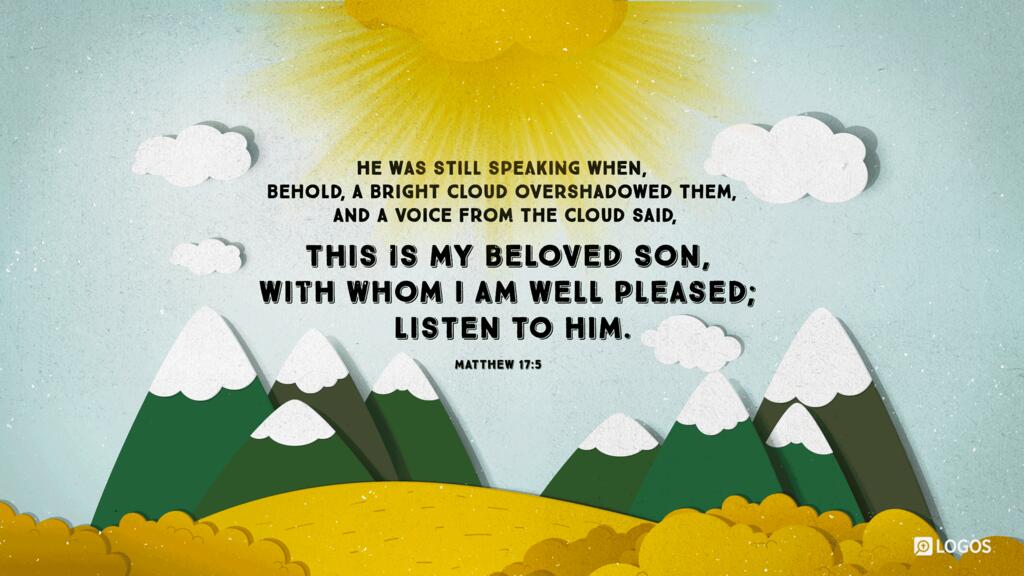
17And after six days Jesus took along Peter and James and John his brother, and led them up on a high mountain by themselves. 2And he was transfigured before them, and his face shone like the sun, and his clothing became bright as the light. 3And behold, Moses and Elijah appeared to them, talking with him. 4So Peter answered and* said to Jesus, “Lord, it is good that we are here! If you want, I will make here three shelters, one for you and one for Moses and one for Elijah.” 5While* he was still speaking, behold, a bright cloud overshadowed them, and behold, a voice from the cloud said, “This is my beloved Son, with whom I am well pleased. Listen to him!” 6And when* the disciples heard this,* they fell down on their faces and were extremely frightened. 7And Jesus came and touched them and* said, “Get up and do not be afraid.” 8And when they* lifted up their eyes they saw no one except him—Jesus alone.
9And as* they were coming down from the mountain, Jesus commanded them saying, “Tell no one the vision until the Son of Man is raised from the dead.” 10And the disciples asked him, saying, “Then why do the scribes say that Elijah must come first?” 11And he answered and* said, “Elijah indeed is coming, and will restore all things. 12But I say to you that Elijah has already come, and they did not recognize him, but did with him whatever they wanted. In the same way also the Son of Man is going to suffer at their hands.” 13Then the disciples understood that he had spoken to them about John the Baptist.
Footnotes
- *Here “and” is supplied because the previous participle (“answered”) has been translated as a finite verb
- *Here “while” is supplied as a component of the temporal genitive absolute participle (“speaking”)
- *Here “when” is supplied as a component of the participle (“heard”) which is understood as temporal
- *Here the direct object is supplied from context in the English translation
- *Here “and” is supplied because the previous participle (“touched”) has been translated as a finite verb
- *Here “when” is supplied as a component of the participle (“lifted up”) which is understood as temporal
- *Here “as” is supplied as a component of the temporal genitive absolute participle (“were coming down”)
- *Here “and” is supplied because the previous participle (“answered”) has been translated as a finite verb
Copyright 2012 Lexham Press