Luke 10:1–24
The NET BibleOther versions
English
- NET The NET Bible
- DARBY 1890 Darby Bible
- ASV American Standard Version
- AV 1873 The Cambridge Paragraph Bible of the Authorized English Version
- CSB Christian Standard Bible
- D-R Douay-Rheims Bible
- ESV English Standard Version
- GW GOD’S WORD Translation
- GNB Good News Translation
- HCSB The Holman Christian Standard Bible
- KJV 1900 King James Version
- LSB Legacy Standard Bible
- LEB The Lexham English Bible
- MSG The Message: The Bible in Contemporary Language
- NASB95 New American Standard Bible (1995)
- NCV New Century Version
- NIrV New International Reader’s Version (1998)
- NIV New International Version (2011)
- NKJV The New King James Version
- NLT New Living Translation
- NRSVue New Revised Standard Version: Updated Edition
- RSV The Revised Standard Version
- RSVCE The Revised Standard Version, Catholic Edition
- TNIV Today’s New International Version
- YLT Young’s Literal Translation
Arabic
Czech
French
German
Greek
Hungarian
Italian
Korean
Latin
Portuguese
Russian
Simplified Chinese
Spanish
Traditional Chinese
The Mission of the Seventy-Two
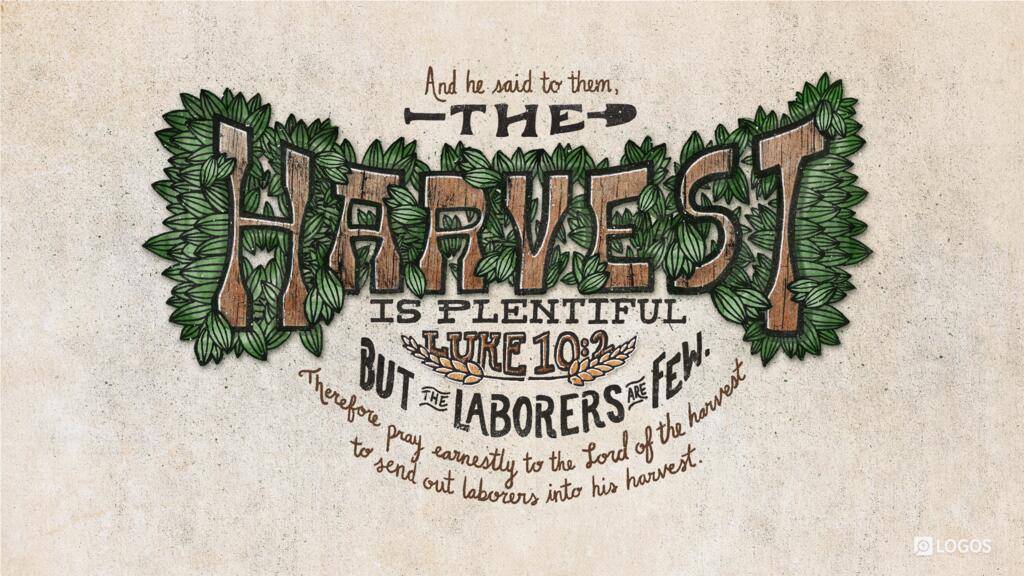
10:1After this1 the Lord appointed seventy-two2 others and sent them on ahead of him two by two into every town3 and place where he himself was about to go. 10:2He4 said to them, “The harvest is plentiful, but the workers are few. Therefore ask the Lord of the harvest5 to send out6 workers into his harvest. 10:3Go! I7 am sending you out like lambs8 surrounded by wolves.910:4Do not carry10 a money bag,11 a traveler’s bag,12 or sandals, and greet no one on the road.1310:5Whenever14 you enter a house,15 first say, ‘May peace16 be on this house!’ 10:6And if a peace-loving person17 is there, your peace will remain on him, but if not, it will return to you.1810:7Stay19 in that same house, eating and drinking what they give you,20 for the worker deserves his pay.21 Do not move around from house to house. 10:8Whenever22 you enter a town23 and the people24 welcome you, eat what is set before you. 10:9Heal25 the sick in that town26 and say to them, ‘The kingdom of God27 has come upon28 you!’ 10:10But whenever29 you enter a town30 and the people31 do not welcome32 you, go into its streets33 and say, 10:11‘Even the dust of your town34 that clings to our feet we wipe off35 against you.36 Nevertheless know this: The kingdom of God has come.’3710:12I tell you, it will be more bearable on that day for Sodom38 than for that town!39
10:13“Woe to you, Chorazin!40 Woe to you, Bethsaida! For if41 the miracles42 done in you had been done in Tyre43 and Sidon,44 they would have repented long ago, sitting in sackcloth and ashes. 10:14But it will be more bearable for Tyre and Sidon in the judgment than for you! 10:15And you, Capernaum,45 will you be exalted to heaven?46 No, you will be thrown down to Hades!47
10:16“The one who listens48 to you listens to me,49 and the one who rejects you rejects me, and the one who rejects me rejects50 the one who sent me.”51
10:17Then52 the seventy-two53 returned with joy, saying, “Lord, even the demons submit to54 us in your name!”5510:18So56 he said to them, “I saw57 Satan fall58 like lightning59 from heaven. 10:19Look, I have given you authority to tread60 on snakes and scorpions61 and on the full force of the enemy,62 and nothing will63 hurt you. 10:20Nevertheless, do not rejoice that64 the spirits submit to you, but rejoice65 that your names stand written66 in heaven.”
10:21On that same occasion67 Jesus68 rejoiced69 in the Holy Spirit and said, “I praise70 you, Father, Lord71 of heaven and earth, because72 you have hidden these things from the wise73 and intelligent, and revealed them to little children. Yes, Father, for this was your gracious will.7410:22All things have been given to me by my Father.75 No one knows who the Son is except the Father, or who the Father is except the Son and anyone to whom the Son decides76 to reveal him.”
10:23Then77 Jesus78 turned79 to his80 disciples and said privately, “Blessed81 are the eyes that see what you see! 10:24For I tell you that many prophets and kings longed to see82 what you see but did not see it, and to hear what you hear but did not hear it.”
Footnotes
- 1 Grk “And after these things.” Here δέ (de) has not been translated.
- 2 There is a difficult textual problem here and in v. 17, where the number is either “seventy” (א A C L W Θ Ξ Ψ f1, 13 𝔐 and several church fathers and early versions) or “seventy-two” (𝔓75 B D 0181 lat as well as other versions and fathers). The more difficult reading is “seventy-two,” since scribes would be prone to assimilate this passage to several OT passages that refer to groups of seventy people (Num 11:13–17; Deut 10:22; Judg 8:30; 2 Kgs 10:1 et al.); this reading also has slightly better support. “Seventy” could be the preferred reading if scribes drew from the tradition of the number of translators of the , which the puts at seventy-two ( ), although this is far less likely. All things considered, “seventy-two” is a much more difficult reading and accounts for the rise of the other. Only Luke notes a second larger mission like the one in 9:1–6.
- 3 Or “city.”
- 4 Here δέ (de) has not been translated.
- 5 The phrase Lord of the harvest recognizes God’s sovereignty over the harvest process.
- 6 Grk “to thrust out.”
- 7 Grk “Behold I.” The Greek word ἰδού (idou) has not been translated because it has no exact English equivalent here, but adds interest and emphasis ( 1).
- 8 On the imagery of lambs see Isa 40:11, Ezek 34:11–31, and John 10:1–18.
- 9 This imagery of wolves is found in intertestamental Judaism as well; see Pss. Sol. 8:23.
- 10 On the command Do not carry see Luke 9:3. The travel instructions communicate a note of urgency and stand in contrast to philosophical teachers, who often took a bag. There is no ostentation in this ministry.
- 11 Traditionally, “a purse.”
- 12 Or possibly “a beggar’s bag” (L&N 6.145; πήρα).
- 13 Or “no one along the way.”
- 14 Here δέ (de) has not been translated.
- 15 Grk “Into whatever house you enter.” This acts as a distributive, meaning every house they enter; this is expressed more naturally in English as “whenever you enter a house.”
- 16 The statement ‘May peace be on this house!’ is really a benediction, asking for God’s blessing. The requested shalom (peace) is understood as coming from God.
- 17 Grk “a son of peace,” a Hebrew idiom for a person of a certain class or kind, as specified by the following genitive construction (in this case, “of peace”). Such constructions are discussed further in L&N 9.4. Here the expression refers to someone who responds positively to the disciples’ message, like “wisdom’s child” in Luke 7:30.
- 18 The response to these messengers determines how God’s blessing is bestowed—if they are not welcomed with peace, their blessing will return to them. Jesus shows just how important their mission is by this remark.
- 19 Here δέ (de) has not been translated.
- 20 Grk “eating and drinking the things from them” (an idiom for what the people in the house provide the guests).
- 21 On the phrase the worker deserves his pay see 1 Tim 5:18 and 1 Cor 9:14.
- 22 Grk “And whatever town you enter,” but this is more often expressed in English as “whenever you enter a town.” Here καί (kai) has not been translated because of differences between Greek and English style.
- 23 Or “city.” Jesus now speaks of the town as a whole, as he will in vv. 10–12.
- 24 Grk “and they”; the referent (the people who live in the town) has been specified in the translation for clarity.
- 25 Here καί (kai) has not been translated because of differences between Greek and English style. Because of the length and complexity of the Greek sentence, a new sentence was started here in the translation. Ministry (heal the sick) is to take place where it is well received (note welcome in the preceding verse).
- 26 Grk “in it”; the referent (that town) has been specified in the translation for clarity.
- 27 The kingdom of God is a major theme of Jesus. It is a realm in which Jesus rules and to which those who trust him belong. See Luke 6:20; 11:20; 17:20–21.
- 28 Or “come near to you,” suggesting the approach (but not arrival) of the kingdom. But the combination of the perfect tense of ἐγγίζω (engizō) with the preposition ἐπί (epi) most likely suggests that the sense is “has come upon” (see ἐγγίζω 2; W. R. Hutton, “The Kingdom of God Has Come,” 64 [Dec 1952]: 89–91; and D. L. Bock, Luke [], 2:; cf. also “is at hand for you”). These passages argue that a key element of the kingdom is its ability to overcome the power of Satan and those elements in the creation that oppose humanity. Confirmation of this understanding comes in v. 18 and in Luke 11:14–23, especially the parable of vv. 21–23.
- 29 Grk “whatever town you enter,” but this is more often expressed in English as “whenever you enter a town.”
- 30 Or “city.”
- 31 Grk “and they”; the referent (the people who live in the town) has been specified in the translation for clarity.
- 32 More discussion takes place concerning rejection (the people do not welcome you), as these verses lead into the condemnation of certain towns for their rejection of God’s kingdom.
- 33 The term πλατεῖα (plateia) refers to the “broad street,” so this refers to the main roads of the town.
- 34 Or “city.”
- 35 See Luke 9:5, where the verb is different but the meaning is the same. This was a sign of rejection.
- 36 Here ὑμῖν (humin) has been translated as a dative of disadvantage.
- 37 Or “has come near.” As in v. (see above), the combination of ἐγγίζω (engizō) with the preposition ἐπί (epi) is decisive in showing that the sense is “has come” (see ἐγγίζω 2, and W. R. Hutton, “The Kingdom of God Has Come,” 64 [Dec 1952]: 89–91).
- 38 The allusion to Sodom, the most wicked of OT cities from Gen 19:1–29, shows that to reject the current message is even more serious than the worst sins of the old era and will result in more severe punishment. The noun Sodom is in emphatic position in the Greek text.
- 39 Or “city.”
- 40 Chorazin was a town of Galilee that was probably fairly small in contrast to Bethsaida and is otherwise unattested. Bethsaida was declared a polis by the tetrarch Herod Philip, sometime after a.d. 30.
- 41 This introduces a second class (contrary to fact) condition in the Greek text.
- 42 Or “powerful deeds.”
- 43 For location see ; ; ; ; .
- 44 Tyre and Sidon are two other notorious OT cities (Isa 23; Jer 25:22; 47:4). The remark is a severe rebuke, in effect: “Even the sinners of the old era would have responded to the proclamation of the kingdom, unlike you!” For location see ; ; .
- 45 Capernaum was a town on the northwest shore of the Sea of Galilee, 680 ft (204 m) below sea level. It was a major trade and economic center in the North Galilean region. For location see ; ; .
- 46 The interrogative particle introducing this question expects a negative reply.
- 47 In the OT, Hades was known as Sheol. It is the place where the unrighteous will reside (Matt 11:23; Luke 16:23; Rev 20:13–14).
- 48 Grk “hears you”; but as the context of vv. 8–9 makes clear, it is response that is the point. In contemporary English, “listen to” is one way to express this function (L&N 31.56).
- 49 Jesus linked himself to the disciples’ message: Responding to the disciples (listens to you) counts as responding to him.
- 50 The double mention of rejection in this clause—ἀθετῶν ἀθετεῖ (athetōn athetei) in the Greek text—keeps up the emphasis of the section.
- 51 The one who sent me refers to God.
- 52 Here δέ (de) has been translated as “then” to indicate the implied sequence of events within the narrative.
- 53 See the note on the number “seventy-two” in .
- 54 Or “the demons obey”; see L&N 36.18.
- 55 The prepositional phrase “in your name” indicates the sphere of authority for the messengers’ work of exorcism.
- 56 Here δέ (de) has been translated as “so” to indicate that Jesus’ reply in vv. 18–20 follows from the positive report of the messengers in v. 17.
- 57 This is an imperfect tense verb.
- 58 In Greek, this is a participle and comes at the end of the verse, making it somewhat emphatic.
- 59 This is probably best taken as allusion to Isa 14:12; the phrase in common is ἐκ τοῦ οὐρανοῦ (ek tou ouranou). These exorcisms in Jesus’ name are a picture of Satan’s greater defeat at Jesus’ hands (D. L. Bock, Luke [], 2:).
- 60 Or perhaps, “trample on” (which emphasizes the impact of the feet on the snakes). See L&N 15.226.
- 61 Snakes and scorpions are examples of the hostility in the creation that is defeated by Jesus. The use of battle imagery shows who the kingdom fights against. See Acts 28:3–6.
- 62 Or “I have given you authority to tread on snakes and scorpions, and [authority] over the full force of the enemy.” The second prepositional phrase can be taken either as modifying the infinitive πατεῖν (patein, “to tread”) or the noun ἐξουσίαν (exousian, “power”). The former is to be preferred and has been represented in the translation. The enemy is a reference to Satan (mentioned in v. 18).
- 63 This is an emphatic double negative in the Greek text.
- 64 Grk “do not rejoice in this, that.” This is awkward in contemporary English and has been simplified to “do not rejoice that.”
- 65 The verb here is a present imperative, so the call is to an attitude of rejoicing.
- 66 The verb here, a perfect tense, stresses a present reality of that which was a completed action, that is, their names were etched in the heavenly stone, as it were.
- 67 Grk “In that same hour” (L&N 67.1).
- 68 Grk “he”; the referent (Jesus) has been specified in the translation for clarity.
- 69 Jesus rejoiced. The account of the mission in 10:1–24 ends with several remarks about joy.
- 70 Or “thank.”
- 71 The title Lord is an important name for God, showing his sovereignty, but it is interesting that it comes next to a reference to the Father, a term indicative of God’s care. The two concepts are often related in the NT; see Eph 1:3–6.
- 72 Or “that.”
- 74 Grk “for (to do) thus was well pleasing before you,” ἔμπροσθεν 1.δ; speaking of something taking place “before” God is a reverential way of avoiding direct connection of the action to him.
- 75 This verse has been noted for its conceptual similarity to teaching in John’s Gospel (10:15; 17:2). The authority of the Son and the Father are totally intertwined.
- 76 Or “wishes”; or “intends”; or “plans” (cf. βούλομαι 2.b). Here it is the Son who has sovereignty.
- 77 Here καί (kai) has been translated as “then” to indicate the implied sequence of events within the narrative.
- 78 Grk “he”; the referent (Jesus) has been specified in the translation for clarity.
- 79 Grk “turning to the disciples, he said.” The participle στραφείς (strapheis) has been translated as a finite verb due to requirements of contemporary English style.
- 80 Grk “the”; in context the article is used as a possessive pronoun ( ).
- 81 This beatitude highlights the great honor bestowed on the disciples to share in this salvation, as v. 20 also noted. See also Luke 2:30.
- 82 This is what past prophets and kings had wanted very much to see, yet the fulfillment had come to the disciples. This remark is like 1 Pet 1:10–12 or Heb 1:1–2.
Cross references
- 73 See 1 Cor 1:26–31.
The NET Bible First Edition, Copyright 1996-2005 by Biblical Studies Press