Isaiah 49:7–20
The NET BibleOther versions
English
- NET The NET Bible
- DARBY 1890 Darby Bible
- ASV American Standard Version
- AV 1873 The Cambridge Paragraph Bible of the Authorized English Version
- CSB Christian Standard Bible
- D-R Douay-Rheims Bible
- ESV English Standard Version
- GW GOD’S WORD Translation
- GNB Good News Translation
- HCSB The Holman Christian Standard Bible
- KJV 1900 King James Version
- LSB Legacy Standard Bible
- LEB The Lexham English Bible
- MSG The Message: The Bible in Contemporary Language
- NASB95 New American Standard Bible (1995)
- NCV New Century Version
- NIrV New International Reader’s Version (1998)
- NIV New International Version (2011)
- NKJV The New King James Version
- NLT New Living Translation
- NRSVue New Revised Standard Version: Updated Edition
- RSV The Revised Standard Version
- RSVCE The Revised Standard Version, Catholic Edition
- YLT Young’s Literal Translation
Arabic
Czech
French
German
Hebrew
Hungarian
Italian
Korean
Latin
Portuguese
Russian
Simplified Chinese
Spanish
Traditional Chinese
49:7This is what the Lord,
the protector18 of Israel, their Holy One,19 says
to the one who is despised20 and rejected21 by nations,22
a servant of rulers:
“Kings will see and rise in respect,23
princes will bow down,
because of the faithful Lord,
the Holy One of Israel who has chosen you.”
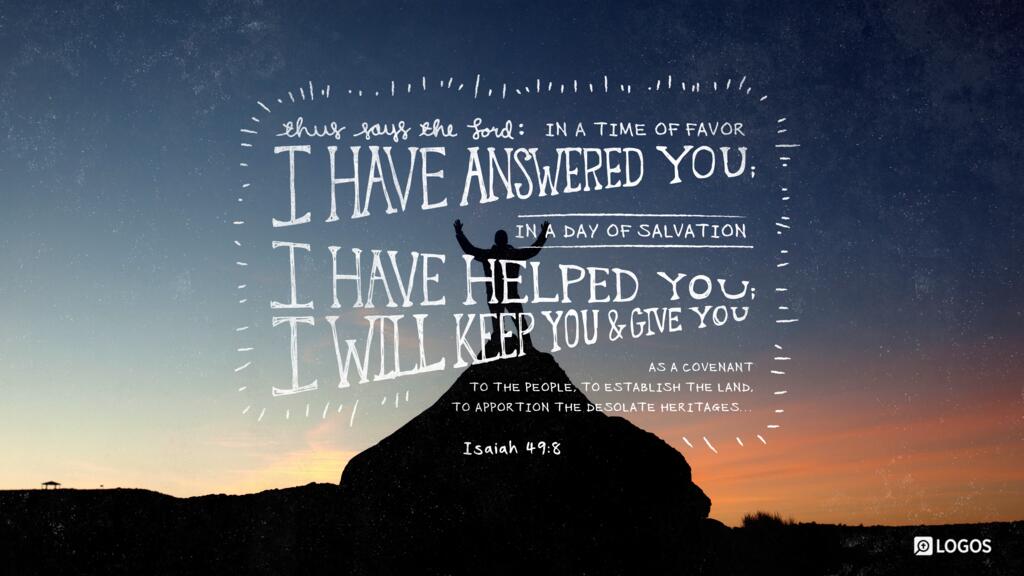
49:8This is what the Lord says:
“At the time I decide to show my favor, I will respond to you;
in the day of deliverance I will help you;
I will protect you24 and make you a covenant mediator for people,25
and to reassign the desolate property.
49:9You will say28 to the prisoners, ‘Come out,’
and to those who are in dark dungeons,29 ‘Emerge.’30
They will graze beside the roads;
on all the slopes they will find pasture.
49:10They will not be hungry or thirsty;
the sun’s oppressive heat will not beat down on them,31
for one who has compassion on them will guide them;
he will lead them to springs of water.
49:11I will make all my mountains into a road;
I will construct my roadways.”
49:12Look, they come from far away!
Look, some come from the north and west,
and others from the land of Sinim!32
49:13Shout for joy, O sky!33
Rejoice, O earth!
Let the mountains give a joyful shout!
For the Lord consoles his people
and shows compassion to the34 oppressed.
The Lord Remembers Zion
49:14“Zion said, ‘The Lord has abandoned me,
the sovereign master35 has forgotten me.’
49:15Can a woman forget her baby who nurses at her breast?36
Can she withhold compassion from the child she has borne?37
Even if mothers38 were to forget,
I could never forget you!39
49:16Look, I have inscribed your name40 on my palms;
your walls are constantly before me.
49:17Your children hurry back,
while those who destroyed and devastated you depart.
49:18Look all around you!41
All of them gather to you.
As surely as I live,” says the Lord,
“you will certainly wear all of them like jewelry;
you will put them on as if you were a bride.
49:19Yes, your land lies in ruins;
it is desolate and devastated.42
But now you will be too small to hold your residents,
and those who devoured you will be far away.
49:20Yet the children born during your time of bereavement
will say within your hearing,
‘This place is too cramped for us,43
make room for us so we can live here.’44
Footnotes
- 18 Heb “redeemer.” See the note at .
- 19 See the note on the phrase “the Holy One of Israel” in .
- 20 The Hebrew text reads literally “to [one who] despises life.” It is preferable to read with the Qumran scroll 1QIsaa לבזוי, which should be vocalized as a passive participle, לִבְזוּי (livzuy, “to the one despised with respect to life” [נֶפֶשׁ is a genitive of specification]). The consonantal sequence וי was probably misread as ה in the tradition. The contextual argument favors the 1QIsaa reading. As J. N. Oswalt (Isaiah [], 2:) points out, the three terse phrases “convey a picture of lowliness, worthlessness, and helplessness.”
- 21 ’s Piel participle (“to the one who rejects”) does not fit contextually. The form should be revocalized as a Pual, “to the one rejected.”
- 22 Parallelism (see “rulers,” “kings,” “princes”) suggests that the singular גּוֹי (goy) be emended to a plural or understood in a collective sense (see 55:5).
- 23 For this sense of קוּם (qum), see Gen 19:1; 23:7; 33:10; Lev 19:32; 1 Sam 20:41; 25:41; 1 Kgs 2:19; Job 29:8.
- 24 The translation assumes the verb is derived from the root נָצָר (natsar, “protect”). Some prefer to derive it from the root יָצָר (yatsar, “form”).
- 25 Heb “a covenant of people.” A person cannot literally be a covenant; בְּרִית (bérit) is probably metonymic here, indicating a covenant mediator. Here עָם (’am, “people”) appears to refer to Israel. See the note at .
- 26 The Hiphil of קוּם (qum, “arise”) is probably used here in the sense of “rebuild.”
- 27 The “land” probably stands by metonymy for the ruins within it.
- 28 Heb “to say.” In the Hebrew text the infinitive construct is subordinated to what precedes.
- 29 Heb “in darkness” (so , , , , ); “the prisoners of darkness.”
- 30 Heb “show yourselves” (so , , ).
- 31 Heb “and the heat and the sun will not strike them.” In Isa 35:7, its only other occurrence in the OT, שָׁרָב (sharav) stands parallel to “parched ground” and in contrast to “pool.” In later Hebrew and Aramaic it refers to “dry heat, heat of the sun” ( 1627 ). Here it likely has this nuance and forms a hendiadys with “sun.”
- 32 The reads “Sinim” here; the Dead Sea Scrolls read “Syene,” a location in Egypt associated with modern Aswan. A number of recent translations adopt this reading: “Syene” (, ); “Aswan” (); “Egypt” (). The precise location of the land of Sinim is uncertain, but since the north and west are mentioned in the previous line, it was a probably located in the distant east or south.
- 33 Or “O heavens.” The Hebrew term שָׁמַיִם (shamayim) may be translated “heavens” or “sky” depending on the context.
- 34 Heb “his” (so , , , , ).
- 35 The Hebrew term translated “sovereign master” here is אֲדֹנָי (’adonay).
- 36 Heb “her suckling”; “her nursing child.”
- 37 Heb “so as not to have compassion on the son of her womb?”
- 38 Heb “these” (so , ).
- 39 The argument of v. 15 seems to develop as follows: The Lord has an innate attachment to Zion, just like a mother does for her infant child. But even if mothers were to suddenly abandon their children, the Lord would never forsake Zion. In other words, the Lord’s attachment to Zion is like a mother’s attachment to her infant child, but even stronger.
- 40 Heb “you.” Here the pronoun is put by metonymy for the person’s name.
- 41 Heb “Lift up around your eyes and see.”
- 42 Heb “Indeed your ruins and your desolate places, and the land of your destruction.” This statement is abruptly terminated in the Hebrew text and left incomplete.
- 43 Heb “me.” The singular is collective.
- 44 Heb “draw near to me so I can dwell.”
The NET Bible First Edition, Copyright 1996-2005 by Biblical Studies Press