Ecclesiastes 11:9–12:1
The NET BibleOther versions
English
- NET The NET Bible
- DARBY 1890 Darby Bible
- ASV American Standard Version
- AV 1873 The Cambridge Paragraph Bible of the Authorized English Version
- CSB Christian Standard Bible
- D-R Douay-Rheims Bible
- ESV English Standard Version
- GW GOD’S WORD Translation
- GNB Good News Translation
- HCSB The Holman Christian Standard Bible
- KJV 1900 King James Version
- LSB Legacy Standard Bible
- LEB The Lexham English Bible
- MSG The Message: The Bible in Contemporary Language
- NASB95 New American Standard Bible (1995)
- NCV New Century Version
- NIrV New International Reader’s Version (1998)
- NIV New International Version (2011)
- NKJV The New King James Version
- NLT New Living Translation
- NRSVue New Revised Standard Version: Updated Edition
- RSV The Revised Standard Version
- RSVCE The Revised Standard Version, Catholic Edition
- TNIV Today’s New International Version
- YLT Young’s Literal Translation
Arabic
Czech
French
German
Hebrew
Hungarian
Italian
Korean
Latin
Portuguese
Russian
Simplified Chinese
Spanish
Traditional Chinese
Enjoy Life to the Fullest under the Fear of God
11:9Rejoice, young man, while you are young,25
and let your heart cheer you in the days of your youth.
Follow the impulses26 of your heart and the desires27 of your eyes,
but know that God will judge your motives and actions.28
11:10Banish29 emotional stress30 from your mind.31
and put away pain32 from your body;33
for youth34 and the prime of life35 are fleeting.36
Fear God Now Because Old Age and Death Come Quickly
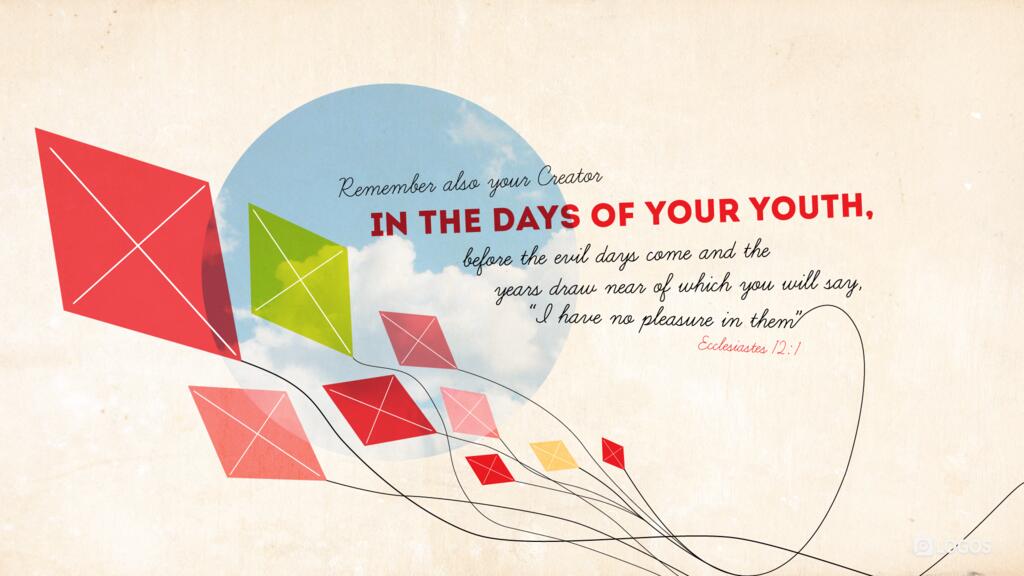
12:1So remember1 your Creator in the days of your youth—
before2 the difficult3 days come,
and the years draw near when you will say, “I have no pleasure in them”;
Footnotes
- 25 Heb “in your youth”; or “in your childhood.”
- 26 Heb “walk in the ways of your heart.”
- 27 Heb “the sight.”
- 28 Heb “and know that concerning all these God will bring you into judgment.” The point is not that following one’s impulses and desires is inherently bad and will bring condemnation from God. Rather the point seems to be: As you follow your impulses and desires, realize that all you think and do will eventually be evaluated by God. So one must seek joy within the boundaries of God’s moral standards.
- 29 The verb סוּר (sur, “to remove”) normally depicts a concrete action of removing a physical object from someone’s presence ( סור 1). Here, it is used figuratively (hypocatastasis) of the emotional/psychological action of banishing unnecessary emotional stress from one’s mind. The Hiphil usage means “to remove; to abolish; to keep away; to turn away; to push aside” ( 1). The English versions render this term in a variety of ways, none of which is very poetic: “remove” (, , , ); “turn aside” (); “ward off” (); and “banish” (, , , , , ).
- 30 The root “vexation” (כַּעַס, ka’as) has a broad range of meanings: “anger” (Deut 4:25; 9:18), “irritation” (Deut 32:21), “offend” (2 Kgs 23:26; Neh 3:37), “vexation” or “frustration” (Ezek 20:28), “grief” (1 Sam 1:6), and “worry” (Ps 112:10; Eccl 7:9); cf. כַּעַס. Here, it refers in general to unnecessary emotional stress and anxiety that can deprive a person of the legitimate enjoyment of life and its temporal benefits.
- 31 Heb “your heart.”
- 32 In light of the parallelism, רָעָה (ra’ah) does not refer to ethical evil, but to physical injury, pain, deprivation or suffering (e.g., Deut 31:17, 21; 32:23; 1 Sam 10:19; Neh 1:3; 2:17; Pss 34:20; 40:13; 88:4; 107:26; Eccl 12:1; Jer 2:27; Lam 3:38); see רָעָה 4.b; 949 רָעָה 2. This sense is best captured as “pain” (, , , , ) or “the troubles [of your body]” (, ), rather than “evil” (, , , ) or “sorrow” ().
- 33 Heb “your flesh.”
- 34 Or “childhood.”
- 35 Or “youth”; Heb “black hair” or “the dawn [of life].” The feminine noun הַשַּׁחֲרוּת (hashakharut) is a , occurring only here. There is debate whether it is from שָׁחֹר (shakhor) which means “black” (i.e. black hair, e.g., Lev 13:31, 37; Song 5:11; שׁחר; 1007 שָׁחֹר and שָׁחַר) or שַׁחַר (shakhar) which means “dawn” (e.g., Gen 19:15; Job 3:9; Song 6:10; שָׁחַר). If this term is from שָׁחֹר it is used in contrast to gray hair that characterizes old age (e.g., Prov 16:31; 20:29). This would be a figure (metonymy of association) for youthfulness. On the other hand, if the term is from שַׁחַר it connotes the “dawn of life” or “prime of life.” This would be a figure (hypocatastasis) for youthfulness. In either case, the term is a figure for “youth” or “prime of life,” as the parallel term הַיַּלְדוּת (hayyaldut, “youth” or “childhood”) indicates. The term is rendered variously in the English versions: “black hair” (); “the dawn of youth” (); “the dawn of life” (, , , ); “the prime of life” (, ); “vigor” (); “youth” (); and “manhood” (). The plural forms of הַשַּׁחֲרוּת and הַיַּלְדוּת are examples of the plural of state or condition that a person experiences for a temporary period of time, e.g., זְקֻנִים (zéqunim, “old age”); נְעוּרִים (né’urim, “youth”); and עֲלוּמִים (’alumim, “youthfulness”); see §7.4.2b.
- 36 The term הֶבֶל (hevel, “vanity”) often connotes the temporal idea “fleeting” (e.g., Prov 31:30; Eccl 3:19; 6:12; 7:15; 9:9). This nuance is suggested here by the collocation of “youth” (הַיַּלְדוּת, hayyaldut) and “the prime of life” (הַשַּׁחֲרוּת, hashakharut).
- 1 The imperative זְכֹר (zekhor, “Remember!”) is a figurative expression (metonymy of association) for obeying God and acknowledging his lordship over one’s life (e.g., Num 15:40; Deut 8:18; Pss 42:6–7; 63:6–8; 78:42; 103:18; 106:7; 119:52, 55; Jer 51:50; Ezek 20:43; Jonah 2:7; Mal 4:4). The exhortation to fear God and obey his commands in 12:13–14 spells out what it means to “remember” God.
- 2 The temporal adjective עַד (’ad, “before”) appears three times in 12:1–7 (vv. 1b, 2a, 6a). Likewise, the temporal preposition בְּ (bet, “when”) is repeated (vv. 3a, 4b). These seven verses comprise one long sentence in Hebrew: The main clause is 12:1a (“Remember your Creator in the days of your youth”), while 12:1b–7 consists of five subordinate temporal clauses (“before … before … when … when … before …”).
- 3 The adjective רָעָה (ra’ah, “evil”) does not refer here to ethical evil, but to physical difficulty, injury, pain, deprivation and suffering (e.g., Deut 31:17, 21; 32:23; 1 Sam 10:19; Neh 1:3; 2:17; Pss 34:20; 40:13; 88:4; 107:26; Eccl 11:10; Jer 2:27; Lam 3:38); see רָעָה 4.b; 949 רָעָה 2.
The NET Bible First Edition, Copyright 1996-2005 by Biblical Studies Press