Ecclesiastes 12:1–7
The NET BibleOther versions
English
- NET The NET Bible
- DARBY 1890 Darby Bible
- ASV American Standard Version
- AV 1873 The Cambridge Paragraph Bible of the Authorized English Version
- CSB Christian Standard Bible
- D-R Douay-Rheims Bible
- ESV English Standard Version
- GW GOD’S WORD Translation
- GNB Good News Translation
- HCSB The Holman Christian Standard Bible
- KJV 1900 King James Version
- LSB Legacy Standard Bible
- LEB The Lexham English Bible
- MSG The Message: The Bible in Contemporary Language
- NASB95 New American Standard Bible (1995)
- NCV New Century Version
- NIrV New International Reader’s Version (1998)
- NIV New International Version (2011)
- NKJV The New King James Version
- NLT New Living Translation
- NRSVue New Revised Standard Version: Updated Edition
- RSV The Revised Standard Version
- RSVCE The Revised Standard Version, Catholic Edition
- TNIV Today’s New International Version
- YLT Young’s Literal Translation
Arabic
Czech
French
German
Hebrew
Hungarian
Italian
Korean
Latin
Portuguese
Russian
Simplified Chinese
Spanish
Traditional Chinese
Fear God Now Because Old Age and Death Come Quickly
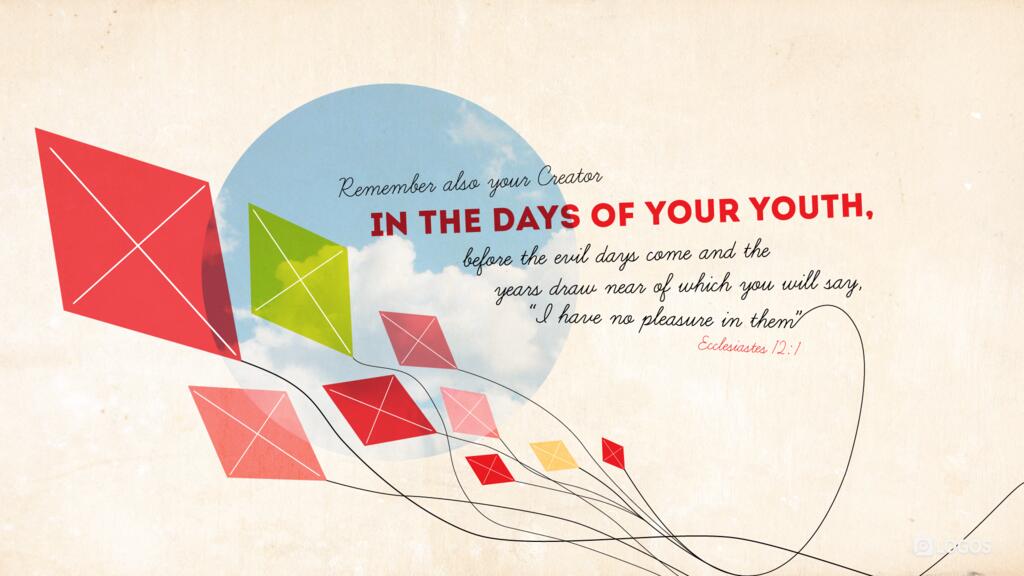
12:1So remember1 your Creator in the days of your youth—
before2 the difficult3 days come,
and the years draw near when you will say, “I have no pleasure in them”;
12:2before the sun and the light4 of the moon and the stars grow dark,
and the clouds disappear5 after the rain;
12:3when those who keep watch over the house6 begin to tremble,7
and the virile men begin to stoop over,8
and the grinders9 begin to cease because they grow few,
and those who look through the windows grow dim,10
12:4and the doors along the street are shut;
when the sound of the grinding mill11 grows low,
and one is awakened12 by the sound of a bird,
and all their13 songs14 grow faint,15
12:5and they are afraid of heights and the dangers16 in the street;
the almond blossoms17 grow white,18
and the grasshopper19 drags itself along,20
and the caper berry21 shrivels up22—
because man goes to his eternal home,23
and the mourners go about in the streets—
12:6before the silver cord is removed,
or the golden bowl is broken,
or the pitcher is shattered at the well,24
or the water wheel25 is broken at the cistern—
12:7and the dust returns to the earth as it was,
and the life’s breath26 returns to God who gave it.
Footnotes
- 1 The imperative זְכֹר (zekhor, “Remember!”) is a figurative expression (metonymy of association) for obeying God and acknowledging his lordship over one’s life (e.g., Num 15:40; Deut 8:18; Pss 42:6–7; 63:6–8; 78:42; 103:18; 106:7; 119:52, 55; Jer 51:50; Ezek 20:43; Jonah 2:7; Mal 4:4). The exhortation to fear God and obey his commands in 12:13–14 spells out what it means to “remember” God.
- 2 The temporal adjective עַד (’ad, “before”) appears three times in 12:1–7 (vv. 1b, 2a, 6a). Likewise, the temporal preposition בְּ (bet, “when”) is repeated (vv. 3a, 4b). These seven verses comprise one long sentence in Hebrew: The main clause is 12:1a (“Remember your Creator in the days of your youth”), while 12:1b–7 consists of five subordinate temporal clauses (“before … before … when … when … before …”).
- 3 The adjective רָעָה (ra’ah, “evil”) does not refer here to ethical evil, but to physical difficulty, injury, pain, deprivation and suffering (e.g., Deut 31:17, 21; 32:23; 1 Sam 10:19; Neh 1:3; 2:17; Pss 34:20; 40:13; 88:4; 107:26; Eccl 11:10; Jer 2:27; Lam 3:38); see רָעָה 4.b; 949 רָעָה 2.
- 4 Heb “the light and the moon and the stars.” The phrase “the light and the moon” is a hendiadys (two separate terms denoting one idea) or perhaps even a hendiatris (three separate terms denoting one idea) for “the light of the moon and stars” (e.g., Gen 1:14).
- 5 The verb שׁוּב (shuv, “to return”) here denotes “to desist” ( שׁוּב 3). It pictures the disappearance of the clouds as a result of the precipitation of their contents.
- 6 Heb “the watchers of the house.”
- 7 The verb זְוּעַ (zéua’, “to tremble”) probably does not refer to physical tremors but to trembling in fear (e.g., Esth 5:9; Hab 2:7; Sir 48:12); cf. זוע). At the onset of old age, those who had been the most courageous during their youth suddenly become fearful.
- 8 The verb עָוַת (’avat, “to bend; to stoop”) means “to be stooped” ( עות) rather than “to bend themselves” ( 736 עות). The perfect tense may be taken in an ingressive sense (“begin to stoop over”).
- 9 The term הַטֹּחֲנוֹת (hattokhanot, Qal active participle feminine plural from טָחַן, takhan, “to grind”) is a double entendre. In its literal sense, it refers to female mill-grinders; in its figurative sense, it refers to molar teeth ( *טֹחֲנָה). The related Hebrew noun טַחֲנָה (takhanah) refers to a “mill,” and the related Arabic noun tahinat means “molar tooth” ( *טַחֲנָה).
- 10 The verb חָשַׁךְ (khashakh, “to grow dim”) is used elsewhere in reference to failing eyesight (e.g., Ps 69:24; Lam 5:17); see חשׁך 2. Therefore, the phrase “those who look through the windows” is probably a figurative description of the eyes, picturing failing eyesight at the onset of old age.
- 11 The noun טַחֲנָה (takhanah) refers to a “grinding-mill” where grain is ground into flour ( טַחֲנָה). The term is here used as a double entendre, figuratively describing the loss of one’s teeth at the onset of old age. The figurative usage also draws upon the polysemantic nature of this noun; the related Arabic root tahinat means “molar tooth” ( *טֹחֲנָה).
- 12 Heb “rises up.” The verb קוּם (qum, “to arise”) refers to being awakened from sleep in the middle of the night by a sound (e.g., Exod 12:30; 1 Sam 3:6, 8) and waking up early in the morning (e.g., Gen 24:54; Judg 16:3; Ruth 3:14; Neh 2:12; Job 14:12; 24:14); see קוּם 1; 877 קוּם 1.a. Here it describes one of the frustrations of old age: the elderly person is unable to get a full night’s sleep because every little sound awakens him in the middle of the night or too early in the morning.
- 13 The term “their” does not appear in the Hebrew text, but is supplied in the translation for clarity and smoothness.
- 14 Heb “all the daughters of song.” The expression “the daughters of song” (בְּנוֹת הַשִּׁיר, bénot hashir) is an idiom for “songs; musical sounds; melodious notes” ( I בַּת 2; 123 בַּת 5; §128.v). The genitive הַשִּׁיר (“song”) represents the nature, quality, character or condition of the construct בְּנוֹת (“daughters”); see §9.5.3b. The idiom refers to the musical songs sung during one’s youth or to the ability to hear songs that are sung. This line is lamenting the loss of hearing which occurs at the onset of old age.
- 15 Heb “are brought low.”
- 16 The Hebrew noun חַתְחַתִּים (khatkhattim) literally means “terrors” ( חַתְחַת; 369 חַתְחַת). Here it is used as a metonymy (cause for effect) to refer to dangers that cause the elderly to be fearful of going outside or walking along the streets. The form חַתְחַתִּים is a reduplicated noun stem from the root חתת (“terror”); חַתְחַת; 369 חַתְחַת. The reduplication of the noun stem intensifies its meaning: the noun חִתַּת (khittat) means “terror,” so the intensified reduplicated form חַתְחַת (khatkhat) connotes something like “great terror” (see S. Moscati, Comparative Grammar, 78–79, §12.9–13). The plural form חַתְחַתִּים (“great terrors”) denotes plural of number (more than one) or plural of intensity (which would further intensify the experience of fear); see §7.4.3a.
- 17 The noun שָׁקֵד (shaqed) is used in the OT in reference to the “almond nut” (e.g., Gen 43:11; Num 17:23) and metonymically (product for thing producing it) for the “almond tree” (e.g., Jer 1:11); cf. שָׁקֵד; 1052 שָׁקֵד 2.
- 18 The verb נצץ (“to blossom”) is a geminate verb (II = III) that, in this case, is written with a matres lectionis (plene spelling) rather than the normal spelling of וינץ ( §73.g). The Hiphil verb יָנֵאץ (yane’ts) is from the root נצץ “to shine; to sparkle; to blossom” ( נצץ; 665 נָצַץ). It is used in reference to almond blossoms whose color progresses from pink to white as they ripen (e.g., Song 6:11). This is an appropriate metaphor (comparison of sight) to describe white hair that often accompanies the onset of old age.
- 19 Or “locust.”
- 20 The verb סָבַל (saval, “to bear a heavy load”) means “to drag oneself along” as a burden ( 687 סָבַל) or “to become thick; to move slowly forward; to clear off” ( סבל).
- 21 The noun אֲבִיּוֹנָה (’aviyyonah, “caper berry, caper fruit”) is a , occurring only here in the Hebrew Bible. It refers to the Capparis spinosa fruit which was eaten as an aphrodisiac in the ancient Near East ( אֲבִיּוֹנָה; 2–3 אֲבִיּוֹנָה). There are two options for the interpretation of this figure: (1) At the onset of old age, the sexual virility that marked one’s youth is nothing more than a distant memory, and even aphrodisiacs fail to stimulate sexual desire to allow for sexual intercourse. (2) The onset of old age is like the shriveling up of the caper berry fruit; the once virile youth has passed his prime just like a shriveled caper berry can no longer provide a sexual stimulant.
- 22 The vocalizes consonantal ותפר as וְתָפֵר (vétafer, conjunction + Hiphil imperfect 3rd person feminine singular from פָּרַר, parar, “to burst”). However, an alternate vocalization tradition of וְתֻפַּר (vétupar, conjunction + Hophal imperfect 3rd person feminine singular “to be broken down”) is reflected in the which reads καὶ διασκεδασθῇ (kai diaskedasthē, “is scattered”) and Symmachus καὶ διαλυθῇ (kai dialuthē, “is broken up”) which is followed by the . On the other hand, Aquila’s καὶ καρπεύσει (kai karpeusei, “are enjoyed,” of fruits) reflects וְתִפְרֶה (Qal imperfect 3rd person feminine singular from פָרַה, “to bear fruit”); this does not reflect an alternate reading but a translator’s error in word division between וְתָפֵר הָאֲבִיּוֹנָה (vétafer ha’aviyyonah, “the caper berry bursts”) and וְתִפְרֶה אֲבִיּוֹנָה (vétifreh ’aviyyonah, “the caper berry bears fruit”). Or “fails”; or “bursts.” The meaning of the verb פָּרַר (parar, “to break; to make ineffectual”) is debated: (1) “to be ineffectual,” that is, to fail to provide sexual power as an aphrodisiac, or (2) “to break; to burst,” that is, the caper berry fruit shrivels as it lingers on its branch beyond its period of ripeness ( פרר 2.f; 830 I. פָּרַר 2.d).
- 23 In the construct phrase בֵּית עוֹלָמוֹ (bet ’olamo, “house of his eternity”), the genitive עוֹלָמוֹ (“eternity”) functions as an attributive adjective: “his eternal home.” This is an idiom for the grave as the resting place of the body (e.g., Ps 49:12 [11]; Job 7:9; 14:10–12; Eccl 12:5) or Sheol as the residence of the dead (e.g., Job 17:13; 30:23); see I בַּיִת 2; (5); 109 בַּיִת 1.d. For example, the term בֵּית (“house”) is used in Job 30:23 in parallelism with “death” (מָוֶת, mavet). The same idiom appears in postbiblical Hebrew: “the house of eternity” (בֵּית עוֹלָם, bet ’olam) is a euphemism for a burial ground or cemetery (e.g., Lamentations Rabbah 1:5); see 1084–85 עָלַם III. This idiom is also found in a Moabite text in reference to the grave (Deir Alla Inscription 2:6). A similar idiom is found in Phoenician and Palmyrene in reference to the grave ( 35). The idiom appears to have originated in Egyptian literature (H. A. Hoffner, 2:113). See F. Cumont, Afterlife in Roman Paganism, 48–50.
- 24 Heb “water-spring.”
- 25 The term גַּלְגַּל (galgal, “wheel”) refers to the “water wheel” or “paddle wheel” for drawing water from a well ( I גַּלְגַּל 2; 165 גַּלְגַּל 1.b). This Hebrew noun is related to the Akkadian term gulgullu (“pot”), as well as Phoenician (?) גלגל (“wheel for drawing water”). The Latin term girgillus (“lever for the bucket”) is a late derivation from this term. See G. Dalman, Arbeit und Sitte in Palästina, 2:225–28.
- 26 Or “spirit.” The likely referent is the life’s breath that originates with God. See Eccl 3:19, as well as Gen 2:7; 6:17; 7:22.
The NET Bible First Edition, Copyright 1996-2005 by Biblical Studies Press