Exodus 1:8–2:10
The Message: The Bible in Contemporary LanguageOther versions
English
- MSG The Message: The Bible in Contemporary Language
- DARBY 1890 Darby Bible
- ASV American Standard Version
- AV 1873 The Cambridge Paragraph Bible of the Authorized English Version
- CSB Christian Standard Bible
- D-R Douay-Rheims Bible
- ESV English Standard Version
- GW GOD’S WORD Translation
- GNB Good News Translation
- HCSB The Holman Christian Standard Bible
- KJV 1900 King James Version
- LSB Legacy Standard Bible
- LEB The Lexham English Bible
- NET The NET Bible
- NASB95 New American Standard Bible (1995)
- NCV New Century Version
- NIrV New International Reader’s Version (1998)
- NIV New International Version (2011)
- NKJV The New King James Version
- NLT New Living Translation
- NRSVue New Revised Standard Version: Updated Edition
- RSV The Revised Standard Version
- RSVCE The Revised Standard Version, Catholic Edition
- YLT Young’s Literal Translation
Arabic
Czech
French
German
Hebrew
Hungarian
Italian
Korean
Latin
Portuguese
Russian
Simplified Chinese
Spanish
Traditional Chinese
“A New King … Who Didn’t Know Joseph”
8–10A new king came to power in Egypt who didn’t know Joseph. He spoke to his people in alarm, “There are way too many of these Israelites for us to handle. We’ve got to do something: Let’s devise a plan to contain them, lest if there’s a war they should join our enemies, or just walk off and leave us.”
11–14So they organized them into work-gangs and put them to hard labor under gang-foremen. They built the storage cities Pithom and Rameses for Pharaoh. But the harder the Egyptians worked them the more children the Israelites had—children everywhere! The Egyptians got so they couldn’t stand the Israelites and treated them worse than ever, crushing them with slave labor. They made them miserable with hard labor—making bricks and mortar and back-breaking work in the fields. They piled on the work, crushing them under the cruel workload.
15–16The king of Egypt had a talk with the two Hebrew midwives; one was named Shiphrah and the other Puah. He said, “When you deliver the Hebrew women, look at the sex of the baby. If it’s a boy, kill him; if it’s a girl, let her live.”
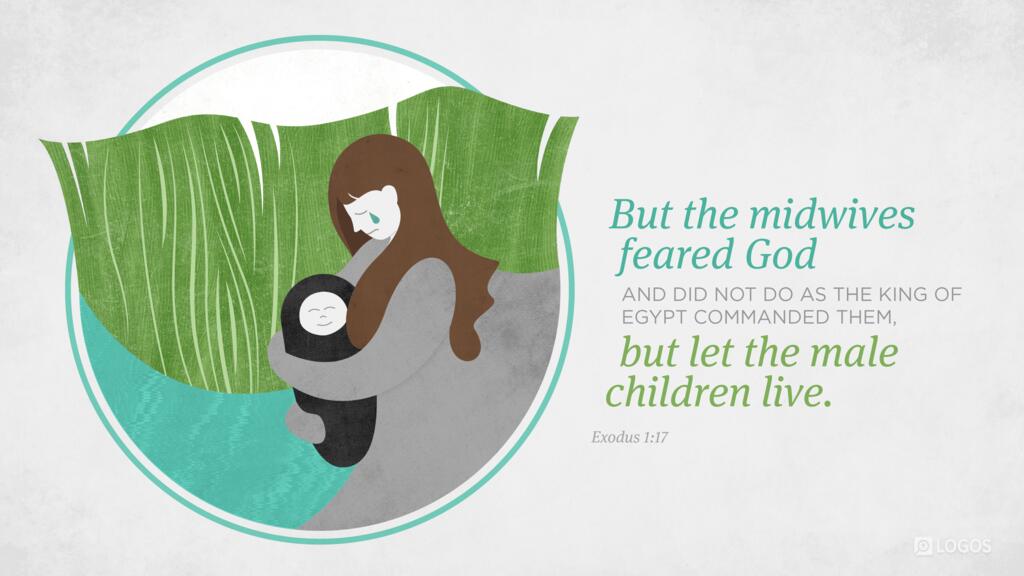
17–18But the midwives had far too much respect for God and didn’t do what the king of Egypt ordered; they let the boy babies live. The king of Egypt called in the midwives. “Why didn’t you obey my orders? You’ve let those babies live!”
19The midwives answered Pharaoh, “The Hebrew women aren’t like the Egyptian women; they’re vigorous. Before the midwife can get there, they’ve already had the baby.”
20–21God was pleased with the midwives. The people continued to increase in number—a very strong people. And because the midwives honored God, God gave them families of their own.
22So Pharaoh issued a general order to all his people: “Every boy that is born, drown him in the Nile. But let the girls live.”
Moses
1–32A man from the family of Levi married a Levite woman. The woman became pregnant and had a son. She saw there was something special about him and hid him. She hid him for three months. When she couldn’t hide him any longer she got a little basket-boat made of papyrus, waterproofed it with tar and pitch, and placed the child in it. Then she set it afloat in the reeds at the edge of the Nile.
4–6The baby’s older sister found herself a vantage point a little way off and watched to see what would happen to him. Pharaoh’s daughter came down to the Nile to bathe; her maidens strolled on the bank. She saw the basket-boat floating in the reeds and sent her maid to get it. She opened it and saw the child—a baby crying! Her heart went out to him. She said, “This must be one of the Hebrew babies.”
7Then his sister was before her: “Do you want me to go and get a nursing mother from the Hebrews so she can nurse the baby for you?”
8Pharaoh’s daughter said, “Yes. Go.” The girl went and called the child’s mother.
9Pharaoh’s daughter told her, “Take this baby and nurse him for me. I’ll pay you.” The woman took the child and nursed him.
10After the child was weaned, she presented him to Pharaoh’s daughter who adopted him as her son. She named him Moses (Pulled-Out), saying, “I pulled him out of the water.”
Copyright 2005 Eugene H. Peterson.