Exodus 1:8–2:10
Christian Standard BibleOther versions
English
- CSB Christian Standard Bible
- DARBY 1890 Darby Bible
- ASV American Standard Version
- AV 1873 The Cambridge Paragraph Bible of the Authorized English Version
- D-R Douay-Rheims Bible
- ESV English Standard Version
- GW GOD’S WORD Translation
- GNB Good News Translation
- HCSB The Holman Christian Standard Bible
- KJV 1900 King James Version
- LSB Legacy Standard Bible
- LEB The Lexham English Bible
- MSG The Message: The Bible in Contemporary Language
- NET The NET Bible
- NASB95 New American Standard Bible (1995)
- NCV New Century Version
- NIrV New International Reader’s Version (1998)
- NIV New International Version (2011)
- NKJV The New King James Version
- NLT New Living Translation
- NRSVue New Revised Standard Version: Updated Edition
- RSV The Revised Standard Version
- RSVCE The Revised Standard Version, Catholic Edition
- YLT Young’s Literal Translation
Arabic
Czech
French
German
Hebrew
Hungarian
Italian
Korean
Latin
Portuguese
Russian
Simplified Chinese
Spanish
Traditional Chinese
8A new king, who did not know about Joseph, came to power in Egypt. 9He said to his people, “Look, the Israelite people are more numerous and powerful than we are.e 10Come, let’s deal shrewdly with them; otherwise they will multiply further, and when war breaks out, they will join our enemies, fight against us, and leave the country.”f 11So the Egyptians assigned taskmasters over the Israelites to oppress them with forced labor.g They built Pithom and Rameses as supply citiesh for Pharaoh. 12But the more they oppressed them, the more they multiplied and spread so that the Egyptians came to dreadC the Israelites. 13They worked the Israelites ruthlesslyi 14and made their lives bitter with difficult labor in brick and mortar and in all kinds of fieldwork. They ruthlessly imposed all this work on them.j
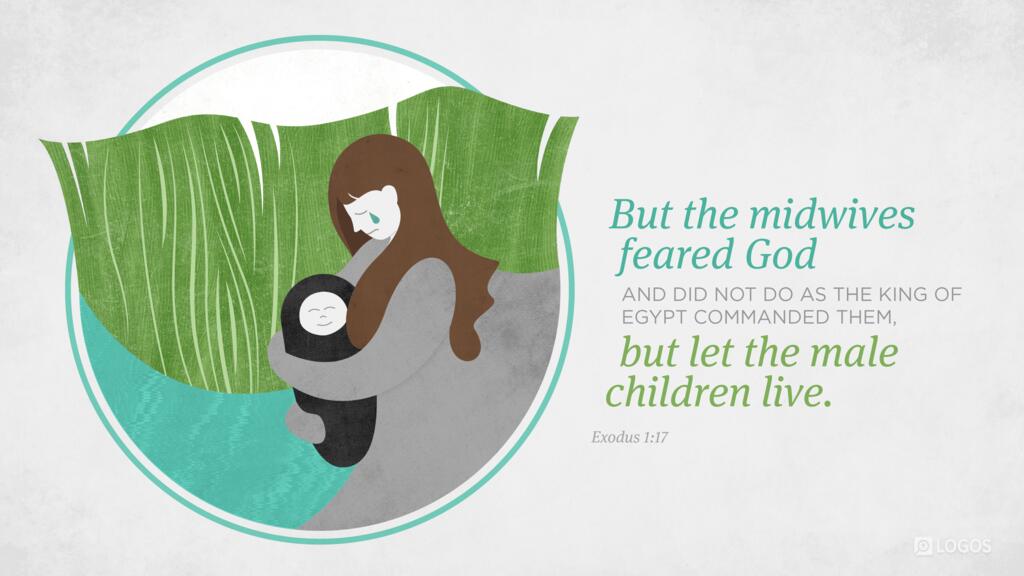
15The king of Egypt said to the Hebrew midwives—the first, whose name was Shiphrah, and the second, whose name was Puah—16“When you help the Hebrew women give birth, observe them as they deliver. If the child is a son, kill him, but if it’s a daughter, she may live.” 17The midwives, however, feared Godk and did not do as the king of Egypt had told them;l they let the boys live. 18So the king of Egypt summoned the midwives and asked them, “Why have you done this and let the boys live?”
19The midwives said to Pharaoh, “The Hebrew women are not like the Egyptian women, for they are vigorous and give birth before the midwife can get to them.”m
20So God was good to the midwives,n and the people multiplied and became very numerous. 21Since the midwives feared God, he gave them families.o 22Pharaoh then commanded all his people, “You must throw every son born to the Hebrews into the Nile, but let every daughter live.”p
MOSES’S BIRTH AND ADOPTION
2Now a man from the family of Levi married a Levite woman.q 2The woman became pregnant and gave birth to a son; when she saw that he was beautiful,D she hid him for three months.r 3But when she could no longer hide him, she got a papyrus basket for him and coated it with asphalt and pitch. She placed the child in it and set it among the reeds by the bank of the Nile. 4Then his sisters stood at a distance in order to see what would happen to him.
5Pharaoh’s daughter went down to bathe at the Nile while her servant girls walked along the riverbank. She saw the basket among the reeds, sent her slave girl, took it, 6opened it, and saw him, the child—and there he was, a little boy, crying. She felt sorry for him and said, “This is one of the Hebrew boys.”
7Then his sister said to Pharaoh’s daughter, “Should I go and call a Hebrew woman who is nursing to nurse the boy for you?”
8“Go,” Pharaoh’s daughter told her. So the girl went and called the boy’s mother. 9Then Pharaoh’s daughter said to her, “Take this child and nurse him for me, and I will pay your wages.” So the woman took the boy and nursed him. 10When the child grew older, she brought him to Pharaoh’s daughter, and he became her son. She named him Moses,A “Because,” she said, “I drew him out of the water.”
Footnotes
Cross references
- ePs 105:24
- fPs 83:3–4; Ac 7:19
- gGn 15:13; Ex 2:11; 3:7; 5:4–5; 6:6; Dt 26:6
- hGn 47:11; 1Kg 9:19; 2Ch 8:4
- iDt 4:20
- jEx 2:23; Nm 20:15; Ac 7:19
- kEx 1:21; Pr 16:6
- lDn 3:16–18; Ac 4:18–20; 5:29
- mJos 2:4; 2Sm 17:20
- nPr 11:18; Is 3:10
- o1Sm 2:35; 2Sm 7:11,27; 1Kg 11:38; Ps 127:1
- pGn 41:1; Ac 7:19
- qEx 6:20; Nm 26:59; 1Ch 23:14
- rAc 7:20; Heb 11:23
- sEx 15:20; Nm 26:59
Copyright 2017 Holman Bible Publishers