Luke 18:1–23
The Lexham English BibleOther versions
English
- LEB The Lexham English Bible
- DARBY 1890 Darby Bible
- ASV American Standard Version
- AV 1873 The Cambridge Paragraph Bible of the Authorized English Version
- CSB Christian Standard Bible
- D-R Douay-Rheims Bible
- ESV English Standard Version
- GW GOD’S WORD Translation
- GNB Good News Translation
- HCSB The Holman Christian Standard Bible
- KJV 1900 King James Version
- LSB Legacy Standard Bible
- MSG The Message: The Bible in Contemporary Language
- NET The NET Bible
- NASB95 New American Standard Bible (1995)
- NCV New Century Version
- NIrV New International Reader’s Version (1998)
- NIV New International Version (2011)
- NKJV The New King James Version
- NLT New Living Translation
- NRSVue New Revised Standard Version: Updated Edition
- RSV The Revised Standard Version
- RSVCE The Revised Standard Version, Catholic Edition
- YLT Young’s Literal Translation
Arabic
Czech
French
German
Greek
Hungarian
Italian
Korean
Latin
Portuguese
Russian
Simplified Chinese
Spanish
Traditional Chinese
The Parable of the Unjust Judge
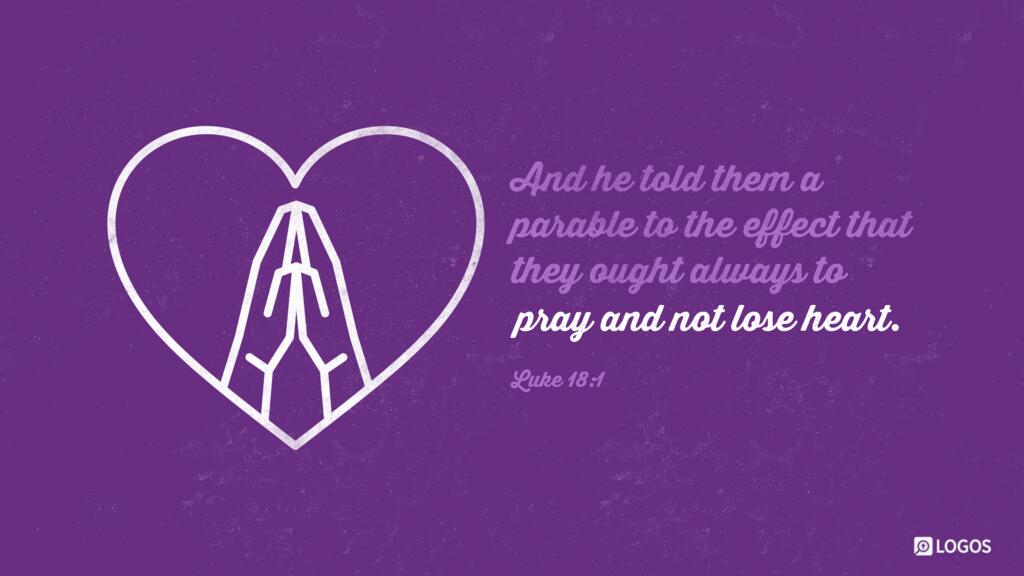
18And he told them a parable to show that they must always pray and not be discouraged, 2saying, “There was a certain judge in a certain town who did not fear God and did not respect people. 3And there was a widow in that town, and she kept coming to him, saying, ‘Grant me justice against my adversary!’ 4And he was not willing for a time, but after these things he said to himself, ‘Even if I do not fear God or respect people, 5yet because this widow is causing trouble for me, I will grant her justice, so that she does not wear me down in the end by her* coming back!’ ” 6And the Lord said, “Listen to what the unrighteous judge is saying! 7And will not God surely see to it that justice is donea to his chosen ones who cry out to him day and night, and will he delay toward them? 8I tell you that he will see to it that justice is doneb for them soon! Nevertheless, when* the Son of Man comes, then will he find faith on earth?”
The Parable of the Pharisee and the Tax Collector
9And he also told this parable to some who trusted in themselves that they were righteous, and looked down on everyone else:c 10“Two men went up to the temple to pray, one a Pharisee and the other a tax collector. 11The Pharisee stood and* prayed these things with reference to himself: ‘God, I give thanks to you that I am not like other people—swindlers, unrighteous people, adulterers, or even like this tax collector! 12I fast twice a week; I give a tenth of all that I get.’ 13But the tax collector, standing far away, did not want even to raise his eyes to heaven, but was beating his breast, saying, ‘God, be merciful to me, a sinner!’ 14I tell you, this man went down to his house justified rather than that one! For everyone who exalts himself will be humbled, but the one who humbles himself will be exalted.”
Little Children Brought to Jesus
15Now they were bringing even their* babies to him so that he could touch them. But when* the disciples saw it,* they rebuked them. 16But Jesus called them to himself, saying, “Allow the children to come to me, and do not forbid them, for to such belongsd the kingdom of God. 17Truly I say to you, whoever does not welcome the kingdom of God like a young child will never enter into it.”
A Rich Young Man
18And a certain ruler asked him, saying, “Good Teacher, by* doing what will I inherit eternal life?” 19And Jesus said to him, “Why do you call me good? No one is good except God alone. 20You know the commandments: ‘Do not commit adultery, do not murder, do not steal, do not give false testimony, honor your father and mother.’ ”e 21And he said, “All these I have observed from myf youth.” 22And when he* heard this,* Jesus said to him, “You still lack one thing:g Sell all that you have, and distribute the proceeds* to the poor—and you will have treasure in heaven—and come, follow me.” 23But when he* heard these things he became very sad, because he was extremely wealthy.
Footnotes
- *Here “by” is supplied as a component of the participle (“coming back”) which is understood as means
- aLiterally “carry out the giving of justice”
- bLiterally “he will carry out the giving of justice”
- *Here “when” is supplied as a component of the participle (“comes”) which is understood as temporal
- cLiterally “the rest”
- *Here “and” is supplied because the previous participle (“stood”) has been translated as a finite verb
- *Literally “the”; the Greek article is used here as a possessive pronoun
- *Here “when” is supplied as a component of the participle (“saw”) which is understood as temporal
- *Here the direct object is supplied from context in the English translation
- dLiterally “for of such is”
- *Here “by” is supplied as a component of the participle (“doing”) which is understood as means
- eA quotation from Exod 20:12–16; Deut 5:16–20
- fSome manuscripts omit “my”
- *Here “when” is supplied as a component of the participle (“heard”) which is understood as temporal
- *Here the direct object is supplied from context in the English translation
- gLiterally “one still lacking to you”
- *Here the direct object is supplied from context in the English translation
- *Here “when” is supplied as a component of the participle (“heard”) which is understood as temporal
Copyright 2012 Lexham Press