John 19:26–35
The Lexham English BibleOther versions
English
- LEB The Lexham English Bible
- DARBY 1890 Darby Bible
- ASV American Standard Version
- AV 1873 The Cambridge Paragraph Bible of the Authorized English Version
- CSB Christian Standard Bible
- D-R Douay-Rheims Bible
- ESV English Standard Version
- GW GOD’S WORD Translation
- GNB Good News Translation
- HCSB The Holman Christian Standard Bible
- KJV 1900 King James Version
- LSB Legacy Standard Bible
- MSG The Message: The Bible in Contemporary Language
- NET The NET Bible
- NASB95 New American Standard Bible (1995)
- NCV New Century Version
- NIrV New International Reader’s Version (1998)
- NIV New International Version (2011)
- NKJV The New King James Version
- NLT New Living Translation
- NRSVue New Revised Standard Version: Updated Edition
- RSV The Revised Standard Version
- RSVCE The Revised Standard Version, Catholic Edition
- YLT Young’s Literal Translation
Arabic
Czech
French
German
Greek
Hungarian
Italian
Korean
Latin
Portuguese
Russian
Simplified Chinese
Spanish
Traditional Chinese
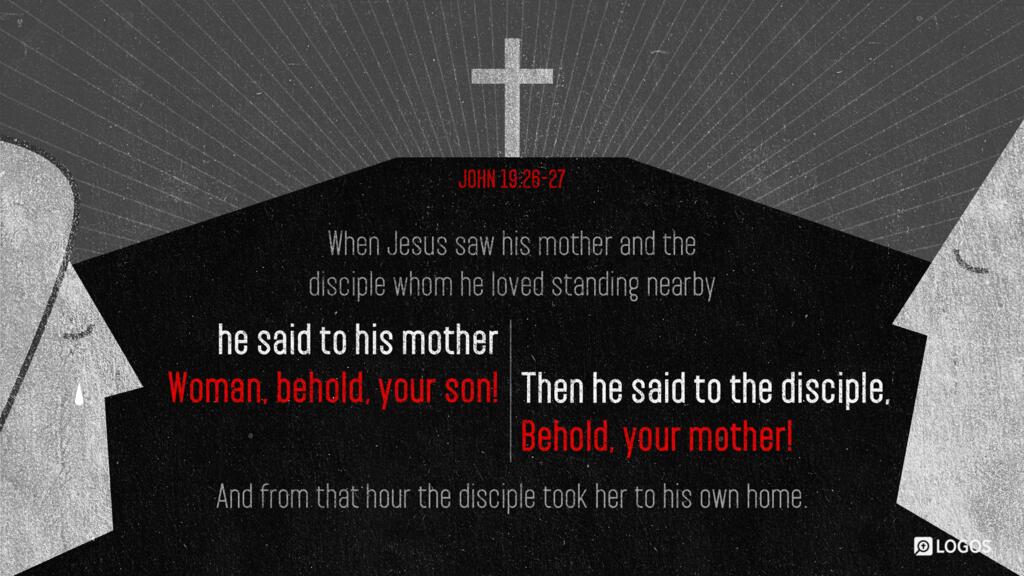
26So Jesus, seeing his* mother and the disciple whom he loved standing there, said to his* mother, “Woman, behold your son!” 27Then he said to the disciple, “Behold your mother!” And from that hour the disciple took her into his own home.
Jesus Dies on the Cross
28After this, Jesus, knowing that now at last everything was completed, in order that the scripture would be fulfilled, said, “I am thirsty.” 29A jar full of sour wine was standing there, so they put a sponge full of the sour wine on a branch of hyssop and* brought it* to his mouth. 30Then when he had received the sour wine, Jesus said, “It is completed,”d and bowing his* head, he gave up his* spirit.
31Then the Jews, because it was the day of preparation, so that the bodies would not remain on the cross on the Sabbath (for that Sabbath was an important day), asked Pilate that their legs could be broken and they could be taken away. 32So the soldiers came and broke the legs of the first and of the other who had been crucified with him. 33But when they* came to Jesus, after they saw he was already dead, they did not break his legs. 34But one of the soldiers pierced his side with a spear, and blood and water came out immediately. 35And the one who has seen it* has testified, and his testimony is true, and that person knows that he is telling the truth, so that you also may believe.
Footnotes
- *Literally “the”; the Greek article is used here as a possessive pronoun
- *Literally “the”; the Greek article is used here as a possessive pronoun
- *Here “and” is supplied because the previous participle (“put”) has been translated as a finite verb
- *Here the direct object is supplied from context in the English translation
- dOr (traditionally) “it is finished”
- *Literally “the”; the Greek article is used here as a possessive pronoun
- *Literally “the”; the Greek article is used here as a possessive pronoun
- *Here “when” is supplied as a component of the participle (“came”) which is understood as temporal
- *Here the direct object is supplied from context in the English translation
Copyright 2012 Lexham Press