John 19:26–35
The NET BibleOther versions
English
- NET The NET Bible
- DARBY 1890 Darby Bible
- ASV American Standard Version
- AV 1873 The Cambridge Paragraph Bible of the Authorized English Version
- CSB Christian Standard Bible
- D-R Douay-Rheims Bible
- ESV English Standard Version
- GW GOD’S WORD Translation
- GNB Good News Translation
- HCSB The Holman Christian Standard Bible
- KJV 1900 King James Version
- LSB Legacy Standard Bible
- LEB The Lexham English Bible
- MSG The Message: The Bible in Contemporary Language
- NASB95 New American Standard Bible (1995)
- NCV New Century Version
- NIrV New International Reader’s Version (1998)
- NIV New International Version (2011)
- NKJV The New King James Version
- NLT New Living Translation
- NRSVue New Revised Standard Version: Updated Edition
- RSV The Revised Standard Version
- RSVCE The Revised Standard Version, Catholic Edition
- YLT Young’s Literal Translation
Arabic
Czech
French
German
Greek
Hungarian
Italian
Korean
Latin
Portuguese
Russian
Simplified Chinese
Spanish
Traditional Chinese
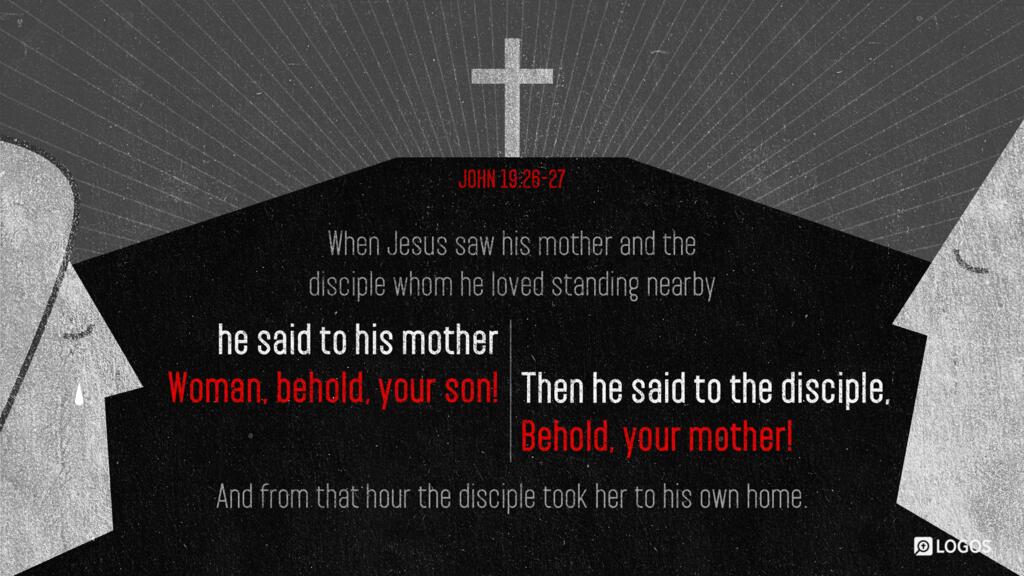
19:26So when Jesus saw his mother and the disciple whom he loved standing there, he said to his mother, “Woman,79 look, here is your son!” 19:27He then said to his disciple, “Look, here is your mother!” From that very time80 the disciple took her into his own home.
Jesus’ Death
19:28After this Jesus, realizing that by this time81 everything was completed,82 said (in order to fulfill the scripture),83 “I am thirsty!”8419:29A jar full of sour wine85 was there, so they put a sponge soaked in sour wine on a branch of hyssop86 and lifted it87 to his mouth. 19:30When88 he had received the sour wine, Jesus said, “It is completed!”89 Then he bowed his head and gave up his spirit.90
19:31Then, because it was the day of preparation, so that the bodies should not stay on the crosses on the Sabbath91 (for that Sabbath was an especially important one),92 the Jewish leaders93 asked Pilate to have the victims’ legs94 broken95 and the bodies taken down.9619:32So the soldiers came and broke the legs of the two men who had been crucified97 with Jesus,98 first the one and then the other.9919:33But when they came to Jesus and saw that he was already dead, they did not break his legs. 19:34But one of the soldiers pierced100 his side with a spear, and blood and water101 flowed out immediately. 19:35And the person who saw it102 has testified (and his testimony is true, and he103 knows that he is telling the truth),104 so that you also may believe.
Footnotes
- 79 The term Woman is Jesus’ normal, polite way of addressing women (Matt 15:28, Luke 13:12; John 4:21; 8:10; 19:26; 20:15; see γυνή 1). But it is unusual for a son to address his mother with this term. The custom in both Hebrew (or Aramaic) and Greek would be for a son to use a qualifying adjective or title. Is there significance in Jesus’ use here? Jesus probably used the term here to help establish Mary and the beloved disciple in a new “mother-son” relationship. Someone would soon need to provide for Mary since Jesus, her oldest son, would no longer be alive. By using this term Jesus distanced himself from Mary so the beloved disciple could take his place as her earthly son (cf. John 2:4). See D. A. Carson, John, 617–18, for discussion about symbolic interpretations of this relationship between Mary and the beloved disciple.
- 80 Grk “from that very hour.”
- 81 Or “that already.”
- 82 Or “finished,” “accomplished”; Grk “fulfilled.”
- 83 A reference to Ps 69:21 or Ps 22:15.
- 84 In order to fulfill (τελειωθῇ [teleiōthē], a wordplay on the previous statement that everything was completed [τετέλεσται, tetelestai]) the scripture, he said, “I am thirsty.” The scripture referred to is probably Ps 69:21, “They also gave me gall for my food, and for my thirst they gave me vinegar to drink.” Also suggested, however, is Ps 22:15, “My tongue cleaves to the roof of my mouth, and you [God] lay me in the dust of death.” Ps 22:1 reads “My God, my God, why have you forsaken me?,” a statement Jesus makes from the cross in both Matt 27:46 and Mark 15:34. In light of the connection in the Fourth Gospel between thirst and the living water which Jesus offers, it is highly ironic that here Jesus himself, the source of that living water, expresses his thirst. And since 7:39 associates the living water with the Holy Spirit, Jesus’ statement here in 19:28 amounts to an admission that at this point he has been forsaken by God (cf. Ps 22:1, Matt 27:46, and Mark 15:34).
- 85 The cheap sour wine was called in Latin posca, and referred to a cheap vinegar wine diluted heavily with water. It was the drink of slaves and soldiers, and was probably there for the soldiers who had performed the crucifixion.
- 86 Hyssop was a small aromatic bush; exact identification of the plant is uncertain. The hyssop used to lift the wet sponge may have been a form of reed (κάλαμος, kalamos, “reed,” is used in Matt 27:48 and Mark 15:36); the biblical name can refer to several different species of plant (at least eighteen different plants have been suggested).
- 87 Or “and brought it.”
- 88 Grk “Then when.” Here οὖν (oun) has not been translated for stylistic reasons.
- 89 Or “It is accomplished,” “It is finished,” or “It is ended.” See on .
- 90 Or “he bowed his head and died”; Grk “he bowed his head and gave over the spirit.”
- 91 The Jewish authorities, because this was the day of preparation for the Sabbath and the Passover (cf. 19:14), requested Pilate to order the legs of the three who had been crucified to be broken. This would hasten their deaths, so that the bodies could be removed before the beginning of the Sabbath at 6 p.m. This was based on the law of Deut 21:22–23 and Josh 8:29 that specified the bodies of executed criminals who had been hanged on a tree should not remain there overnight. According to Josephus this law was interpreted in the 1st century to cover the bodies of those who had been crucified ( 4.5.2 [4.317]). Philo of Alexandria also mentions that on occasion, especially at festivals, the bodies were taken down and given to relatives to bury ( 10 [83]). The normal Roman practice would have been to leave the bodies on the crosses, to serve as a warning to other would-be offenders.
- 92 This is a parenthetical note by the author.
- 93 Or “the Jewish authorities”; Grk “the Jews.” Here the phrase refers to the Jewish leaders. See also the note on the phrase “Jewish leaders” in v. .
- 94 Grk “asked Pilate that the legs of them might be broken.” The referent of “them” (the three individuals who were crucified, collectively referred to as “the victims”) has been supplied in the translation for clarity.
- 95 To have the legs … broken. Breaking the legs of a crucified person was a way of speeding up his death, since the victim could no longer use his legs to push upward in order to be able to draw a breath. This breaking of the legs was called in Latin crurifragium, and was done with a heavy mallet.
- 96 Grk “asked Pilate that their legs might be broken and they might be taken down.” Here because of the numerous ambiguous third person references it is necessary to clarify that it was the crucified men whose legs were to be broken and whose corpses were to be removed from the crosses.
- 97 See the note on Crucify in .
- 98 Grk “with him”; the referent (Jesus) has been specified in the translation for clarity.
- 99 Grk “broke the legs of the first and of the other who had been crucified with him.”
- 100 If it was obvious to the soldiers that the victim was already dead it is difficult to see why one of them would try to inflict a wound. The Greek verb pierced (νύσσω, nussō) can indicate anything from a slight prod to a mortal wound. Probably one of the soldiers gave an exploratory stab to see if the body would jerk. If not, he was really dead. This thrust was hard enough to penetrate the side, since the author states that blood and water flowed out immediately.
- 101 How is the reference to the blood and water that flowed out from Jesus’ side to be understood? This is probably to be connected with the statements in 1 John 5:6–8. In both passages water, blood, and testimony are mentioned. The Spirit is also mentioned in 1 John 5:7 as the source of the testimony, while here the testimony comes from one of the disciples (19:35). The connection between the Spirit and the living water with Jesus’ statement of thirst just before he died in the preceding context has already been noted (see 19:28). For the author, the water which flowed out of Jesus’ side was a symbolic reference to the Holy Spirit who could now be given because Jesus was now glorified (cf. 7:39); Jesus had now departed and returned to that glory which he had with the Father before the creation of the world (cf. 17:5). The mention of blood recalls the motif of the Passover lamb as a sacrificial victim. Later references to sacrificial procedures in the appear to support this: Pesahim 5:3 and 5:5 state that the blood of the sacrificial animal should not be allowed to congeal but should flow forth freely at the instant of death so that it could be used for sprinkling; Tamid 4:2 actually specifies that the priest is to pierce the heart of the sacrificial victim and cause the blood to come forth.
- 102 The word “it” is not in the Greek text but is implied. Direct objects were often omitted in Greek when clear from the context.
- 103 Grk “and that one.”
- 104 A parenthetical note by the author.
The NET Bible First Edition, Copyright 1996-2005 by Biblical Studies Press