John 18:39–19:16
The Lexham English BibleOther versions
English
- LEB The Lexham English Bible
- DARBY 1890 Darby Bible
- ASV American Standard Version
- AV 1873 The Cambridge Paragraph Bible of the Authorized English Version
- CSB Christian Standard Bible
- D-R Douay-Rheims Bible
- ESV English Standard Version
- GW GOD’S WORD Translation
- GNB Good News Translation
- HCSB The Holman Christian Standard Bible
- KJV 1900 King James Version
- LSB Legacy Standard Bible
- MSG The Message: The Bible in Contemporary Language
- NET The NET Bible
- NASB95 New American Standard Bible (1995)
- NCV New Century Version
- NIrV New International Reader’s Version (1998)
- NIV New International Version (2011)
- NKJV The New King James Version
- NLT New Living Translation
- NRSVue New Revised Standard Version: Updated Edition
- RSV The Revised Standard Version
- RSVCE The Revised Standard Version, Catholic Edition
- TNIV Today’s New International Version
- YLT Young’s Literal Translation
Arabic
Czech
French
German
Greek
Hungarian
Italian
Korean
Latin
Portuguese
Russian
Simplified Chinese
Spanish
Traditional Chinese
39But it is your custom that I release for you one prisoner* at the Passover. So do you want me* to release for you the king of the Jews?” 40Then they shouted again, saying, “Not this man, but Barabbas!” (Now Barabbas was a revolutionary.)c
Pilate Attempts to Release Jesus
19So then Pilate took Jesus and had him flogged.* 2And the soldiers wove a crown of thorns and placed it* on his head, and put a purple robe on him, 3and were coming up to him and saying, “Hail, king of the Jews!” and were giving him slaps in the face.
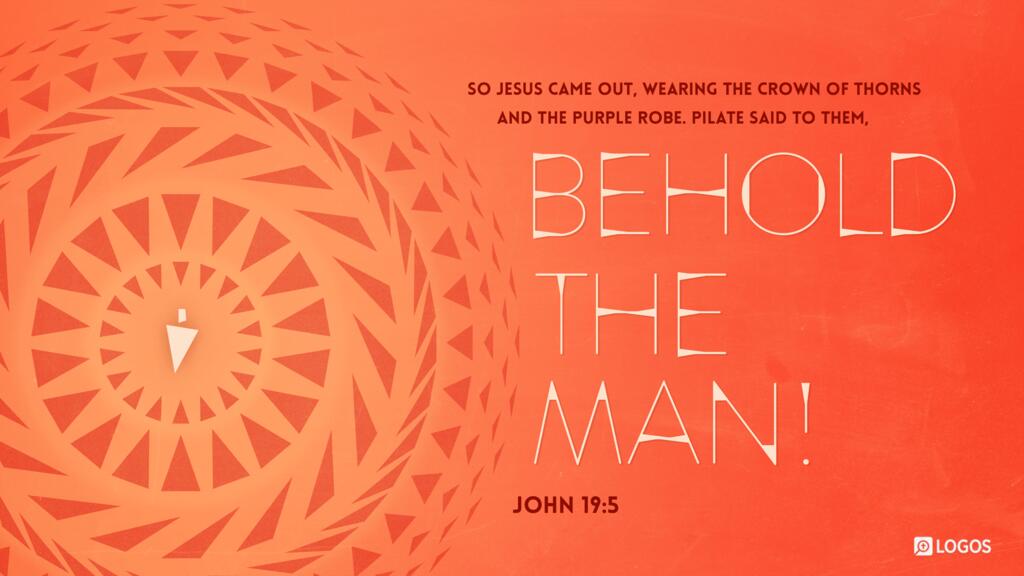
4And Pilate came outside again and said to them, “Behold, I am bringing him outside to you, so that you will know that I find no basis for an accusation against him.” 5Then Jesus came outside wearing the crown of thorns and the purple robe, and he said to them, “Behold the man!” 6So when they saw him, the chief priests and the officers shouted, saying, “Crucify! Crucify!” Pilate said to them, “You take him and crucify him!* For I do not find a basis for an accusation against him.” 7The Jews replied to him, “We have a law, and according to the law he ought to die, because he made himself out to be the Son of God!”
8So when Pilate heard this statement, he was even more afraid, 9and he entered into the governor’s residence again and said to Jesus, “Where are you from?” But Jesus did not give him an answer. 10So Pilate said to him, “Will you not speak to me? Do you not know that I have authority to release you, and I have authority to crucify you?” 11Jesus replied to him, “You would not have any authority over me unless it was given to you from above. For this reason the one who handed me over to you has greater sin.”
12From this point on Pilate was seeking to release him, but the Jews shouted, saying, “If you release this man, you are not a friend of Caesar! Everyone who makes himself out to be a king opposes Caesar!” 13So Pilate, when he* heard these words, brought Jesus outside and sat down on the judgment seat, in the place called The Stone Pavement (but Gabbatha in Aramaic). 14(Now it was the day of preparation of the Passover; it was about the sixth hour.) And he said to the Jews, “Behold your king!”
15Then those shouted, “Away with him! Away with him! Crucify him!” Pilate said to them, “Shall I crucify your king?” The chief priests replied, “We do not have a king except Caesar!” 16So then he handed him over to them in order that he could be crucified.
Jesus Is Crucified
So they took Jesus,
Footnotes
- *The word “prisoner” is not in the Greek text, but is implied
- *Here the direct object is supplied from context in the English translation
- cOr perhaps “robber”
- *This verb has causative force in context; Pilate did not personally carry out the sentence
- *Here the direct object is supplied from context in the English translation
- *Here the direct object is supplied from context in the English translation
- *Here “when” is supplied as a component of the participle (“heard”) which is understood as temporal
Copyright 2012 Lexham Press