Romans 8:11–23
The NET BibleOther versions
English
- NET The NET Bible
- DARBY 1890 Darby Bible
- ASV American Standard Version
- AV 1873 The Cambridge Paragraph Bible of the Authorized English Version
- CSB Christian Standard Bible
- D-R Douay-Rheims Bible
- ESV English Standard Version
- GW GOD’S WORD Translation
- GNB Good News Translation
- HCSB The Holman Christian Standard Bible
- KJV 1900 King James Version
- LSB Legacy Standard Bible
- LEB The Lexham English Bible
- MSG The Message: The Bible in Contemporary Language
- NASB95 New American Standard Bible (1995)
- NCV New Century Version
- NIrV New International Reader’s Version (1998)
- NIV New International Version (2011)
- NKJV The New King James Version
- NLT New Living Translation
- NRSVue New Revised Standard Version: Updated Edition
- RSV The Revised Standard Version
- RSVCE The Revised Standard Version, Catholic Edition
- YLT Young’s Literal Translation
Arabic
Czech
French
German
Greek
Hungarian
Italian
Korean
Latin
Portuguese
Russian
Simplified Chinese
Spanish
Traditional Chinese
8:11Moreover if the Spirit of the one10 who raised Jesus from the dead lives in you, the one who raised Christ11 from the dead will also make your mortal bodies alive through his Spirit who lives in you.12
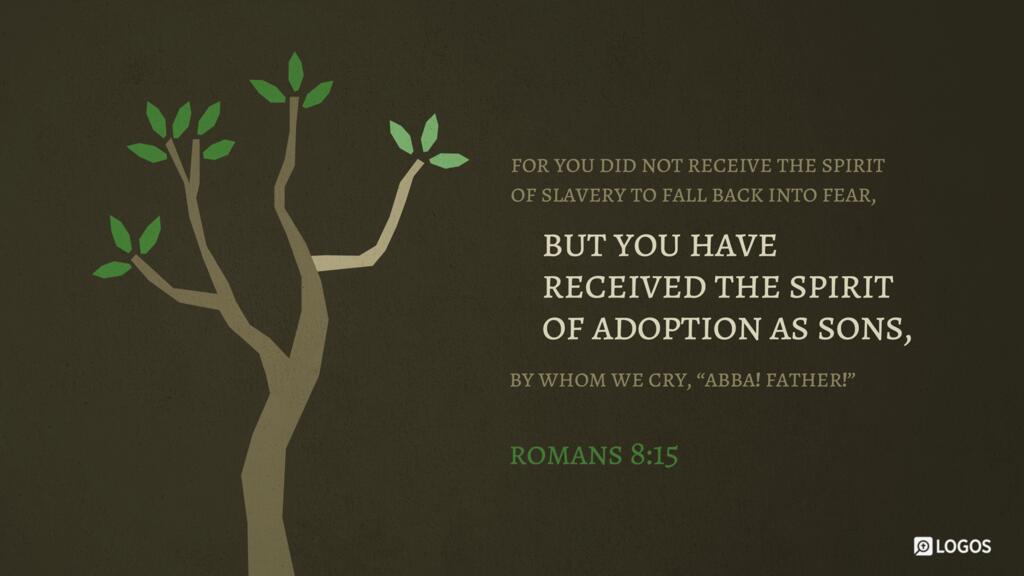
8:12So then,13 brothers and sisters,14 we are under obligation, not to the flesh, to live according to the flesh 8:13(for if you live according to the flesh, you will15 die),16 but if by the Spirit you put to death the deeds of the body you will live. 8:14For all who are led by the Spirit of God are17 the sons of God. 8:15For you did not receive the spirit of slavery leading again to fear,18 but you received the Spirit of adoption,19 by whom20 we cry, “Abba, Father.” 8:16The Spirit himself bears witness to21 our spirit that we are God’s children. 8:17And if children, then heirs (namely, heirs of God and also fellow heirs with Christ)22—if indeed we suffer with him so we may also be glorified with him.
8:18For I consider that our present sufferings cannot even be compared23 to the glory that will be revealed to us. 8:19For the creation eagerly waits for the revelation of the sons of God. 8:20For the creation was subjected to futility—not willingly but because of God24 who subjected it—in hope 8:21that the creation itself will also be set free from the bondage of decay into the glorious freedom of God’s children. 8:22For we know that the whole creation groans and suffers together until now. 8:23Not only this, but we ourselves also, who have the firstfruits of the Spirit,25 groan inwardly as we eagerly await our adoption,26 the redemption of our bodies.27
Footnotes
- 10 The one who raised Jesus from the dead refers to God (also in the following clause).
- 11 Several read Ἰησοῦν (Iēsoun, “Jesus”) after Χριστόν (Christon, “Christ”; א* A D* 630 1506 1739 1881 bo); C 81 104 lat have Ἰησοῦν Χριστόν. The shorter reading is more likely to be original, though, both because of external evidence (א2 B D2 F G Ψ 33 𝔐 sa) and internal evidence (scribes were much more likely to add the name “Jesus” if it were lacking than to remove it if it were already present in the text, especially to harmonize with the earlier mention of Jesus in the verse).
- 12 Most (B D F G Ψ 33 1739 1881 𝔐 lat) have διά (dia) followed by the accusative: “because of his Spirit who lives in you.” The genitive “through his Spirit” is supported by א A C(*) 81 104 1505 1506 al, and is slightly preferred.
- 13 There is a double connective here that cannot be easily preserved in English: “consequently therefore,” emphasizing the conclusion of what he has been arguing.
- 14 Grk “brothers.” See note on the phrase “brothers and sisters” in .
- 15 Grk “are about to, are certainly going to.”
- 16 This remark is parenthetical to Paul’s argument.
- 17 Grk “For as many as are being led by the Spirit of God, these are.”
- 18 Grk “slavery again to fear.”
- 19 The Greek term υἱοθεσία (huiothesia) was originally a legal technical term for adoption as a son with full rights of inheritance. notes, “a legal t.t. of ‘adoption’ of children, in our lit., i.e. in Paul, only in a transferred sense of a transcendent filial relationship between God and humans (with the legal aspect, not gender specificity, as major semantic component).”
- 20 Or “in that.”
- 21 Or possibly “with.” , however, notes the following: “At issue, grammatically, is whether the Spirit testifies alongside of our spirit ( of association), or whether he testifies to our spirit (indirect object) that we are God’s children. If the former, the one receiving this testimony is unstated (is it God? or believers?). If the latter, the believer receives the testimony and hence is assured of salvation via the inner witness of the Spirit. The first view has the advantage of a σύν- (sun-) prefixed verb, which might be expected to take an accompanying of association (and is supported by , , etc.). But there are three reasons why πνεύματι (pneumati) should not be taken as association: (1) Grammatically, a with a σύν- prefixed verb does not necessarily indicate association. This, of course, does not preclude such here, but this fact at least opens up the alternatives in this text. (2) Lexically, though συμμαρτυρέω (summartureō) originally bore an associative idea, it developed in the direction of merely intensifying μαρτυρέω (martureō). This is surely the case in the only other NT text with a (Rom 9:1). (3) Contextually, a of association does not seem to support Paul’s argument: ‘What standing has our spirit in this matter? Of itself it surely has no right at all to testify to our being sons of God’ [C. E. B. Cranfield, Romans [], 1:]. In sum, Rom 8:16 seems to be secure as a text in which the believer’s assurance of salvation is based on the inner witness of the Spirit. The implications of this for one’s soteriology are profound: The objective data, as helpful as they are, cannot by themselves provide assurance of salvation; the believer also needs (and receives) an existential, ongoing encounter with God’s Spirit in order to gain that familial comfort.”
- 22 Grk “on the one hand, heirs of God; on the other hand, fellow heirs with Christ.” Some prefer to render v. 17 as follows: “And if children, then heirs—that is, heirs of God. Also fellow heirs with Christ if indeed we suffer with him so we may also be glorified with him.” Such a translation suggests two distinct inheritances, one coming to all of God’s children, the other coming only to those who suffer with Christ. The difficulty of this view, however, is that it ignores the correlative conjunctions μέν … δέ (men … de, “on the one hand … on the other hand”): The construction strongly suggests that the inheritances cannot be separated since both explain “then heirs.” For this reason, the preferred translation puts this explanation in parentheses.
- 23 Grk “are not worthy [to be compared].”
- 24 Grk “because of the one”; the referent (God) has been specified in the translation for clarity.
- 25 Or “who have the Spirit as firstfruits.” The genitive πνεύματος (pneumatos) can be understood here as possessive (“the firstfruits belonging to the Spirit”) although it is much more likely that this is a genitive of apposition (“the firstfruits, namely, the Spirit”); cf. , .
- 26 See the note on “adoption” in v. .
- 27 Grk “body.”
The NET Bible First Edition, Copyright 1996-2005 by Biblical Studies Press