Matthew 26:14–46
The NET BibleOther versions
English
- NET The NET Bible
- DARBY 1890 Darby Bible
- ASV American Standard Version
- AV 1873 The Cambridge Paragraph Bible of the Authorized English Version
- CSB Christian Standard Bible
- D-R Douay-Rheims Bible
- ESV English Standard Version
- GW GOD’S WORD Translation
- GNB Good News Translation
- HCSB The Holman Christian Standard Bible
- KJV 1900 King James Version
- LSB Legacy Standard Bible
- LEB The Lexham English Bible
- MSG The Message: The Bible in Contemporary Language
- NASB95 New American Standard Bible (1995)
- NCV New Century Version
- NIrV New International Reader’s Version (1998)
- NIV New International Version (2011)
- NKJV The New King James Version
- NLT New Living Translation
- NRSVue New Revised Standard Version: Updated Edition
- RSV The Revised Standard Version
- RSVCE The Revised Standard Version, Catholic Edition
- YLT Young’s Literal Translation
Arabic
Czech
French
German
Greek
Hungarian
Italian
Korean
Latin
Portuguese
Russian
Simplified Chinese
Spanish
Traditional Chinese
The Plan to Betray Jesus
26:14Then one of the twelve, the one named Judas Iscariot, went to the chief priests 26:15and said, “What will you give me to betray him into your hands?”17 So they set out thirty silver coins for him. 26:16From that time18 on, Judas19 began looking for an opportunity to betray him.
The Passover
26:17Now on the first day of the feast of20 Unleavened Bread the disciples came to Jesus and said,21 “Where do you want us to prepare for you to eat the Passover?”2226:18He23 said, “Go into the city to a certain man and tell him, ‘The Teacher says, “My time is near. I will observe the Passover with my disciples at your house.” ’ ” 26:19So24 the disciples did as Jesus had instructed them, and they prepared the Passover. 26:20When25 it was evening, he took his place at the table26 with the twelve.2726:21And while they were eating he said, “I tell you the truth,28 one of you will betray me.”2926:22They30 became greatly distressed31 and each one began to say to him, “Surely not I, Lord?” 26:23He32 answered, “The one who has dipped his hand into the bowl with me33 will betray me. 26:24The Son of Man will go as it is written about him, but woe to that man by whom the Son of Man is betrayed! It would be better for him if he had never been born.” 26:25Then34 Judas, the one who would betray him, said, “Surely not I, Rabbi?” Jesus35 replied, “You have said it yourself.”
The Lord’s Supper
26:26While36 they were eating, Jesus took bread, and after giving thanks he broke it, gave it to his disciples, and said, “Take, eat, this is my body.” 26:27And after taking the cup and giving thanks, he gave it to them, saying, “Drink from it, all of you, 26:28for this is my blood, the blood37 of the covenant,38 that is poured out for many for the forgiveness of sins. 26:29I39 tell you, from now on I will not drink of this fruit40 of the vine until that day when I drink it new with you in my Father’s kingdom.” 26:30After41 singing a hymn,42 they went out to the Mount of Olives.
The Prediction of Peter’s Denial
26:31Then Jesus said to them, “This night you will all fall away because of me, for it is written:
‘I will strike the shepherd,
and the sheep of the flock will be scattered.’43
26:32But after I am raised, I will go ahead of you into Galilee.” 26:33Peter44 said to him, “If they all fall away because of you, I will never fall away!” 26:34Jesus said to him, “I tell you the truth,45 on this night, before the rooster crows, you will deny me three times.” 26:35Peter said to him, “Even if I must die with you, I will never deny you.” And all the disciples said the same thing.
Gethsemane
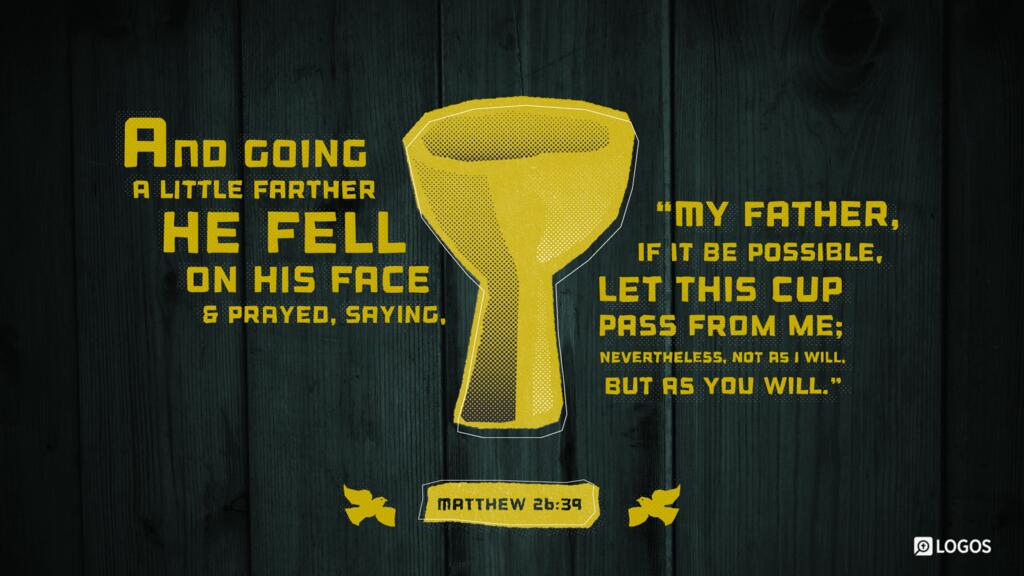
26:36Then Jesus went with them to a place called Gethsemane, and he said to the disciples, “Sit here while I go over there and pray.” 26:37He took with him Peter and the two sons of Zebedee, and became anguished and distressed. 26:38Then he said to them, “My soul is deeply grieved, even to the point of death. Remain here and stay awake with me.” 26:39Going a little farther, he threw himself down with his face to the ground and prayed,46 “My Father, if possible,47 let this cup48 pass from me! Yet not what I will, but what you will.” 26:40Then he came to the disciples and found them sleeping. He49 said to Peter, “So, couldn’t you stay awake with me for one hour? 26:41Stay awake and pray that you will not fall into temptation. The spirit is willing, but the flesh is weak.” 26:42He went away a second time and prayed,50 “My Father, if this cup51 cannot be taken away unless I drink it, your will must be done.” 26:43He came again and found them sleeping; they could not keep their eyes open.5226:44So leaving them again, he went away and prayed for the third time, saying the same thing once more. 26:45Then he came to the disciples and said to them, “Are you still sleeping and resting? Look, the hour is approaching, and the Son of Man is betrayed into the hands of sinners. 26:46Get up, let us go. Look! My betrayer53 is approaching!”
Footnotes
- 17 Grk “What will you give to me, and I will betray him to you?”
- 18 Here καί (kai) has not been translated.
- 19 Grk “he”; the referent (Judas) has been specified in the translation for clarity.
- 20 The words “the feast of” are not in the Greek text, but have been supplied for clarity.
- 21 Grk “the disciples came to Jesus, saying.” The participle λέγοντες (legontes) has been translated as a finite verb to make the sequence of events clear in English.
- 22 This required getting a suitable lamb and finding lodging in Jerusalem where the meal could be eaten. The population of the city swelled during the feast, so lodging could be difficult to find. The Passover was celebrated each year in commemoration of the Israelites’ deliverance from Egypt; thus it was a feast celebrating redemption (see Exod 12). The Passover lamb was roasted and eaten after sunset in a family group of at least ten people ( Pesahim 7.13). People ate the meal while reclining (see the note on table in ). It included, besides the lamb, unleavened bread and bitter herbs as a reminder of Israel’s bitter affliction at the hands of the Egyptians. Four cups of wine mixed with water were also used for the meal. For a further description of the meal and the significance of the wine cups, see E. Ferguson, Backgrounds of Early Christianity, 523–24.
- 23 Here δέ (de) has not been translated.
- 24 Here καί (kai) has been translated as “now” to indicate the transition to a new topic.
- 25 Here δέ (de) has not been translated.
- 26 Grk “he was reclining at table,” as 1st century middle eastern meals were not eaten while sitting at a table, but while reclining on one’s side on the floor with the head closest to the low table and the feet farthest away.
- 27 Many witnesses, some of them important, have μαθητῶν (mathētōn, “disciples”; א A L W Δ Θ 33 892 1241 1424 lat) or μαθητῶν αὐτοῦ (mathētōn autou, “his disciples”; 0281 it) after δώδεκα (dōdeka, “twelve”). However, such clarifications are typical scribal expansions to the text. Further, the shorter reading (the one that ends with δώδεκα) has strong support in 𝔓37vid,45vid B D K Γ f1, 13 565 579 700 . Thus both internally and externally the reading that ends the verse with “the twelve” is to be preferred.
- 28 Grk “Truly (ἀμήν, amēn), I say to you.”
- 29 Or “will hand me over.”
- 30 Here καί (kai) has not been translated.
- 31 The participle λυπούμενοι (lupoumenoi) has been translated as a finite verb to make the sequence of events clear in English.
- 32 Grk “answering, he said.” This is somewhat redundant and has been simplified in the translation. Here δέ (de) has not been translated.
- 33 The one who has dipped his hand into the bowl with me. The point of Jesus’ comment here is not to identify the specific individual per se, but to indicate that it is one who was close to him—somebody whom no one would suspect. His comment serves to heighten the treachery of Judas’ betrayal.
- 34 Grk “answering, Judas.” This is somewhat redundant and has been simplified in the translation. Here δέ (de) has been translated as “then” to reflect the sequence of events in the narrative.
- 35 Grk “he”; the referent (Jesus) has been specified in the translation for clarity.
- 36 Here δέ (de) has not been translated.
- 37 Grk “for this is my blood of the covenant that is poured out for many.” In order to avoid confusion about which is poured out, the translation supplies “blood” twice so that the following phrase clearly modifies “blood,” not “covenant.”
- 38 Although most witnesses read καινῆς (kainēs, “new”) here, this is evidently motivated by the parallel in Luke 22:20. Apart from the possibility of homoioteleuton, there is no good reason for the shorter reading to have arisen later on. But since it is found in such good and diverse witnesses (e.g., 𝔓37, 45vid א B L Z Θ 0298vid 33 mae), the likelihood of homoioteleuton becomes rather remote. Jesus’ death established the forgiveness promised in the new covenant of Jer 31:31. Jesus is reinterpreting the symbolism of the Passover meal, indicating the presence of a new era.
- 39 Here δέ (de) has not been translated.
- 40 Grk “produce” (“the produce of the vine” is a figurative expression for wine).
- 41 Here καί (kai) has not been translated.
- 42 After singing a hymn. The Hallel Psalms (Pss 113–118) were sung during the meal. Psalms 113 and 114 were sung just before the second cup and 115–118 were sung at the end of the meal, after the fourth, or hallel cup.
- 43 A quotation from Zech 13:7.
- 44 Grk “answering, Peter said to him.” This is somewhat redundant and has been simplified in the translation. Here δέ (de) has not been translated.
- 45 Grk “Truly (ἀμήν, amēn), I say to you.”
- 46 Grk “ground, praying and saying.” Here the participle λέγων (legōn) is redundant in contemporary English and has not been translated.
- 47 Grk “if it is possible.”
- 48 This cup alludes to the wrath of God that Jesus would experience (in the form of suffering and death) for us. See Ps 11:6; 75:8–9; Isa 51:17, 19, 22 for this figure.
- 49 Here καί (kai) has not been translated.
- 50 Grk “saying.” The participle λέγων (legōn) is redundant here in contemporary English and has not been translated.
- 51 Grk “this”; the referent (the cup) has been specified in the translation for clarity.
- 52 Grk “because their eyes were weighed down,” an idiom for becoming extremely or excessively sleepy (L&N 23.69).
- 53 Grk “the one who betrays me.”
The NET Bible First Edition, Copyright 1996-2005 by Biblical Studies Press