Galatians 4:21–5:1
The NET BibleOther versions
English
- NET The NET Bible
- DARBY 1890 Darby Bible
- ASV American Standard Version
- AV 1873 The Cambridge Paragraph Bible of the Authorized English Version
- CSB Christian Standard Bible
- D-R Douay-Rheims Bible
- ESV English Standard Version
- GW GOD’S WORD Translation
- GNB Good News Translation
- HCSB The Holman Christian Standard Bible
- KJV 1900 King James Version
- LSB Legacy Standard Bible
- LEB The Lexham English Bible
- MSG The Message: The Bible in Contemporary Language
- NASB95 New American Standard Bible (1995)
- NCV New Century Version
- NIrV New International Reader’s Version (1998)
- NIV New International Version (2011)
- NKJV The New King James Version
- NLT New Living Translation
- NRSVue New Revised Standard Version: Updated Edition
- RSV The Revised Standard Version
- RSVCE The Revised Standard Version, Catholic Edition
- YLT Young’s Literal Translation
Arabic
Czech
French
German
Greek
Hungarian
Italian
Korean
Latin
Portuguese
Russian
Simplified Chinese
Spanish
Traditional Chinese
An Appeal from Allegory
4:21Tell me, you who want to be under the law, do you not understand the law?324:22For it is written that Abraham had two sons, one by the33 slave woman and the other by the free woman. 4:23But one, the son by the slave woman, was born by natural descent,34 while the other, the son by the free woman, was born through the promise. 4:24These things may be treated as an allegory,35 for these women represent two covenants. One is from Mount Sinai bearing children for slavery; this is Hagar. 4:25Now Hagar represents Mount Sinai in Arabia and corresponds to the present Jerusalem, for she is in slavery with her children. 4:26But the Jerusalem above is free,36 and she is our mother. 4:27For it is written:
“Rejoice, O barren woman who does not bear children;37
break forth and shout, you who have no birth pains,
because the children of the desolate woman are more numerous
than those of the woman who has a husband.”38
4:28But you,39 brothers and sisters,40 are children of the promise like Isaac. 4:29But just as at that time the one born by natural descent41 persecuted the one born according to the Spirit,42 so it is now. 4:30But what does the scripture say? “Throw out the slave woman and her son, for the son of the slave woman will not share the inheritance with the son”43 of the free woman. 4:31Therefore, brothers and sisters,44 we are not children of the slave woman but of the free woman.
Freedom of the Believer
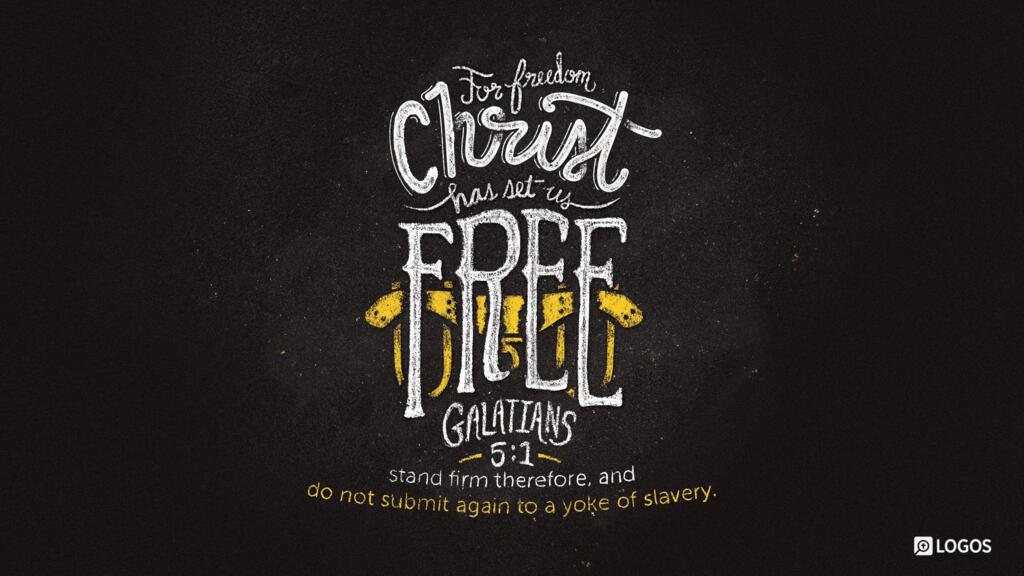
5:1For freedom1 Christ has set us free. Stand firm, then, and do not be subject again to the yoke2 of slavery.
Footnotes
- 32 Or “will you not hear what the law says?” The Greek verb ἀκούω (akouō) means “hear, listen to,” but by figurative extension it can also mean “obey.” It can also refer to the process of comprehension that follows hearing, and that sense fits the context well here.
- 33 Paul’s use of the Greek article here and before the phrase “free woman” presumes that both these characters are well known to the recipients of his letter. This verse is given as an example of the category called “well-known (‘celebrity’ or ‘familiar’) article” by .
- 34 Grk “born according to the flesh”; σάρξ 4 has “Of natural descent τὰ τέκνα τῆς σαρκός children by natural descent Ro 9:8 (opp. τὰ τέκνα τῆς ἐπαγγελίας). ὁ μὲν ἐκ τῆς παιδίσκης κατὰ σάρκα γεγέννηται Gal 4:23; cp. vs. 29.”
- 35 Grk “which things are spoken about allegorically.” Paul is not saying the OT account is an allegory, but rather that he is constructing an allegory based on the OT account.
- 36 The meaning of the statement the Jerusalem above is free is that the other woman represents the second covenant (cf. v. 24); she corresponds to the Jerusalem above that is free. Paul’s argument is very condensed at this point.
- 37 The direct object “children” is not in the Greek text, but has been supplied for clarity. Direct objects were often omitted in Greek when clear from the context.
- 38 Grk “because more are the children of the barren one than of the one having a husband.” A quotation from Isa 54:1.
- 39 Most (א A C D2 Ψ 062 𝔐 lat sy bo) read “we” here, while “you” is found in 𝔓46 B D* F G 0261vid 0278 33 1739 sa. It is more likely that a copyist, noticing the first person pronouns in vv. 26 and 31, changed a second person pronoun here to first person for consistency.
- 40 Grk “brothers.” See note on the phrase “brothers and sisters” in .
- 41 Grk “according to the flesh”; see the note on the phrase “by natural descent” in .
- 42 Or “the one born by the Spirit’s [power].”
- 43 A quotation from Gen 21:10. The phrase of the free woman does not occur in Gen 21:10.
- 44 Grk “brothers.” See note on the phrase “brothers and sisters” in .
- 1 Translating the dative as “For freedom” shows the purpose for Christ setting us free; however, it is also possible to take the phrase in the sense of means or instrument (“with [or by] freedom”), referring to the freedom mentioned in 4:31 and implied throughout the letter.
- 2 Here the yoke figuratively represents the burdensome nature of slavery.
The NET Bible First Edition, Copyright 1996-2005 by Biblical Studies Press