Ezekiel 18:1–20
The NET BibleOther versions
English
- NET The NET Bible
- DARBY 1890 Darby Bible
- ASV American Standard Version
- AV 1873 The Cambridge Paragraph Bible of the Authorized English Version
- CSB Christian Standard Bible
- D-R Douay-Rheims Bible
- ESV English Standard Version
- GW GOD’S WORD Translation
- GNB Good News Translation
- HCSB The Holman Christian Standard Bible
- KJV 1900 King James Version
- LSB Legacy Standard Bible
- LEB The Lexham English Bible
- MSG The Message: The Bible in Contemporary Language
- NASB95 New American Standard Bible (1995)
- NCV New Century Version
- NIrV New International Reader’s Version (1998)
- NIV New International Version (2011)
- NKJV The New King James Version
- NLT New Living Translation
- NRSVue New Revised Standard Version: Updated Edition
- RSV The Revised Standard Version
- RSVCE The Revised Standard Version, Catholic Edition
- YLT Young’s Literal Translation
Arabic
Czech
French
German
Hebrew
Hungarian
Italian
Korean
Latin
Portuguese
Russian
Simplified Chinese
Spanish
Traditional Chinese
Individual Retribution
18:1The word of the Lord came to me: 18:2“What do you mean by quoting this proverb concerning the land of Israel,
“ ‘The fathers eat sour grapes
And the children’s teeth become numb?’1
18:3“As surely as I live, declares the sovereign Lord,2 you will not quote this proverb in Israel anymore! 18:4Indeed! All lives are mine—the life of the father as well as the life of the son is mine. The one3 who sins will die.
18:5“Suppose a man is righteous. He practices what is just and right, 18:6does not eat pagan sacrifices on the mountains4 or pray to the idols5 of the house of Israel, does not defile his neighbor’s wife, does not have sexual relations with a6 woman during her period, 18:7does not oppress anyone, but gives the debtor back whatever was given in pledge,7 does not commit robbery,8 but gives his bread to the hungry and clothes the naked, 18:8does not engage in usury or charge interest,9 but refrains10 from wrongdoing, promotes true justice11 between men, 18:9and follows my statutes and observes my regulations by carrying them out.12 That man13 is righteous; he will certainly live,14 declares the sovereign Lord.
18:10“Suppose such a man has15 a violent son who sheds blood and does any of these things16 mentioned previously 18:11(though the father did not do any of them).17 He eats pagan sacrifices on the mountains,18 defiles his neighbor’s wife, 18:12oppresses the poor and the needy,19 commits robbery, does not give back what was given in pledge, prays to20 idols, performs abominable acts, 18:13engages in usury and charges interest. Will he live? He will not! Because he has done all these abominable deeds he will certainly die.21 He will bear the responsibility for his own death.22
18:14“But suppose he in turn has a son who notices all the sins his father commits, considers them, and does not follow his father’s example.2318:15He does not eat pagan sacrifices on the mountains, does not pray to the idols of the house of Israel, does not defile his neighbor’s wife, 18:16does not oppress anyone or keep what has been given in pledge, does not commit robbery, gives his food to the hungry, and clothes the naked, 18:17refrains from wrongdoing,24 does not engage in usury or charge interest, carries out my regulations and follows my statutes. He will not die for his father’s iniquity;25 he will surely live. 18:18As for his father, because he practices extortion, robs his brother, and does what is not good among his people, he will die for his iniquity.
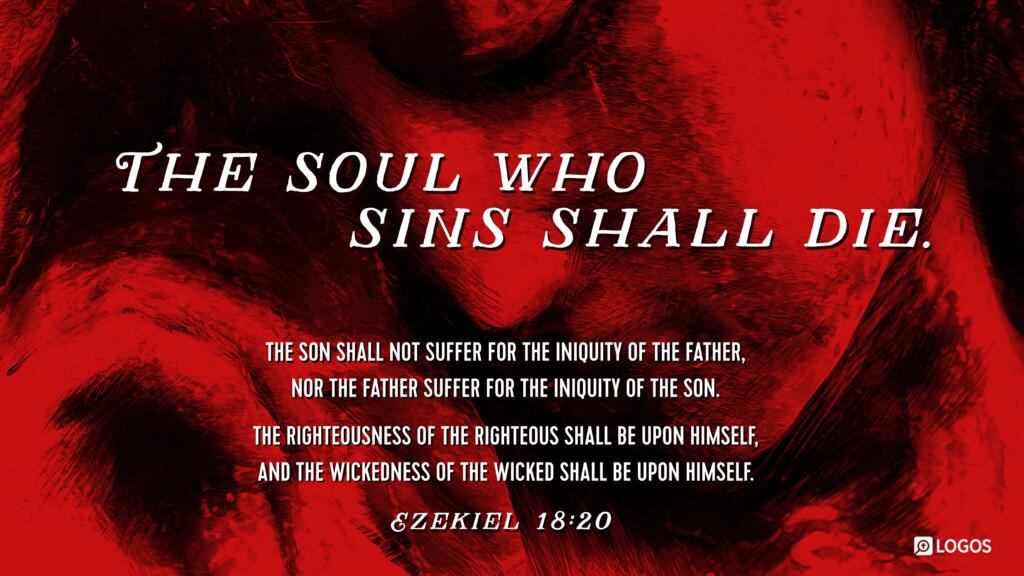
18:19“Yet you say, ‘Why should the son not suffer26 for his father’s iniquity?’ When the son does what is just and right, and observes all my statutes and carries them out, he will surely live. 18:20The person who sins is the one who will die. A son will not suffer27 for his father’s iniquity, and a father will not suffer28 for his son’s iniquity; the righteous person will be judged according to his righteousness, and the wicked person according to his wickedness.29
Footnotes
- 1 This word only occurs here and in the parallel passage in Jer 31:29–30 in the Qal stem and in Eccl 10:10 in the Piel stem. In the latter passage it refers to the bluntness of an ax that has not been sharpened. Here the idea is of the “bluntness” of the teeth, not from having ground them down due to the bitter taste of sour grapes but to the fact that they have lost their “edge,” “bite,” or “sharpness” because they are numb from the sour taste. For this meaning for the word, see W. L. Holladay, Jeremiah (Hermeneia), 2:.
- 2 This expression occurs often in Ezekiel (5:11; 14:16, 18, 20; 16:48; 17:16, 19; 20:3, 31, 33; 33:11, 27; 34:8; 35:6, 11).
- 3 Heb “life.”
- 4 Heb, “on the mountains he does not eat.” The mountains are often mentioned as the place where idolatrous sacrifices were eaten (Ezek 20:28; 22:9; 34:6).
- 5 Heb, “does not lift up his eyes.” This refers to looking to idols for help.
- 6 Heb, “does not draw near to.” “Draw near” is a euphemism for sexual intercourse (Lev 18:14; Deut 22:14; Isa 8:3).
- 7 Heb “restores to the debtor his pledge.” The root occurs in Exod 22:25 in reference to restoring a man’s garment as a pledge before nightfall.
- 8 The Hebrew term refers to seizure of property, usually by the rich (Isa 3:14; 10:2; Mic 2:2 [see Lev 5:21, 22]).
- 9 This law was given in Lev 25:36.
- 10 Heb, “turns back his hand.”
- 11 Heb “justice of truth.”
- 12 The reads לַעֲשׂוֹת אֱמֶת (la’asot ’emet, “to do with integrity”), while the reads “to do them,” presupposing לַעֲשׂוֹת אֹתָם (la’asot ’otam). The ם (mem) and ת (tav) have been reversed in the . The refelcts the original, supported by similar phrasing in Ezekiel 11:20; 20:19.
- 13 Heb “he.”
- 14 Heb “living, he will live.” The infinitive absolute precedes the finite verb for emphasis.
- 15 Heb “begets.”
- 16 Heb “and he does, a brother, from one of these.” If “brother” is retained, it may be an adverbial accusative, “against a brother” (i.e., fellow Israelite). But the form is likely dittographic (note the אח [aleph-heth] combination in the following form).
- 17 Heb “and he all of these did not do.” The parenthetical note refers back to the father described in the preceding verses.
- 18 See note on “mountains” in v. .
- 19 The poor and needy are often mentioned together in the OT (Deut 24:14; Jer 22:16; Ezek 16:49; Ps 12:6; 35:10; 37:14).
- 20 Heb “lifts up his eyes.”
- 21 Heb “be put to death.” The translation follows an alternative reading that appears in several ancient textual witnesses.
- 22 Heb “his blood will be upon him.”
- 23 Heb “and he sees and does not do likewise.”
- 24 This translation follows the . The reads “restrains his hand from the poor,” which makes no sense here.
- 25 Or “in his father’s punishment.” The phrase “in/for [a person’s] iniquity/punishment” occurs fourteen times in Ezekiel: here and in vv. 18, 19, 20; 3:18, 19; 4:17; 7:13, 16; 24:23; 33:6, 8, 9; 39:23. The Hebrew word for “iniquity” may also mean the “punishment for iniquity.”
- 26 Heb “lift up, bear.”
- 27 Heb “lift up, bear.”
- 28 Heb “lift up, bear.”
- 29 Heb “the righteousness of the righteous one will be upon him, and the wickedness of the wicked one will be upon him.”
The NET Bible First Edition, Copyright 1996-2005 by Biblical Studies Press