Get the #1 Bible app for transformative study, preaching, and teaching.
 Loading…
A service of Logos Bible Software
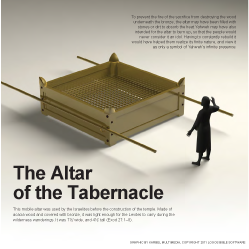
38:1–7 The instructions for the bronze altar are given in 27:1–8. In this passage, the altar is constructed in conformity with those instructions. See note on 27:1–8. |
38:1 altar Located in the outer courtyard of the tabernacle.
 Altar AYBD
Altars DOT: P
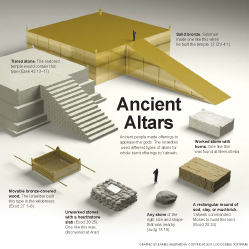
 Altars in the Old Testament Table
acacia wood Since the altar is wood overlaid with bronze, the hollow core was probably filled with earth to give the altar structural stability. This would also allow the bronze altar to conform with the requirement of 20:24.
38:7 hollow with boards The weight of Israel’s largest sacrifice, the bull, would be anywhere between 1,100–2,200 pounds (or 500–1,000 kilograms). A hollow altar probably could not have supported this weight; therefore, the animal was butchered as part of the sacrificial process (Lev 1:6).
38:8 he made the basin of bronze Instructions for the bronze basin appear in Exod 30:17–21. Little information is given about the design or construction of the piece itself. The text here and in ch. 30 focuses on the function of the basin.
the mirrors of Ancient mirrors were not glass, but highly polished discs of copper or bronze, fitted with handles of a variety of costly materials.
the serving women Nothing is known about this group of women, identified in the Hebrew text in this verse as tsove’oth. Similar language is used to describe Levites in the sense that they are qualified to serve as part of the temple workforce (Num 4:23), so it follows that these women may have worked on behalf of the tabernacle in some capacity. The only other place these women are mentioned is in 1 Sam 2:22, where Eli, the priest, is upset with his sons for sleeping with some of them.
38:9–20 The plan for the court of the tabernacle is first described in Exod 27:9–19. Now the materials for the courtyard enclosure are constructed. See note on 27:9–19. |
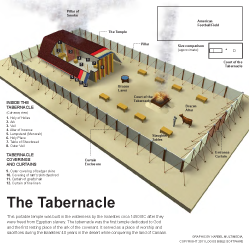
Tabernacle Materials and Equipment Table
38:21–31 These verses present a catalog of all of the materials used for the construction of the tabernacle, Israel’s tent shrine. The quantities of gold, silver, and bronze used for the project total more than seven tons of precious metals (vv. 24–29). All of the architectural and furniture elements listed here are described in more detail in the previous chapters (25:1–30:38; 35:1–38:19). This closes the account of the tabernacle construction proper (see note on 35:1–29). |
38:21 the Levites Members of the tribe of Levi. Levites were assigned the duties of erecting, disassembling, and transporting the tabernacle during the wilderness journey (Num 3–4).
Levites and Priests AYBD
Priests, Priesthood DOT: P
38:22 did all that Yahweh commanded The work was completed according to the instructions found in Exod 25–30.
38:24 the wave offering This refers to the freewill offering mentioned in 35:29. A freewill offering was given on occasion and out of devotion rather than for an expressed purpose (e.g., guilt, peace, sin; Lev 7:16).
talents A unit of weight used for metals exchanged as currency. One talent was approximately 75 pounds (34 kilograms).
Weights and Measures AYBD
Coinage AYBD
Money HBD
shekel A unit of weight for weighing metals as currency. One silver shekel weighed approximately 2/5th of an ounce or 11–13 grams. The weight for other precious metals is unknown.
Weights and Measures AYBD
Coinage AYBD
Money HBD
38:26 a bekah A unit of weight measuring 1/5th of an ounce or 5.5 grams.
everyone Official records were often kept in temples and other sacred spaces in the ancient Near East, as many priests often doubled as scribes.
six hundred and three thousand five hundred and fifty The numbers given here and elsewhere in the narratives of the exodus and subsequent wilderness wanderings are logistically problematic. See note on Num 1:46..
 Large Numbers in the Exodus and Wilderness Journey
38:30 the tent of assembly In this context, this likely refers to the tabernacle. See note on Exod 27:21.
Tabernacle AYBD
Tabernacle DOT: P

|
About Faithlife Study BibleFaithlife Study Bible (FSB) is your guide to the ancient world of the Old and New Testaments, with study notes and articles that draw from a wide range of academic research. FSB helps you learn how to think about interpretation methods and issues so that you can gain a deeper understanding of the text. |
| Copyright |
Copyright 2012 Logos Bible Software. |
| Support Info | fsb |
Table of Contents