Get the #1 Bible app for transformative study, preaching, and teaching.
 Loading…
A service of Logos Bible Software
35:1–29 The description of the construction of the tabernacle begins here with Moses reminding the people of the Sabbath regulations (vv. 1–3). As they are about to set out on their first collective building project since leaving Egypt, Moses must remind them that they are not to continue to work as slaves but are to remember their Creator by resting on the seventh day (20:8–11; Deut 5:12–15). In Exod 35:4–29, Moses tells the people to bring the materials needed for construction of the tabernacle and its furnishings. The catalog of materials is derived from Yahweh’s detailed instructions given to Moses in chs. 25–31. In chs. 35–39, the Israelite craftsmen named in 31:1–11 construct the tabernacle and all of the sacred items detailed earlier. The account of the work is extremely detailed, narrating the execution of the instructions from chs. 25–30 item by item. The careful mention of every detail, despite the resultant repetition of earlier material, serves to emphasize how the work was completed precisely as instructed. The narrative from 36:8 to 39:32 presents little new information as it painstakingly details the work being carried out according to Yahweh’s explicit instructions. The tabernacle itself is constructed in ch. 36. The fabrication of the tabernacle furniture and its utensils follows in chs. 37–38. The priestly garments are made in ch. 39. The account culminates in ch. 40 with the assembly and consecration of the tabernacle. |
 Tabernacle Materials and Equipment Table
35:3 You will not kindle a fire The Israelites must cook their supply of manna the night before the Sabbath (see 16:23; compare Num 11:8). Cooking on the Sabbath was forbidden.
35:5 willing of heart The qualification that people give willingly is key to understanding the significance of this building project for the community. The tabernacle was not constructed by forceful means, such as taxation or confiscation. At a later time a tax will be levied for maintenance (Exod 30:11–16). Ultimately, the people willingly bring more than is needed (35:21–36:7).
35:6 fine linen The Hebrew term used here, shesh, derives from an Egyptian term denoting cloth of very high quality.
35:7 fine leather See note on 25:5.
35:8 oil for the lamp Meaning, for the lampstand (see 25:31 and note; compare 27:20–21).
the anointing oil Anointing oil was used to designate that someone or something was chosen by God. See note on 30:25.
the fragrant incense Ancients burned with the intent the deity would smell the incense and be invited to its location. The smoke also acted as a cloaking agent, lest one see the divine presence too clearly. See note on 30:7.
35:9 onyx The Hebrew term used here, shoham, refers to a gemstone of some kind. It may refer to onyx or to lapis lazuli.
ephod and the breast piece See note on 25:7.
35:10 the skilled of heart Such workers are listed in 31:1–11. They are called to begin work in 35:30–36:7.
35:11 tabernacle See note on 26:1. Due to using different versification, the nrsv places “tabernacle” in the previous verse.
 Tabernacle AYBD
Tabernacle DOT: P
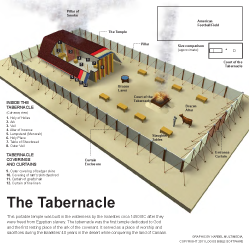
35:12 ark The ark of the covenant. See note on 25:10.
atonement cover The lid for the ark. See note on 25:17.
the curtain of The curtain that closes off the Holy of Holies from view. See 26:31–36 and note.
35:13 table See note on 25:23–30. The table is made of acacia wood, overlain with gold, and carried via four rings and two poles. It was designed to hold drink offerings, incense, and the Bread of the Presence (Lev 4:25–26).
35:14 lampstand of Refers to the golden lampstand in the holy place. See Exod 25:31 and note.
35:15 the altar of incense The small altar stationed in front of the veil leading to the most holy place, where the ark of the covenant was kept. See note on 30:1–10.
Incense Altars AYBD
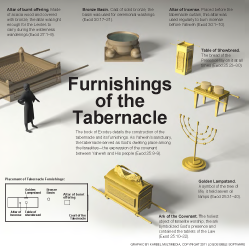
the entrance curtain That is, the outer door that separates the “common” world from the holy space that is the tabernacle. The screen is described more in 26:36–37.
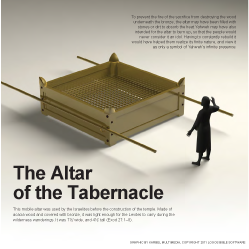
35:16 the altar of the burnt offering The bronze altar for sacrifices that was in the courtyard of the tabernacle. See 27:1–8 and note.
Altar AYBD
Altars DOT: P
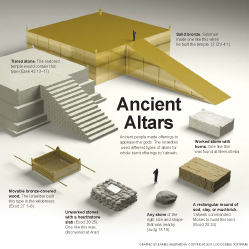
35:17 the courtyard See 27:9–19 and note.
35:19 the woven garments These are detailed in ch. 28 and crafted in ch. 39. Special garments marked the priests, and especially the high priest. Priestly garments were associated with social status.
Levites and Priests AYBD
Priestly Clothing DOT: P
Priests, Priesthood DOT: P
35:21 heart lifted Both the craftsmen and the donors are described in this way (vv. 21, 26; 36:2). A similar phenomenon happens in Ezra, when God stirs the spirit of both King Cyrus and a group Judeans, in order to rebuild the temple (Ezra 1:1, 5). These Judeans begin what will turn out to be a series of three returns to Jerusalem from Babylonian exile. Both instances—the tabernacle construction and the return to the land—are united by the fact that this movement in the spirit results in financial and material support for the erection of the divine dwelling.
the tent of assembly See note on Exod 27:21.
35:22 gold object Presumably gold items received or plundered in Egypt (12:35–36) that were not used for the golden calf (32:2–3).
35:25 yarn The fact that these garments or linens are fine and made of costly (i.e., blue, purple, and scarlet) yarns suggests that these materials were taken out of Egypt, like the gold objects (12:35–36).
35:26 spun the goat hair The goats’ hair was to be spun into a type of wool, which was then woven into eleven curtains (25:4; 26:7–14). This was the work of skilled women (vv. 25–26). See 26:7 and note.
35:29 freely An offering given on occasion and out of devotion rather than for an expressed purpose (e.g., guilt, peace, sin; Lev 7:16).
35:30–36:38 The account of the building of the tabernacle begins with Moses’ call to Bezalel, Oholiab, and the other craftsmen (Exod 35:30–35). These men receive the materials in 36:1–7 and construct the tabernacle structure in 36:8–38, following the instructions from ch. 26. |
35:31 the Spirit of God In the ot, specific skills or tasks are often associated with divine enablement. Heightened wisdom in any given area was viewed as coming from God, the source of all wisdom.
35:34 to teach The skills of Bezalel and Oholiab were necessary, but such a large project needed more than two skilled craftsmen. For these two men, being filled with skill and knowledge came with an innate responsibility to teach others, that more people may take part in the work of fulfilling God’s plan as it was revealed to Moses in 25:8–9.

|
About Faithlife Study BibleFaithlife Study Bible (FSB) is your guide to the ancient world of the Old and New Testaments, with study notes and articles that draw from a wide range of academic research. FSB helps you learn how to think about interpretation methods and issues so that you can gain a deeper understanding of the text. |
| Copyright |
Copyright 2012 Logos Bible Software. |
| Support Info | fsb |
Table of Contents