Psalm 79:1–13
The NET BibleOther versions
English
- NET The NET Bible
- DARBY 1890 Darby Bible
- ASV American Standard Version
- AV 1873 The Cambridge Paragraph Bible of the Authorized English Version
- CSB Christian Standard Bible
- D-R Douay-Rheims Bible
- ESV English Standard Version
- GW GOD’S WORD Translation
- GNB Good News Translation
- HCSB The Holman Christian Standard Bible
- KJV 1900 King James Version
- LSB Legacy Standard Bible
- LEB The Lexham English Bible
- MSG The Message: The Bible in Contemporary Language
- NASB95 New American Standard Bible (1995)
- NCV New Century Version
- NIrV New International Reader’s Version (1998)
- NIV New International Version (2011)
- NKJV The New King James Version
- NLT New Living Translation
- NRSVue New Revised Standard Version: Updated Edition
- RSV The Revised Standard Version
- RSVCE The Revised Standard Version, Catholic Edition
- TNIV Today’s New International Version
- YLT Young’s Literal Translation
Arabic
Czech
French
German
Hebrew
Hungarian
Italian
Korean
Latin
Portuguese
Russian
Simplified Chinese
Spanish
Traditional Chinese
79:1O God, foreigners1 have invaded your chosen land;2
they have polluted your holy temple
and turned Jerusalem3 into a heap of ruins.
79:2They have given the corpses of your servants
to the birds of the sky;4
the flesh of your loyal followers
to the beasts of the earth.
79:3They have made their blood flow like water
all around Jerusalem, and there is no one to bury them.5
79:4We have become an object of disdain to our neighbors;
those who live on our borders taunt and insult us.6
79:5How long will this go on, O Lord?7
Will you stay angry forever?
How long will your rage8 burn like fire?
79:6Pour out your anger on the nations that do not acknowledge you,9
on the kingdoms that do not pray to you!10
79:7For they have devoured Jacob
and destroyed his home.
79:8Do not hold us accountable for the sins of earlier generations!11
Quickly send your compassion our way,12
for we are in serious trouble!13
79:9Help us, O God, our deliverer!
For the sake of your glorious reputation,14 rescue us!
Forgive our sins for the sake of your reputation!15
79:10Why should the nations say, “Where is their God?”
Before our very eyes may the shed blood of your servants
be avenged among the nations!16
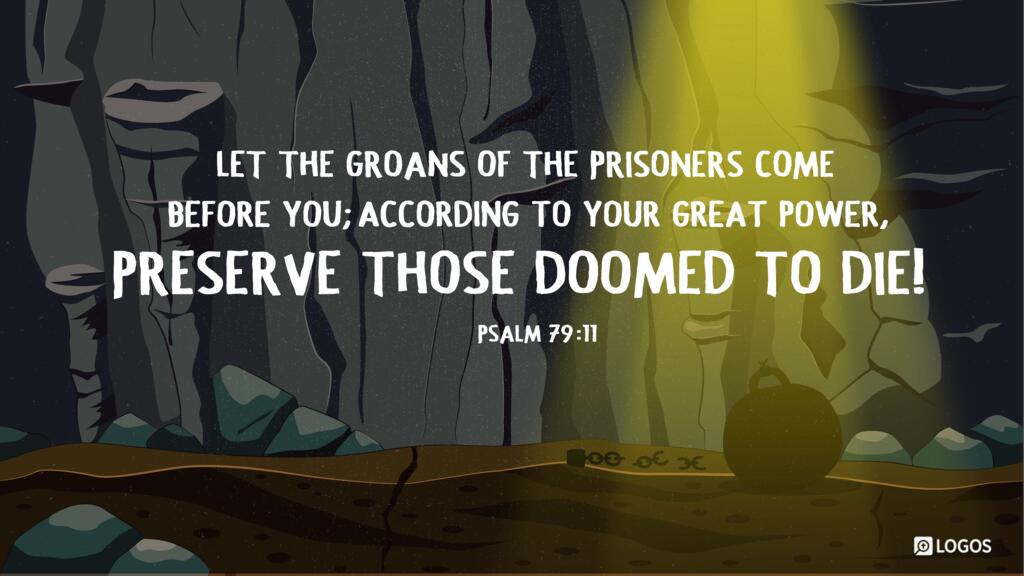
79:11Listen to the painful cries of the prisoners!17
Use your great strength to set free those condemned to die!18
79:12Pay back our neighbors in full!19
May they be insulted the same way they insulted you, O Lord!20
79:13Then we, your people, the sheep of your pasture,
will continually thank you.21
We will tell coming generations of your praiseworthy acts.22
Footnotes
- 1 Or “nations.”
- 2 Heb “have come into your inheritance.”
- 3 For location see ; ; ; ; ; ; ; ; .
- 4 Heb “[as] food for the birds of the sky.”
- 5 Heb “they have poured out their blood like water, all around Jerusalem, and there is no one burying.”
- 6 Heb “an [object of] taunting and [of] mockery to those around us.” See Ps 44:13.
- 7 Heb “How long, O Lord?”
- 8 Or “jealous anger.”
- 9 Heb “which do not know you.” Here the Hebrew term “know” means “acknowledge the authority of.”
- 10 The kingdoms that do not pray to you. The people of these kingdoms pray to other gods, not the Lord, because they do not recognize his authority over them.
- 11 Heb “do not remember against us sins, former.” Some understand “former” as an attributive adjective modifying sins, “former [i.e., chronologically prior] sins” (see 911 רִאשׁוֹן). The present translation assumes that ראשׁנים (“former”) here refers to those who lived formerly, that is, the people’s ancestors (see Lam 5:7). The word is used in this way in Lev 26:45; Deut 19:14 and Eccl 1:11.
- 12 Heb “may your compassion quickly confront us.” The prefixed verbal form is understood as a jussive, indicating a tone of prayer.
- 13 Heb “for we are very low.”
- 14 Heb “the glory of your name.” Here and in the following line “name” stands metonymically for God’s reputation.
- 15 Heb “your name.”
- 16 Heb “may it be known among the nations, to our eyes, the vengeance of the shed blood of your servants.”
- 17 Heb “may the painful cry of the prisoner come before you.”
- 18 Heb “according to the greatness of your arm leave the sons of death.” God’s “arm” here symbolizes his strength to deliver. The verbal form הוֹתֵר (hoter) is a Hiphil imperative from יָתַר (yatar, “to remain; to be left over”). Here it must mean “to leave over; to preserve.” However, it is preferable to emend the form to הַתֵּר (hatter), a Hiphil imperative from נָתַר (natar, “be free”). The Hiphil form is used in Ps 105:20 of Pharaoh freeing Joseph from prison. The phrase “sons of death” (see also Ps 102:21) is idiomatic for those condemned to die.
- 19 Heb “Return to our neighbors sevenfold into their lap.” The number seven is used rhetorically to express the thorough nature of the action. For other rhetorical/figurative uses of the Hebrew phrase שִׁבְעָתַיִם (shiv’atayim, “seven times”) see Gen 4:15, 24; Ps 12:6; Prov 6:31; Isa 30:26.
- 20 Heb “their reproach with which they reproached you, O Lord.”
- 21 Or (hyperbolically) “will thank you forever.”
- 22 Heb “to a generation and a generation we will report your praise.” Here “praise” stands by metonymy for the mighty acts that prompt worship. Cf. Ps 9:14.
The NET Bible First Edition, Copyright 1996-2005 by Biblical Studies Press