Psalm 51:1–7
The NET BibleOther versions
English
- NET The NET Bible
- DARBY 1890 Darby Bible
- ASV American Standard Version
- AV 1873 The Cambridge Paragraph Bible of the Authorized English Version
- CSB Christian Standard Bible
- D-R Douay-Rheims Bible
- ESV English Standard Version
- GW GOD’S WORD Translation
- GNB Good News Translation
- HCSB The Holman Christian Standard Bible
- KJV 1900 King James Version
- LSB Legacy Standard Bible
- LEB The Lexham English Bible
- MSG The Message: The Bible in Contemporary Language
- NASB95 New American Standard Bible (1995)
- NCV New Century Version
- NIrV New International Reader’s Version (1998)
- NIV New International Version (2011)
- NKJV The New King James Version
- NLT New Living Translation
- NRSVue New Revised Standard Version: Updated Edition
- RSV The Revised Standard Version
- RSVCE The Revised Standard Version, Catholic Edition
- TNIV Today’s New International Version
- YLT Young’s Literal Translation
Arabic
Czech
French
German
Hebrew
Hungarian
Italian
Korean
Latin
Portuguese
Russian
Simplified Chinese
Spanish
Traditional Chinese
51:1Have mercy on me, O God, because of1 your loyal love!
Because of2 your great compassion, wipe away my rebellious acts!3
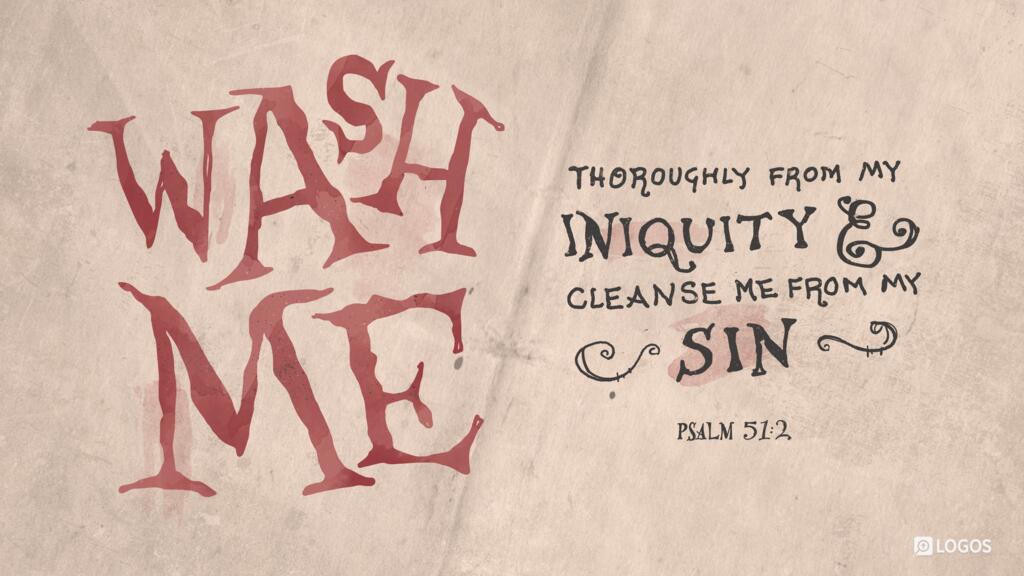
51:2Wash away my wrongdoing!4
Cleanse me of my sin!5
51:3For I am aware of6 my rebellious acts;
I am forever conscious of my sin.7
51:4Against you—you above all8—I have sinned;
I have done what is evil in your sight.
So9 you are just when you confront me;10
you are right when you condemn me.11
51:5Look, I was guilty of sin from birth,
a sinner the moment my mother conceived me.12
51:6Look,13 you desire14 integrity in the inner man;15
you want me to possess wisdom.16
Footnotes
- 1 Or “according to.”
- 2 Or “according to.”
- 3 Traditionally “blot out my transgressions.” Because of the reference to washing and cleansing in the following verse, it is likely that the psalmist is comparing forgiveness to wiping an object clean (note the use of the verb מָחָה (makhah) in the sense of “wipe clean; dry” in 2 Kgs 21:13; Prov 30:20; Isa 25:8). Another option is that the psalmist is comparing forgiveness to erasing or blotting out names from a register (see Exod 32:32–33). In this case one might translate, “erase all record of my rebellious acts.”
- 4 Heb “Thoroughly wash me from my wrongdoing.”
- 5 In vv. 1b–2 the psalmist uses three different words to emphasize the multifaceted character and degree of his sin. Whatever one wants to call it (“rebellious acts,” “wrongdoing,” “sin”), he has done it and stands morally polluted in God’s sight. The same three words appear in Exod 34:7, which emphasizes that God is willing to forgive sin in all of its many dimensions. In v. 2 the psalmist compares forgiveness and restoration to physical cleansing. Perhaps he likens spiritual cleansing to the purification rites of priestly law.
- 6 Heb “know.”
- 7 Heb “and my sin [is] in front of me continually.”
- 8 Heb “only you,” as if the psalmist had sinned exclusively against God and no other. Since the Hebrew verb חָטָא (hata’, “to sin”) is used elsewhere of sinful acts against people (see 306 2.a) and David (the presumed author) certainly sinned when he murdered Uriah (2 Sam 12:9), it is likely that the psalmist is overstating the case to suggest that the attack on Uriah was ultimately an attack on God himself. To clarify the point of the hyperbole, the translation uses “especially,” rather than the potentially confusing “only.”
- 9 The Hebrew term לְמַעַן (léma’an) normally indicates purpose (“in order that”), but here it introduces a logical consequence of the preceding statement. (Taking the clause as indicating purpose here would yield a theologically preposterous idea—the psalmist purposely sinned so that God’s justice might be vindicated!) For other examples of לְמַעַן indicating result, see 2 Kgs 22:17; Jer 27:15; Amos 2:7, as well as §38.3.
- 10 Heb “when you speak.” In this context the psalmist refers to God’s word of condemnation against his sin delivered through Nathan (cf. 2 Sam 12:7–12).
- 11 Heb “when you judge.”
- 12 Heb “Look, in wrongdoing I was brought forth, and in sin my mother conceived me.” The prefixed verbal form in the second line is probably a preterite (without vav [ו] consecutive), stating a simple historical fact. The psalmist is not suggesting that he was conceived through an inappropriate sexual relationship (although the verse has sometimes been understood to mean that, or even that all sexual relationships are sinful). The psalmist’s point is that he has been a sinner from the very moment his personal existence began. By going back beyond the time of birth to the moment of conception, the psalmist makes his point more emphatically in the second line than in the first.
- 13 The juxtaposition of two occurrences of “look” in vv. 5–6 draws attention to the sharp contrast between the sinful reality of the psalmist’s condition and the lofty ideal God has for him.
- 14 The perfect is used in a generalizing sense here.
- 15 Heb “in the covered [places],” i.e., in the inner man.
- 16 Heb “in the secret [place] wisdom you cause me to know.” The Hiphil verbal form is causative, while the imperfect is used in a modal sense to indicate God’s desire (note the parallel verb “desire”). You want me to possess wisdom. Here “wisdom” does not mean “intelligence” or “learning,” but refers to moral insight and skill.
- 17 The imperfect verbal form is used here to express the psalmist’s wish or request.
- 18 Heb “cleanse me with hyssop.” “Hyssop” was a small plant (see 1 Kgs 4:33) used to apply water (or blood) in purification rites (see Exod 12:22; Lev 14:4–6, 49–52; Num 19:6–18. The psalmist uses the language and imagery of such rites to describe spiritual cleansing through forgiveness.
- 19 After the preceding imperfect, the imperfect with vav (ו) conjunctive indicates result.
- 20 The imperfect verbal form is used here to express the psalmist’s wish or request.
- 21 I will be whiter than snow. Whiteness here symbolizes the moral purity resulting from forgiveness (see Isa 1:18).
The NET Bible First Edition, Copyright 1996-2005 by Biblical Studies Press
In other versions
ESVEnglish Standard Version
Have mercy on me, O God,
according to your steadfast love;
according to your abundant mercy
blot out my transgressions.
Wash me thoroughly from my iniquity,
and cleanse me from my sin!
For I know my transgressions,
and my sin is ever before me.
Against you, you only, have I sinned
and done what is evil in your sight,
so that you may be justified in your words
and blameless in your judgment.
Behold, I was brought forth in iniquity,
and in sin did my mother conceive me.
Behold, you delight in truth in the inward being,
and you teach me wisdom in the secret heart.
Purge me with hyssop, and I shall be clean;
wash me, and I shall be whiter than snow.
Copyright 2001 Crossway Bibles
NIVNew International Version (2011)
Have mercy on me, O God,
according to your unfailing love;
according to your great compassion
blot out my transgressions.
Wash away all my iniquity
and cleanse me from my sin.
For I know my transgressions,
and my sin is always before me.
Against you, you only, have I sinned
and done what is evil in your sight;
so you are right in your verdict
and justified when you judge.
Surely I was sinful at birth,
sinful from the time my mother conceived me.
Yet you desired faithfulness even in the womb;
you taught me wisdom in that secret place.
Cleanse me with hyssop, and I will be clean;
wash me, and I will be whiter than snow.
Copyright 1973, 1978, 1984, 2011 Biblica, Inc.
CSBChristian Standard Bible
Be gracious to me, God,
according to your faithful love;
according to your abundant compassion,
blot out my rebellion.
Completely wash away my guilt
and cleanse me from my sin.
For I am conscious of my rebellion,
and my sin is always before me.
Against you—you alone—I have sinned
and done this evil in your sight.
So you are right when you pass sentence;
you are blameless when you judge.
Indeed, I was guilty when I was born;
I was sinful when my mother conceived me.
Surely you desire integrity in the inner self,
and you teach me wisdom deep within.
Purify me with hyssop, and I will be clean;
wash me, and I will be whiter than snow.
Copyright 2017 Holman Bible Publishers
NLTNew Living Translation
Have mercy on me, O God,
because of your unfailing love.
Because of your great compassion,
blot out the stain of my sins.
Wash me clean from my guilt.
Purify me from my sin.
For I recognize my rebellion;
it haunts me day and night.
Against you, and you alone, have I sinned;
I have done what is evil in your sight.
You will be proved right in what you say,
and your judgment against me is just.
For I was born a sinner—
yes, from the moment my mother conceived me.
But you desire honesty from the womb,
teaching me wisdom even there.
Purify me from my sins, and I will be clean;
wash me, and I will be whiter than snow.
Holy Bible, New Living Translation, copyright © 1996, 2004, 2015 by Tyndale House Foundation. Used by permission of Tyndale House Publishers. All rights reserved.
LEBThe Lexham English Bible
Be gracious to me, O God, according to your loyal love.
According to your abundant mercies,
blot out my transgressions.
Wash me thoroughly from my iniquity,
and from my sin cleanse me.
For I myself know my transgressions,
and my sin is ever before me.
Against you, only you, I have sinned
and have done this evil in your eyes,
so that you are correct when you speak,
you are blameless when you judge.
Behold, in iniquity I was born,
and in sin my mother conceived me.
Behold, you delight in truth in the inward parts,
and in the hidden parts you make me to know wisdom.
Purify me with hyssop, and I shall be clean.
Wash me, and I shall be whiter than snow.
Copyright 2012 Lexham Press
KJV 1900King James Version
Have mercy upon me, O God, according to thy lovingkindness:
According unto the multitude of thy tender mercies blot out my transgressions.
Wash me throughly from mine iniquity,
And cleanse me from my sin.
For I acknowledge my transgressions:
And my sin is ever before me.
Against thee, thee only, have I sinned,
And done this evil in thy sight:
That thou mightest be justified when thou speakest,
And be clear when thou judgest.
Behold, I was shapen in iniquity;
And in sin did my mother conceive me.
Behold, thou desirest truth in the inward parts:
And in the hidden part thou shalt make me to know wisdom.
Purge me with hyssop, and I shall be clean:
Wash me, and I shall be whiter than snow.
Public Domain