Proverbs 6:20–29
The NET BibleOther versions
English
- NET The NET Bible
- DARBY 1890 Darby Bible
- ASV American Standard Version
- AV 1873 The Cambridge Paragraph Bible of the Authorized English Version
- CSB Christian Standard Bible
- D-R Douay-Rheims Bible
- ESV English Standard Version
- GW GOD’S WORD Translation
- GNB Good News Translation
- HCSB The Holman Christian Standard Bible
- KJV 1900 King James Version
- LSB Legacy Standard Bible
- LEB The Lexham English Bible
- MSG The Message: The Bible in Contemporary Language
- NASB95 New American Standard Bible (1995)
- NCV New Century Version
- NIrV New International Reader’s Version (1998)
- NIV New International Version (2011)
- NKJV The New King James Version
- NLT New Living Translation
- NRSVue New Revised Standard Version: Updated Edition
- RSV The Revised Standard Version
- RSVCE The Revised Standard Version, Catholic Edition
- TNIV Today’s New International Version
- YLT Young’s Literal Translation
Arabic
Czech
French
German
Hebrew
Hungarian
Italian
Korean
Latin
Portuguese
Russian
Simplified Chinese
Spanish
Traditional Chinese
6:20My child, guard the commands of your father
and do not forsake the instruction of your mother.
6:21Bind them41 on your heart continually;
fasten them around your neck.
6:22When you walk about,42 they43 will guide you;
when you lie down, they will watch over you;
when you wake up,44 they will talk45 to you.
6:23For the commandments46 are like47 a lamp,48
instruction is like a light,
and rebukes of discipline are like49 the road leading to life,50
6:24by keeping51 you from the evil woman,52
from the smooth tongue of53 the loose woman.54
6:25Do not lust55 in your heart for her beauty,
and do not let her captivate you with her alluring eyes;56
6:26for on account57 of a prostitute one is brought down to a loaf of bread,
but the wife of another man58 preys on your precious life.59
6:27Can a man hold60 fire61 against his chest62
without63 burning his clothes?
6:28Can64 a man walk on hot coals
without scorching his feet?
6:29So it is with65 the one who has sex with66 his neighbor’s wife;
Footnotes
- 41 The figures used here are hypocatastases (implied comparisons). There may also be an allusion to Deut 6 where the people were told to bind the law on their foreheads and arms. The point here is that the disciple will never be without these instructions. See further, P. W. Skehan, Studies in Israelite Poetry and Wisdom (), 1–8.
- 42 The verbal form is the Hitpael infinitive construct with a preposition and a suffixed subjective genitive to form a temporal clause. The term הָלַךְ (halakh) in this verbal stem means “to go about; to go to and fro.” The use of these terms in v. 22 also alludes to Deut 6:7.
- 43 Heb “it will guide you.” The verb is singular and the instruction is the subject.
- 44 In both of the preceding cola an infinitive construct was used for the temporal clauses; now the construction uses a perfect tense with vav (ו) consecutive. The verb would then be equivalent to an imperfect tense, but subordinated as a temporal clause here.
- 45 The Hebrew verb means “talk” in the sense of “to muse; to complain; to meditate”; cf. , “advise you.” Instruction bound to the heart will speak to the disciple on awaking.
- 46 Heb “the commandment” (so , , ).
- 47 The comparative “like” does not appear in the Hebrew text, but is implied by the metaphor; it is supplied in the translation for the sake of clarity.
- 48 The terms “lamp,” “light,” and “way” are all metaphors. The positive teachings and commandments will illumine or reveal to the disciple the way to life; the disciplinary correctives will provide guidance into fullness of life.
- 49 The comparative “like” does not appear in the Hebrew text, but is implied by the metaphor; it is supplied in the translation for the sake of clarity.
- 50 Heb “the way of life” (so , , ); , “the way to life.” The noun “life” is a genitive following the construct “way.” It could be an attributive genitive modifying the kind of way/course of life that instruction provides, but it could also be objective in that the course of life followed would produce and lead to life.
- 51 The infinitive construct is epexegetical here, explaining how these teachings function as lights: “by keeping you.” This verse is the transition from the general admonition about heeding the teachings to the practical application.
- 52 The word translated “woman” is modified by רַע (ra’, “evil”) in the sense of violating the codes of the community and inflicting harm on others. The editors propose changing it to read “strange woman” as before, but there is not support for that. Some commentaries follow the and read רַע as “wife of a neighbor” (cf. ; also “the wife of another”; “someone else’s wife”) but that seems to be only a clarification.
- 53 The word “tongue” is not in construct; the word “foreign woman” is in apposition to “smooth of tongue,” specifying whose it is. The word “smooth” then is the object of the preposition, “tongue” is the genitive of specification, and “foreign woman” in apposition.
- 54 The description of the woman as a “strange woman” and now a “loose [Heb “foreign”] woman” is within the context of the people of Israel. She is a “foreigner” in the sense that she is a nonconformist, wayward, and loose. It does not necessarily mean that she is not ethnically an Israelite.
- 55 The negated jussive gives the young person an immediate warning. The verb חָמַד (khamad) means “to desire,” and here in the sense of lust. The word is used in the Decalogue of Deut 5:21 for the warning against coveting. Lusting after someone in the heart, according to Jesus, is a sin of the same kind as the act, not just the first step toward it (Matt 5:28). Playing with temptation in the heart—the seat of the will and the emotions—is only the heart reaching out after the sin.
- 56 Heb “her eyelids” (so , ); “eyelashes”; “flirting eyes”). This term is a synecdoche of part (eyelids) for the whole (eyes) or a metonymy of association for painted eyes and the luring glances that are the symptoms of seduction (e.g., 2 Kgs 9:30). The term “alluring” is not in the Hebrew text, but is supplied in the translation for the sake of clarification.
- 57 The word בְעַד (bé’ad) may be taken either as “on account of” (= by means of a) prostitute (cf. , ), or “for the price of” a prostitute (cf. ). Most expositors take the first reading, though that use of the preposition is unattested, and then must supply “one is brought to.” The verse would then say that going to a prostitute can bring a man to poverty, but going to another man’s wife can lead to death. If the second view were taken, it would mean that one had a smaller price than the other. It is not indicating that one is preferable to the other; both are to be avoided.
- 58 Heb “the wife of a man.”
- 59 These two lines might be an example of synthetic parallelism, that is, “A, what’s more B.” The A-line describes the detrimental moral effect of a man going to a professional prostitute; the B-line heightens this and describes the far worse effect—moral and mortal!—of a man committing adultery with another man’s wife. When a man goes to a prostitute, he lowers himself to become nothing more than a “meal ticket” to sustain the life of that woman; however, when a man commits adultery, he places his very life in jeopardy—the rage of the husband could very well kill him.
- 60 The Qal imperfect (with the interrogative) here has a potential nuance—“Is it possible to do this?” The sentence is obviously a rhetorical question making an affirmation that it is not possible.
- 61 “Fire” provides the analogy for the sage’s warning: Fire represents the sinful woman (hypocatastasis) drawn close, and the burning of the clothes the inevitable consequences of the liaison. See J. L. Crenshaw, “Impossible Questions, Sayings, and Tasks,” Semeia 17 (1980): 19–34. The word “fire” (אֵשׁ, ’esh) plays on the words “man” (אִישׁ,’ish) and “woman” (אִשָּׁה, ’ishah); a passage like this probably inspired R. Gamaliel’s little explanation that what binds a man and a woman together in a holy marriage is י (yod) and ה (he), the two main letters of the holy name Yah. But if the Lord is removed from the relationship, that is, if these two letters are removed, all that is left is the אֵשׁ—the fire of passion. Since Gamaliel was the teacher of Paul, this may have influenced Paul’s advice that it was better to marry than to burn (1 Cor 7:9).
- 62 Heb “snatch up fire into his bosom.”
- 63 The second colon begins with the vav (ו) disjunctive on the noun, indicating a disjunctive clause; here it is a circumstantial clause.
- 64 The particle indicates that this is another rhetorical question like that in v. 27.
- 65 Heb “thus is the one.”
- 66 Heb “who goes in to” (so , ). The Hebrew verb בּוֹא (bo’, “to go in; to enter”) is used throughout scripture as a euphemism for the act of sexual intercourse. Cf. , , “who sleeps with”; “have sexual relations with.”
- 67 Heb “anyone who touches her will not.”
- 68 The verb “touches” is intended here to be a euphemism for illegal sexual contact (e.g., Gen 20:6).
- 69 Heb “will be exempt from”; , “will not go unpunished.”
- 70 The verb is יִנָּקֶה (yinnaqeh), the Niphal imperfect from נָקָה (naqah, “to be empty; to be clean”). From it we get the adjectives “clean,” “free from guilt,” “innocent.” The Niphal has the meanings (1) “to be cleaned out” (of a plundered city; e.g., Isa 3:26), (2) “to be clean; to be free from guilt; to be innocent” (Ps 19:14), (3) “to be free; to be exempt from punishment” [here], and (4) “to be free; to be exempt from obligation” (Gen 24:8).
The NET Bible First Edition, Copyright 1996-2005 by Biblical Studies Press
In other versions
ESVEnglish Standard Version
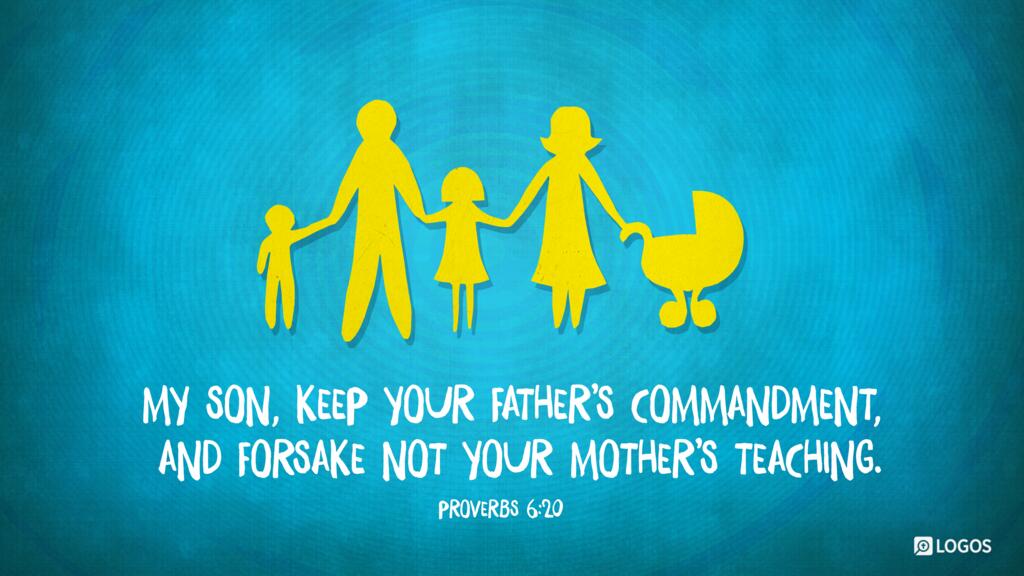
My son, keep your father’s commandment,
and forsake not your mother’s teaching.
Bind them on your heart always;
tie them around your neck.
When you walk, they will lead you;
when you lie down, they will watch over you;
and when you awake, they will talk with you.
For the commandment is a lamp and the teaching a light,
and the reproofs of discipline are the way of life,
to preserve you from the evil woman,
from the smooth tongue of the adulteress.
Do not desire her beauty in your heart,
and do not let her capture you with her eyelashes;
for the price of a prostitute is only a loaf of bread,
but a married woman hunts down a precious life.
Can a man carry fire next to his chest
and his clothes not be burned?
Or can one walk on hot coals
and his feet not be scorched?
So is he who goes in to his neighbor’s wife;
none who touches her will go unpunished.
Copyright 2001 Crossway Bibles
NIVNew International Version (2011)
My son, keep your father’s command
and do not forsake your mother’s teaching.
Bind them always on your heart;
fasten them around your neck.
When you walk, they will guide you;
when you sleep, they will watch over you;
when you awake, they will speak to you.
For this command is a lamp,
this teaching is a light,
and correction and instruction
are the way to life,
keeping you from your neighbor’s wife,
from the smooth talk of a wayward woman.
Do not lust in your heart after her beauty
or let her captivate you with her eyes.
For a prostitute can be had for a loaf of bread,
but another man’s wife preys on your very life.
Can a man scoop fire into his lap
without his clothes being burned?
Can a man walk on hot coals
without his feet being scorched?
So is he who sleeps with another man’s wife;
no one who touches her will go unpunished.
Copyright 1973, 1978, 1984, 2011 Biblica, Inc.
CSBChristian Standard Bible
My son, keep your father’s command,
and don’t reject your mother’s teaching.
Always bind them to your heart;
tie them around your neck.
When you walk here and there, they will guide you;
when you lie down, they will watch over you;
when you wake up, they will talk to you.
For a command is a lamp, teaching is a light,
and corrective discipline is the way to life.
They will protect you from an evil woman,
from the flattering tongue of a wayward woman.
Don’t lust in your heart for her beauty
or let her captivate you with her eyelashes.
For a prostitute’s fee is only a loaf of bread,
but the wife of another man goes after a precious life.
Can a man embrace fire
and his clothes not be burned?
Can a man walk on burning coals
without scorching his feet?
So it is with the one who sleeps with
another man’s wife;
no one who touches her will go unpunished.
Copyright 2017 Holman Bible Publishers
NLTNew Living Translation
My son, obey your father’s commands,
and don’t neglect your mother’s instruction.
Keep their words always in your heart.
Tie them around your neck.
When you walk, their counsel will lead you.
When you sleep, they will protect you.
When you wake up, they will advise you.
For their command is a lamp
and their instruction a light;
their corrective discipline
is the way to life.
It will keep you from the immoral woman,
from the smooth tongue of a promiscuous woman.
Don’t lust for her beauty.
Don’t let her coy glances seduce you.
For a prostitute will bring you to poverty,
but sleeping with another man’s wife will cost you your life.
Can a man scoop a flame into his lap
and not have his clothes catch on fire?
Can he walk on hot coals
and not blister his feet?
So it is with the man who sleeps with another man’s wife.
He who embraces her will not go unpunished.
Holy Bible, New Living Translation, copyright © 1996, 2004, 2015 by Tyndale House Foundation. Used by permission of Tyndale House Publishers. All rights reserved.
LEBThe Lexham English Bible
My child, keep the commandment of your father,
and do not disregard the instruction of your mother.
Bind them on your heart continually;
tie them upon your neck.
When you walk, she will lead you,
When you lie down, she will watch over you,
and when you awake, she will converse with you.
For like a lamp is a commandment, and instruction is light,
and the way of life is the reproof of discipline,
in order to preserve you from an evil woman,
from the smoothness of the tongue of an adulteress.
Do not desire her beauty in your heart;
may she not capture you with her eyelashes.
For the price of a woman, a prostitute, is the price of a loaf of bread,
but the woman belonging to a man hunts precious life.
Can a man carry fire in his lap,
and his clothes not burn?
If a man walks upon the hot coals,
will his feet not be burned?
Thus, he who goes to the wife of his neighbor,
any who touches her shall not go unpunished.
Copyright 2012 Lexham Press
KJV 1900King James Version
My son, keep thy father’s commandment,
And forsake not the law of thy mother:
Bind them continually upon thine heart,
And tie them about thy neck.
When thou goest, it shall lead thee;
When thou sleepest, it shall keep thee;
And when thou awakest, it shall talk with thee.
For the commandment is a lamp; and the law is light;
And reproofs of instruction are the way of life:
To keep thee from the evil woman,
From the flattery of the tongue of a strange woman.
Lust not after her beauty in thine heart;
Neither let her take thee with her eyelids.
For by means of a whorish woman a man is brought to a piece of bread:
And the adulteress will hunt for the precious life.
Can a man take fire in his bosom,
And his clothes not be burned?
Can one go upon hot coals,
And his feet not be burned?
So he that goeth in to his neighbour’s wife;
Whosoever toucheth her shall not be innocent.
Public Domain