Proverbs 30:2–9
The NET BibleOther versions
English
- NET The NET Bible
- DARBY 1890 Darby Bible
- ASV American Standard Version
- AV 1873 The Cambridge Paragraph Bible of the Authorized English Version
- CSB Christian Standard Bible
- D-R Douay-Rheims Bible
- ESV English Standard Version
- GW GOD’S WORD Translation
- GNB Good News Translation
- HCSB The Holman Christian Standard Bible
- KJV 1900 King James Version
- LSB Legacy Standard Bible
- LEB The Lexham English Bible
- MSG The Message: The Bible in Contemporary Language
- NASB95 New American Standard Bible (1995)
- NCV New Century Version
- NIrV New International Reader’s Version (1998)
- NIV New International Version (2011)
- NKJV The New King James Version
- NLT New Living Translation
- NRSVue New Revised Standard Version: Updated Edition
- RSV The Revised Standard Version
- RSVCE The Revised Standard Version, Catholic Edition
- TNIV Today’s New International Version
- YLT Young’s Literal Translation
Arabic
Czech
French
German
Hebrew
Hungarian
Italian
Korean
Latin
Portuguese
Russian
Simplified Chinese
Spanish
Traditional Chinese
30:2Surely5 I am more brutish6 than any other human being,7
and I do not have human understanding;8
30:3I have not learned wisdom,
nor do I have knowledge9 of the Holy One.10
30:4Who has ascended into heaven, and then descended?11
Who has gathered up the winds in his fists?12
Who has bound up the waters in his cloak?13
Who has established all the ends of the earth?14
What is his name, and what is his son’s name?15—if you know!
30:5Every word of God is purified;16
he is like17 a shield for those who take refuge in him.18
30:6Do not add to his words,
lest he reprove you, and prove you to be a liar.19
30:7Two things20 I ask from you;21
do not refuse me before I die:
30:8Remove falsehood and lies22 far from me;
do not give me poverty or riches,
feed me with my allotted portion23 of bread,24
30:9lest I become satisfied and act deceptively25
and say, “Who is the Lord?”
Or lest I become poor and steal
and demean26 the name of my God.
Footnotes
- 5 The particle כִּי (ki) functions in an asseverative sense, “surely; indeed; truly” (R. J. Williams, Hebrew Syntax, 73, §449).
- 6 The noun בַּעַר (ba’ar) means “brutishness”; here it functions as a predicate adjective. It is followed by מֵאִישׁ (me’ish) expressing comparative degree: “more than a man” or “more than any man,” with “man” used in a generic sense. He is saying that he has fallen beneath the level of mankind. Cf. “I am too stupid to be human.”
- 7 Heb “than man.” The verse is using hyperbole; this individual feels as if he has no intelligence at all, that he is more brutish than any other human. Of course this is not true, or he would not be able to speculate on the God of the universe at all.
- 8 Heb “the understanding of a man,” with “man” used attributively here.
- 9 The construction uses repetition to make the point emphatically: “I do not know the knowledge of the Holy One.” Agur’s claim to being “brutish” is here clarified—he is not one of those who has knowledge or understanding of God. C. H. Toy thinks the speaker is being sarcastic in reference to others who may have claimed such knowledge (Proverbs [], ).
- 10 The epithet “the Holy One” is the adjective “holy” put in the masculine plural (as in 9:10). This will harmonize with the plural of majesty used to explain the plural with titles for God. However, takes the plural as a reference to the “holy ones,” presumably referring to angelic beings.
- 11 To make his point Agur includes five questions. These, like Job 38–41, or Proverbs 8:24–29, focus on the divine acts to show that it is absurd for a mere mortal to think that he can explain God’s work or compare himself to God. These questions display mankind’s limitations and God’s incomparable nature. The first question could be open to include humans, but may refer to God alone (as the other questions do).
- 12 The questions are filled with anthropomorphic language. The questioner is asking what humans have ever done this, but the meaning is that only God has done this. “Gathering the wind in his fists” is a way of expressing absolute sovereign control over the forces of nature.
- 13 The question is comparing the clouds of the heavens to garments (e.g., Job 26:8). T. T. Perowne writes, “Men bind up water in skins or bottles; God binds up the rain-floods in the thin, gauzy texture of the changing clouds, which yet by his power does not rend under its burden of waters.”
- 14 The ends of the earth is an expression often used in scripture as a metonymy of subject referring to the people who live in the ends of the earth, the far off and remote lands and islands. While that is possible here as well, this may simply be a synecdoche saying that God created the whole world, even the most remote and distant places.
- 15 The reference to “son” in this passage has prompted many suggestions down through the years: It was identified as Israel in the Jewish Midrashim, the Logos or demiurge by some of the philosophers and allegorical writers, as simple poetic parallelism without a separate identity by some critical scholars, and as Jesus by Christian commentators. Parallels with Ugaritic are interesting, because Baal is referred to as a son; but that is bound up within the pantheon where there was a father god. Some of the Jewish commentators exhibit a strange logic in expressing what Christians would say is only their blindness to the full revelation: There is little cogency in this being a reference to Jesus because if there had been such a person at any time in the past he would have left some tradition about it through his descendants (J. H. Greenstone, Proverbs, 317). But Judaism has taught from the earliest times that Messiah was preexistent (especially in view of Micah 5 and Daniel 7); and the claims of Jesus in the Gospels bear this out. It seems best to say that there is a hint here of the nature of the Messiah as Son, a hint that will later be revealed in full through the incarnation.
- 16 The text here uses an implied comparison (a figure of speech known as hypocatastasis): It compares the perfection of every word from God with some precious metal that has been refined and purified (e.g., Ps 12:6). The point is that God’s word is trustworthy; it has no defects and flaws, nothing false or misleading. The second half of the verse explains the significance of this point—it is safe to trust the Lord.
- 17 The comparative “like” does not appear in the Hebrew text, but is implied by the metaphor; it is supplied in the translation for the sake of clarity.
- 18 The line uses two more figures of speech to declare that God can be trusted for security and salvation. “Shield” is a simple metaphor—God protects. “Take refuge” is another implied comparison (hypocatastasis)—God provides spiritual rest and security for those who put their trust in him.
- 19 The form of the verb is a Niphal perfect tense with a vav consecutive from the root כָּזַב (kazav, “to lie”). In this stem it has the ideas of “been made deceptive,” or “shown to be false” or “proved to be a liar.” One who adds to or changes the word of the Lord will be seen as a liar.
- 20 Wisdom literature often groups things in twos and fours, or in other numerical arrangements (e.g., Amos 1:3–2:6; Job 5:19; Prov 6:16–19).
- 21 Assuming that the contents of vv. 7–9 are a prayer, several English versions have supplied a vocative phrase: “O Lord” (); “O God” (); others have supplied a similar phrase without the vocative “O”: , “Lord”; “God.”
- 22 The two words might form a hendiadys: “falsehood and lies” being equivalent to “complete deception.” The word שָׁוְא means “false; empty; vain; to a false purpose.” The second word means “word of lying,” thus “a lying word.” Taken separately they might refer to false intentions and false words.
- 23 The word חֹק (khoq) means “statute”; it is also used of a definite assignment in labor (Exod 5:14; Prov 31:15), or of a set portion of food (Gen 47:22). Here it refers to food that is the proper proportion for the speaker.
- 24 Agur requested an honest life (not deceitful) and a balanced life (not self-sufficient). The second request about his provision is clarified in v. 9.
- 25 The verb כָּחַשׁ (kakhash) means “to be disappointing; to deceive; to fail; to grow lean.” In the Piel stem it means “to deceive; to act deceptively; to cringe; to disappoint.” The idea of acting deceptively is illustrated in Hos 9:2 where it has the connotation of “disowning” or “refusing to acknowledge” (a meaning very close to its meaning here).
- 26 The Hebrew verb literally means “to take hold of; to seize”; this produces the idea of doing violence to the reputation of God.
The NET Bible First Edition, Copyright 1996-2005 by Biblical Studies Press
In other versions
ESVEnglish Standard Version
Surely I am too stupid to be a man.
I have not the understanding of a man.
I have not learned wisdom,
nor have I knowledge of the Holy One.
Who has ascended to heaven and come down?
Who has gathered the wind in his fists?
Who has wrapped up the waters in a garment?
Who has established all the ends of the earth?
What is his name, and what is his son’s name?
Surely you know!
Every word of God proves true;
he is a shield to those who take refuge in him.
Do not add to his words,
lest he rebuke you and you be found a liar.
Two things I ask of you;
deny them not to me before I die:
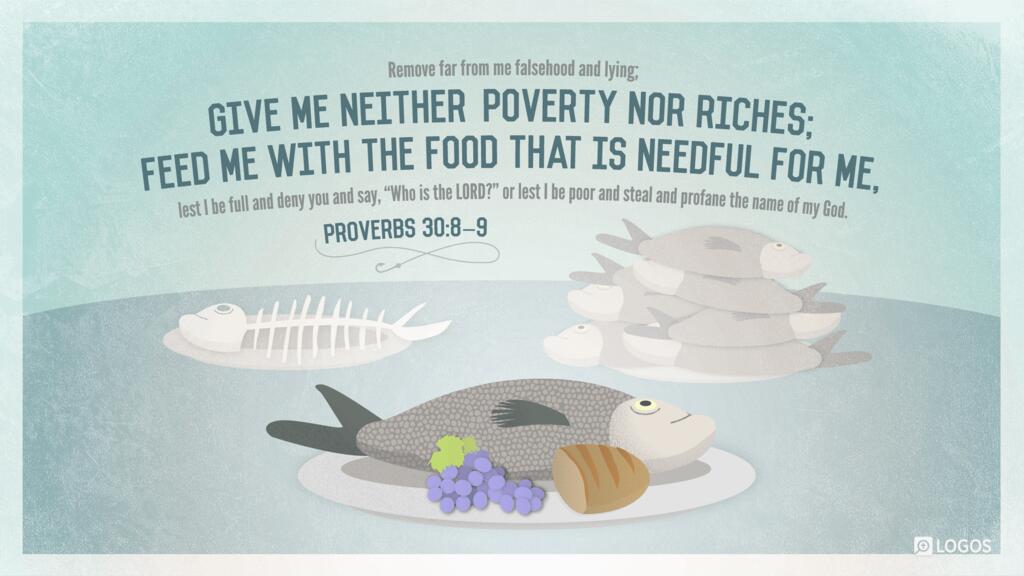
Remove far from me falsehood and lying;
give me neither poverty nor riches;
feed me with the food that is needful for me,
lest I be full and deny you
and say, “Who is the Lord?”
or lest I be poor and steal
and profane the name of my God.
Copyright 2001 Crossway Bibles
NIVNew International Version (2011)
Surely I am only a brute, not a man;
I do not have human understanding.
I have not learned wisdom,
nor have I attained to the knowledge of the Holy One.
Who has gone up to heaven and come down?
Whose hands have gathered up the wind?
Who has wrapped up the waters in a cloak?
Who has established all the ends of the earth?
What is his name, and what is the name of his son?
Surely you know!
“Every word of God is flawless;
he is a shield to those who take refuge in him.
Do not add to his words,
or he will rebuke you and prove you a liar.
“Two things I ask of you, Lord;
do not refuse me before I die:
Keep falsehood and lies far from me;
give me neither poverty nor riches,
but give me only my daily bread.
Otherwise, I may have too much and disown you
and say, ‘Who is the Lord?’
Or I may become poor and steal,
and so dishonor the name of my God.
Copyright 1973, 1978, 1984, 2011 Biblica, Inc.
CSBChristian Standard Bible
I am more stupid than any other person,
and I lack a human’s ability to understand.
I have not gained wisdom,
and I have no knowledge of the Holy One.
Who has gone up to heaven and come down?
Who has gathered the wind in his hands?
Who has bound up the waters in a cloak?
Who has established all the ends of the earth?
What is his name,
and what is the name of his son—
if you know?
Every word of God is pure;
he is a shield to those who take refuge in him.
Don’t add to his words,
or he will rebuke you, and you will be proved a liar.
Two things I ask of you;
don’t deny them to me before I die:
Keep falsehood and deceitful words far from me.
Give me neither poverty nor wealth;
feed me with the food I need.
Otherwise, I might have too much
and deny you, saying, “Who is the Lord?”
or I might have nothing and steal,
profaning the name of my God.
Copyright 2017 Holman Bible Publishers
NLTNew Living Translation
I am too stupid to be human,
and I lack common sense.
I have not mastered human wisdom,
nor do I know the Holy One.
Who but God goes up to heaven and comes back down?
Who holds the wind in his fists?
Who wraps up the oceans in his cloak?
Who has created the whole wide world?
What is his name—and his son’s name?
Tell me if you know!
Every word of God proves true.
He is a shield to all who come to him for protection.
Do not add to his words,
or he may rebuke you and expose you as a liar.
O God, I beg two favors from you;
let me have them before I die.
First, help me never to tell a lie.
Second, give me neither poverty nor riches!
Give me just enough to satisfy my needs.
For if I grow rich, I may deny you and say, “Who is the Lord?”
And if I am too poor, I may steal and thus insult God’s holy name.
Holy Bible, New Living Translation, copyright © 1996, 2004, 2015 by Tyndale House Foundation. Used by permission of Tyndale House Publishers. All rights reserved.
LEBThe Lexham English Bible
Certainly I am more stupid than a man,
and the understanding of humankind is not for me.
And I have not learned wisdom,
nor will I know knowledge of the Holy One.
Who has ascended to heaven and come down?
Who has gathered the wind in the hollow of his hand?
Who has wrapped water in a garment?
Who has established all the ends of the earth?
What is his name and what is the name of his child?
For surely you know.
Every word of God is flawless;
he is a shield for him who takes refuge in him.
Do not add to his words
lest he rebuke you and you be found a liar.
Two things I ask from you;
do not deny me before I die:
Keep falsehood and a lying word far from me;
do not give me poverty or wealth;
provide me with food only for my need.
Or else I will be satisfied and will deny him
and say “Who is Yahweh?”
Or I will be poor and will steal
and profane the name of my God.
Copyright 2012 Lexham Press
KJV 1900King James Version
Surely I am more brutish than any man,
And have not the understanding of a man.
I neither learned wisdom,
Nor have the knowledge of the holy.
Who hath ascended up into heaven, or descended?
Who hath gathered the wind in his fists?
Who hath bound the waters in a garment?
Who hath established all the ends of the earth?
What is his name, and what is his son’s name, if thou canst tell?
Every word of God is pure:
He is a shield unto them that put their trust in him.
Add thou not unto his words,
Lest he reprove thee, and thou be found a liar.
Two things have I required of thee;
Deny me them not before I die:
Remove far from me vanity and lies:
Give me neither poverty nor riches;
Feed me with food convenient for me:
Lest I be full, and deny thee,
And say, Who is the Lord?
Or lest I be poor, and steal,
And take the name of my God in vain.
Public Domain