Proverbs 30:7–9
The NET BibleOther versions
English
- NET The NET Bible
- DARBY 1890 Darby Bible
- ASV American Standard Version
- AV 1873 The Cambridge Paragraph Bible of the Authorized English Version
- CSB Christian Standard Bible
- D-R Douay-Rheims Bible
- ESV English Standard Version
- GW GOD’S WORD Translation
- GNB Good News Translation
- HCSB The Holman Christian Standard Bible
- KJV 1900 King James Version
- LSB Legacy Standard Bible
- LEB The Lexham English Bible
- MSG The Message: The Bible in Contemporary Language
- NASB95 New American Standard Bible (1995)
- NCV New Century Version
- NIrV New International Reader’s Version (1998)
- NIV New International Version (2011)
- NKJV The New King James Version
- NLT New Living Translation
- NRSVue New Revised Standard Version: Updated Edition
- RSV The Revised Standard Version
- RSVCE The Revised Standard Version, Catholic Edition
- TNIV Today’s New International Version
- YLT Young’s Literal Translation
Arabic
Czech
French
German
Hebrew
Hungarian
Italian
Korean
Latin
Portuguese
Russian
Simplified Chinese
Spanish
Traditional Chinese
30:7Two things20 I ask from you;21
do not refuse me before I die:
30:8Remove falsehood and lies22 far from me;
do not give me poverty or riches,
feed me with my allotted portion23 of bread,24
30:9lest I become satisfied and act deceptively25
and say, “Who is the Lord?”
Or lest I become poor and steal
and demean26 the name of my God.
Footnotes
- 20 Wisdom literature often groups things in twos and fours, or in other numerical arrangements (e.g., Amos 1:3–2:6; Job 5:19; Prov 6:16–19).
- 21 Assuming that the contents of vv. 7–9 are a prayer, several English versions have supplied a vocative phrase: “O Lord” (); “O God” (); others have supplied a similar phrase without the vocative “O”: , “Lord”; “God.”
- 22 The two words might form a hendiadys: “falsehood and lies” being equivalent to “complete deception.” The word שָׁוְא means “false; empty; vain; to a false purpose.” The second word means “word of lying,” thus “a lying word.” Taken separately they might refer to false intentions and false words.
- 23 The word חֹק (khoq) means “statute”; it is also used of a definite assignment in labor (Exod 5:14; Prov 31:15), or of a set portion of food (Gen 47:22). Here it refers to food that is the proper proportion for the speaker.
- 24 Agur requested an honest life (not deceitful) and a balanced life (not self-sufficient). The second request about his provision is clarified in v. 9.
- 25 The verb כָּחַשׁ (kakhash) means “to be disappointing; to deceive; to fail; to grow lean.” In the Piel stem it means “to deceive; to act deceptively; to cringe; to disappoint.” The idea of acting deceptively is illustrated in Hos 9:2 where it has the connotation of “disowning” or “refusing to acknowledge” (a meaning very close to its meaning here).
- 26 The Hebrew verb literally means “to take hold of; to seize”; this produces the idea of doing violence to the reputation of God.
The NET Bible First Edition, Copyright 1996-2005 by Biblical Studies Press
In other versions
ESVEnglish Standard Version
Two things I ask of you;
deny them not to me before I die:
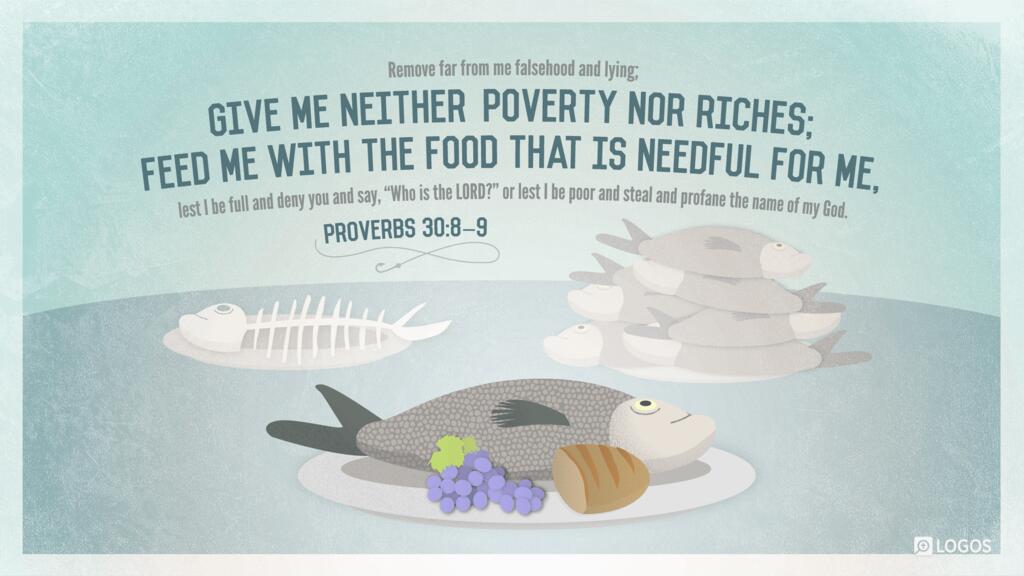
Remove far from me falsehood and lying;
give me neither poverty nor riches;
feed me with the food that is needful for me,
lest I be full and deny you
and say, “Who is the Lord?”
or lest I be poor and steal
and profane the name of my God.
Copyright 2001 Crossway Bibles
NIVNew International Version (2011)
“Two things I ask of you, Lord;
do not refuse me before I die:
Keep falsehood and lies far from me;
give me neither poverty nor riches,
but give me only my daily bread.
Otherwise, I may have too much and disown you
and say, ‘Who is the Lord?’
Or I may become poor and steal,
and so dishonor the name of my God.
Copyright 1973, 1978, 1984, 2011 Biblica, Inc.
CSBChristian Standard Bible
Two things I ask of you;
don’t deny them to me before I die:
Keep falsehood and deceitful words far from me.
Give me neither poverty nor wealth;
feed me with the food I need.
Otherwise, I might have too much
and deny you, saying, “Who is the Lord?”
or I might have nothing and steal,
profaning the name of my God.
Copyright 2017 Holman Bible Publishers
NLTNew Living Translation
O God, I beg two favors from you;
let me have them before I die.
First, help me never to tell a lie.
Second, give me neither poverty nor riches!
Give me just enough to satisfy my needs.
For if I grow rich, I may deny you and say, “Who is the Lord?”
And if I am too poor, I may steal and thus insult God’s holy name.
Holy Bible, New Living Translation, copyright © 1996, 2004, 2015 by Tyndale House Foundation. Used by permission of Tyndale House Publishers. All rights reserved.
LEBThe Lexham English Bible
Two things I ask from you;
do not deny me before I die:
Keep falsehood and a lying word far from me;
do not give me poverty or wealth;
provide me with food only for my need.
Or else I will be satisfied and will deny him
and say “Who is Yahweh?”
Or I will be poor and will steal
and profane the name of my God.
Copyright 2012 Lexham Press
KJV 1900King James Version
Two things have I required of thee;
Deny me them not before I die:
Remove far from me vanity and lies:
Give me neither poverty nor riches;
Feed me with food convenient for me:
Lest I be full, and deny thee,
And say, Who is the Lord?
Or lest I be poor, and steal,
And take the name of my God in vain.
Public Domain