Proverbs 2:5–8
The NET BibleOther versions
English
- NET The NET Bible
- DARBY 1890 Darby Bible
- ASV American Standard Version
- AV 1873 The Cambridge Paragraph Bible of the Authorized English Version
- CSB Christian Standard Bible
- D-R Douay-Rheims Bible
- ESV English Standard Version
- GW GOD’S WORD Translation
- GNB Good News Translation
- HCSB The Holman Christian Standard Bible
- KJV 1900 King James Version
- LSB Legacy Standard Bible
- LEB The Lexham English Bible
- MSG The Message: The Bible in Contemporary Language
- NASB95 New American Standard Bible (1995)
- NCV New Century Version
- NIrV New International Reader’s Version (1998)
- NIV New International Version (2011)
- NKJV The New King James Version
- NLT New Living Translation
- NRSVue New Revised Standard Version: Updated Edition
- RSV The Revised Standard Version
- RSVCE The Revised Standard Version, Catholic Edition
- TNIV Today’s New International Version
- YLT Young’s Literal Translation
Arabic
Czech
French
German
Hebrew
Hungarian
Italian
Korean
Latin
Portuguese
Russian
Simplified Chinese
Spanish
Traditional Chinese
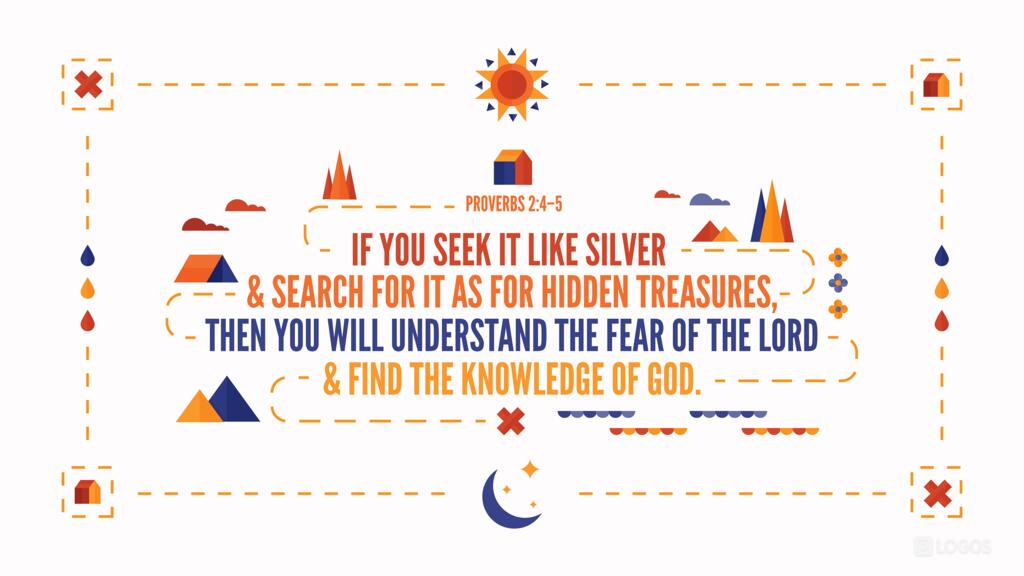
2:5then you will understand17 how to fear the Lord,18
and you will discover19 knowledge20 about God.21
2:6For22 the Lord gives23 wisdom,
and from his mouth24 comes25 knowledge and understanding.
2:7He stores up26 effective counsel27 for the upright,28
and is like29 a shield30 for those who live31 with integrity,32
Footnotes
- 17 The verb בִּין (bin, “to perceive; to understand; to discern”) refers to ability to grasp, discern or be sensitive to what it means to fear the Lord.
- 18 Heb “the fear of the Lord.” The noun is an objective genitive; the Lord is to be the object of fear and reverence.
- 19 Heb “find” (so , , , ).
- 20 The term דַּעַת (da’at, “knowledge”) goes beyond cognition; it is often used metonymically (cause) for obedience (effect); see, e.g., Prov 3:6, “in all your ways acknowledge him,” and 395 This means that the disciple will follow God’s moral code; for to know God is to react ethically and spiritually to his will (e.g., J. H. Greenstone, Proverbs, 18).
- 21 Heb “knowledge of God.” The noun is an objective genitive.
- 22 This is a causal clause. The reason one must fear and know the Lord is that he is the source of true, effectual wisdom.
- 23 The verb is an imperfect tense which probably functions as a habitual imperfect describing a universal truth in the past, present and future.
- 24 This expression is an anthropomorphism; it indicates that the Lord is the immediate source or author of the wisdom. It is worth noting that in the incarnation many of these “anthropomorphisms” become literal in the person of the Logos, the Word, Jesus, who reveals the Father.
- 25 The verb “comes” does not appear in the Hebrew text, but is supplied in the translation for the sake of clarity and smoothness.
- 26 The form is a Kethib/Qere reading. The Kethib וְצָפַן (vétsafan; Qal perfect + vav consecutive) is supported by the and . The Qere יִצְפֹּן (yitspon; Qal imperfect) is supported by the Aramaic of Prov 2:7 (the Aramaic translations of the Hebrew scriptures were called Targums) and Latin . Internal evidence favors the imperfect; another imperfect appears in v. 6a with a similar sense. The Qere is normally preferred; the scribes are indicating that the received reading is corrupt. The Kethib reflects orthographic confusion between י (yod) and ו (vav). As in v. 6a, this Qal imperfect functions as a habitual imperfect describing a universal truth in past, present and future. The verbal root צָפַן (tsafan, “to store up; to treasure up”) is repeated in 2:1 and 2:7. In 2:1, it is the responsibility of man to “store up” wisdom; but in 2:7, it is God who “stores up” wisdom for the wise person who seeks him.
- 27 The noun תּוּשִׁיָּה (tushiyyah) has a two-fold range of meanings: (1) “sound wisdom” (so , ); “effective counsel” and (2) result (metonymy of effect): “abiding success” ( 444 ; W. L. Holladay, Concise Hebrew and Aramaic Lexicon, 388; cf. “victory”). It refers to competent wisdom and its resultant ability to achieve moral success (W. McKane, Proverbs [], 80).
- 28 The Hebrew word translated “upright” (יָשָׁר, yashar) is one of the terms used for the righteous. It points to the right conduct of the believer—that which is right or pleasing in the eyes of God. It stresses that the life of the individual is upright, straightforward, and just. It is paralleled with “those who walk in integrity.”
- 29 The comparative “like” does not appear in the Hebrew text, but is implied by the metaphor; it is supplied in the translation for the sake of clarity.
- 30 The word can be taken as in apposition explaining the subject of the first colon—the Lord is a shield, the Lord stores up. The word then is a metaphor for the protection afforded by the Lord.
- 31 Heb “walk.” The verb “to walk” (הָלַךְ, halakh) is an idiom (based upon hypocatastasis: implied comparison) for habitual manner of life ( 234 3.e).
- 32 Heb “those who walk of integrity.” The noun תֹם (tom, “integrity”) functions as a genitive of manner.
- 33 The infinitive construct לִנְצֹר (lintsor, “to guard”) designates the purpose of the Lord giving “effective counsel” and being a “shield” to the upright. The verb נָצַר (natsar, “to guard”) has a broad range of meanings: (1) to watch over, guard or protect a vineyard from theft (Prov 27:18); (2) to guard one’s lips or heart from evil (Prov 4:23; 13:3); (3) to protect a person from moral or physical danger (Prov 2:8, 11; 4:6; 13:6; 20:28; 22:12; 24:12) and (4) to guard with fidelity = to observe commands, law or covenant (Prov 3:1, 21; 4:13; 5:2; 6:20; 28:7; see 665–666 ). Here God guards the way of the just, that is, the course and conduct of life from the influence of evil.
- 34 Heb “paths of righteousness.” The word “righteousness” is a possessive genitive, signifying the ways that the righteous take.
- 35 The imperfect tense verb יִשְׁמֹר (yishmor, “to protect”) continues the syntactical nuance of the preceding infinitive construct of purpose.
- 36 The Kethib is the singular noun + 3rd person masculine singular suffix חֲסִידוֹ (khasido) “his pious one.” The Qere reads the plural noun + 3rd person masculine singular suffix חֲסִידָיו (khasidav) “his pious ones.” The εὐλαβουμένων αὐτόν (eujlaboumenōn aujton) supports the Qere reading. The noun חֶסֶד (khesed, “the pious”) describes those who show “covenantal faithful love” or “loyal love” to God and his people. The description of the righteous by this term indicates their active participation in the covenant, for which God has promised his protection.
The NET Bible First Edition, Copyright 1996-2005 by Biblical Studies Press
In other versions
ESVEnglish Standard Version
then you will understand the fear of the Lord
and find the knowledge of God.
For the Lord gives wisdom;
from his mouth come knowledge and understanding;
he stores up sound wisdom for the upright;
he is a shield to those who walk in integrity,
guarding the paths of justice
and watching over the way of his saints.
Copyright 2001 Crossway Bibles
NIVNew International Version (2011)
then you will understand the fear of the Lord
and find the knowledge of God.
For the Lord gives wisdom;
from his mouth come knowledge and understanding.
He holds success in store for the upright,
he is a shield to those whose walk is blameless,
for he guards the course of the just
and protects the way of his faithful ones.
Copyright 1973, 1978, 1984, 2011 Biblica, Inc.
CSBChristian Standard Bible
then you will understand the fear of the Lord
and discover the knowledge of God.
For the Lord gives wisdom;
from his mouth come knowledge and understanding.
He stores up success for the upright;
He is a shield for those who live with integrity
so that he may guard the paths of justice
and protect the way of his faithful followers.
Copyright 2017 Holman Bible Publishers
NLTNew Living Translation
Then you will understand what it means to fear the Lord,
and you will gain knowledge of God.
For the Lord grants wisdom!
From his mouth come knowledge and understanding.
He grants a treasure of common sense to the honest.
He is a shield to those who walk with integrity.
He guards the paths of the just
and protects those who are faithful to him.
Holy Bible, New Living Translation, copyright © 1996, 2004, 2015 by Tyndale House Foundation. Used by permission of Tyndale House Publishers. All rights reserved.
LEBThe Lexham English Bible
then you will understand the fear of Yahweh,
and the knowledge of God you will find.
For Yahweh will give wisdom;
from his mouth come knowledge and understanding.
For the upright, he stores sound judgment, a shield for those who walk uprightly,
in order to guard paths of justice
and keep the way of his faithful ones.
Copyright 2012 Lexham Press
KJV 1900King James Version
Then shalt thou understand the fear of the Lord,
And find the knowledge of God.
For the Lord giveth wisdom:
Out of his mouth cometh knowledge and understanding.
He layeth up sound wisdom for the righteous:
He is a buckler to them that walk uprightly.
He keepeth the paths of judgment,
And preserveth the way of his saints.
Public Domain