Philippians 3:7–9
The NET BibleOther versions
English
- NET The NET Bible
- DARBY 1890 Darby Bible
- ASV American Standard Version
- AV 1873 The Cambridge Paragraph Bible of the Authorized English Version
- CSB Christian Standard Bible
- D-R Douay-Rheims Bible
- ESV English Standard Version
- GW GOD’S WORD Translation
- GNB Good News Translation
- HCSB The Holman Christian Standard Bible
- KJV 1900 King James Version
- LSB Legacy Standard Bible
- LEB The Lexham English Bible
- MSG The Message: The Bible in Contemporary Language
- NASB95 New American Standard Bible (1995)
- NCV New Century Version
- NIrV New International Reader’s Version (1998)
- NIV New International Version (2011)
- NKJV The New King James Version
- NLT New Living Translation
- NRSVue New Revised Standard Version: Updated Edition
- RSV The Revised Standard Version
- RSVCE The Revised Standard Version, Catholic Edition
- TNIV Today’s New International Version
- YLT Young’s Literal Translation
Arabic
Czech
French
German
Greek
Hungarian
Italian
Korean
Latin
Portuguese
Russian
Simplified Chinese
Spanish
Traditional Chinese
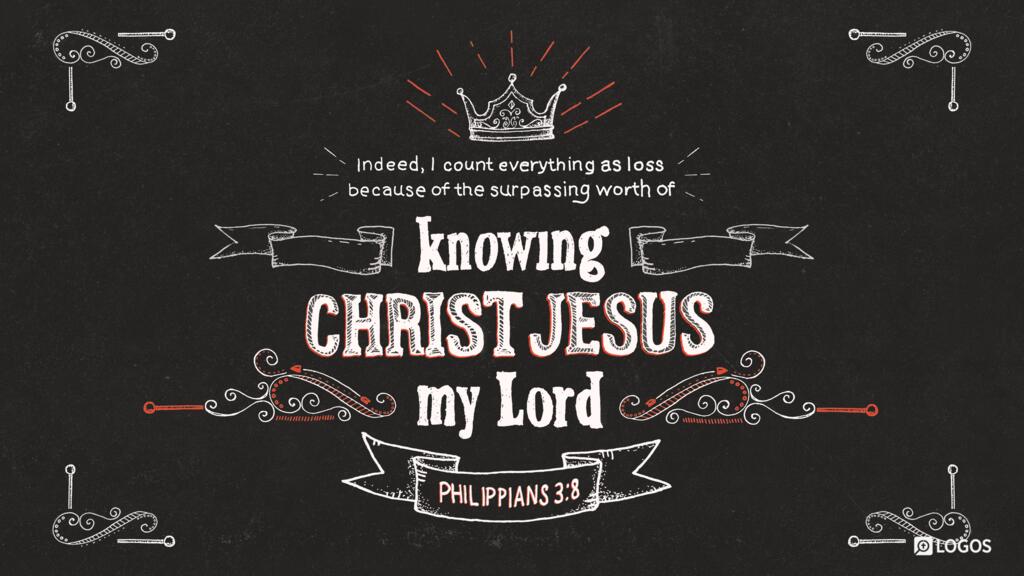
3:7But these assets I have come to regard as liabilities because of Christ. 3:8More than that, I now regard all things as liabilities compared to the far greater value of knowing Christ Jesus my Lord, for whom I have suffered the loss of all things—indeed, I regard them as dung!10—that I may gain Christ, 3:9and be found in him, not because I have my own righteousness derived from the law, but because I have the righteousness that comes by way of Christ’s faithfulness11—a righteousness from God that is in fact12 based on Christ’s13 faithfulness.14
Footnotes
- 10 The word here translated “dung” was often used in Greek as a vulgar term for fecal matter. As such it would most likely have had a certain shock value for the readers. This may well be Paul’s meaning here, especially since the context is about what the flesh produces.
- 11 Or “faith in Christ.” A decision is difficult here. Though traditionally translated “faith in Jesus Christ,” an increasing number of NT scholars are arguing that πίστις Χριστοῦ (pistis Christou) and similar phrases in Paul (here and in Rom 3:22, 26; Gal 2:16, 20; 3:22; Eph 3:12) involve a subjective genitive and mean “Christ’s faith” or “Christ’s faithfulness” (cf., e.g., G. Howard, “The ‘Faith of Christ’,” 85 [1974]: 212–15; R. B. Hays, The Faith of Jesus Christ []; Morna D. Hooker, “Πίστις Χριστοῦ,” 35 [1989]: 321–42). Noteworthy among the arguments for the subjective genitive view is that when πίστις takes a personal genitive it is almost never an objective genitive (cf. Matt 9:2, 22, 29; Mark 2:5; 5:34; 10:52; Luke 5:20; 7:50; 8:25, 48; 17:19; 18:42; 22:32; Rom 1:8; 12; 3:3; 4:5, 12, 16; 1 Cor 2:5; 15:14, 17; 2 Cor 10:15; Phil 2:17; Col 1:4; 2:5; 1 Thess 1:8; 3:2, 5, 10; 2 Thess 1:3; Titus 1:1; Phlm 6; 1 Pet 1:9, 21; 2 Pet 1:5). On the other hand, the objective genitive view has its adherents: A. Hultgren, “The Pistis Christou Formulations in Paul,” 22 (1980): 248–63; J. D. G. Dunn, “Once More, ΠΙΣΤΙΣ ΧΡΙΣΤΟΥ,” Seminar Papers, 1991, 730–44. Most commentaries on Romans and Galatians usually side with the objective view. , which notes that the grammar is not decisive, nevertheless suggests that “the faith/faithfulness of Christ is not a denial of faith in Christ as a Pauline concept (for the idea is expressed in many of the same contexts, only with the verb πιστεύω rather than the noun), but implies that the object of faith is a worthy object, for he himself is faithful.” Though Paul elsewhere teaches justification by faith, this presupposes that the object of our faith is reliable and worthy of such faith.
- 12 The words “in fact” are supplied because of English style, picking up the force of the Greek article with πίστει (pistei). See also the following note on the word “Christ’s.”
- 13 Grk “based on the faithfulness.” The article before πίστει (pistei) is taken as anaphoric, looking back to διὰ πίστεως Χριστοῦ (dia pisteōs Christou); hence, “Christ’s” is implied.
- 14 Or “based on faith.”
The NET Bible First Edition, Copyright 1996-2005 by Biblical Studies Press
In other versions
ESVEnglish Standard Version
But whatever gain I had, I counted as loss for the sake of Christ. Indeed, I count everything as loss because of the surpassing worth of knowing Christ Jesus my Lord. For his sake I have suffered the loss of all things and count them as rubbish, in order that I may gain Christ and be found in him, not having a righteousness of my own that comes from the law, but that which comes through faith in Christ, the righteousness from God that depends on faith—
Copyright 2001 Crossway Bibles
NIVNew International Version (2011)
But whatever were gains to me I now consider loss for the sake of Christ. What is more, I consider everything a loss because of the surpassing worth of knowing Christ Jesus my Lord, for whose sake I have lost all things. I consider them garbage, that I may gain Christ and be found in him, not having a righteousness of my own that comes from the law, but that which is through faith in Christ—the righteousness that comes from God on the basis of faith.
Copyright 1973, 1978, 1984, 2011 Biblica, Inc.
CSBChristian Standard Bible
But everything that was a gain to me, I have considered to be a loss because of Christ. More than that, I also consider everything to be a loss in view of the surpassing value of knowing Christ Jesus my Lord. Because of him I have suffered the loss of all things and consider them as dung, so that I may gain Christ and be found in him, not having a righteousness of my own from the law, but one that is through faith in Christ—the righteousness from God based on faith.
Copyright 2017 Holman Bible Publishers
NLTNew Living Translation
I once thought these things were valuable, but now I consider them worthless because of what Christ has done. Yes, everything else is worthless when compared with the infinite value of knowing Christ Jesus my Lord. For his sake I have discarded everything else, counting it all as garbage, so that I could gain Christ and become one with him. I no longer count on my own righteousness through obeying the law; rather, I become righteous through faith in Christ. For God’s way of making us right with himself depends on faith.
Holy Bible, New Living Translation, copyright © 1996, 2004, 2015 by Tyndale House Foundation. Used by permission of Tyndale House Publishers. All rights reserved.
LEBThe Lexham English Bible
But whatever things were gain to me, these things I have considered loss because of Christ. More than that, I even consider all things to be loss because of the surpassing greatness of the knowledge of Christ Jesus my Lord, for the sake of whom I have suffered the loss of all things, and consider them dung, in order that I may gain Christ and may be found in him, not having my righteousness which is from the law, but which is through faith in Christ, the righteousness from God on the basis of faith,
Copyright 2012 Lexham Press
KJV 1900King James Version
But what things were gain to me, those I counted loss for Christ. Yea doubtless, and I count all things but loss for the excellency of the knowledge of Christ Jesus my Lord: for whom I have suffered the loss of all things, and do count them but dung, that I may win Christ, And be found in him, not having mine own righteousness, which is of the law, but that which is through the faith of Christ, the righteousness which is of God by faith:
Public Domain