Matthew 4:1–11
The NET BibleOther versions
English
- NET The NET Bible
- DARBY 1890 Darby Bible
- ASV American Standard Version
- AV 1873 The Cambridge Paragraph Bible of the Authorized English Version
- CSB Christian Standard Bible
- D-R Douay-Rheims Bible
- ESV English Standard Version
- GW GOD’S WORD Translation
- GNB Good News Translation
- HCSB The Holman Christian Standard Bible
- KJV 1900 King James Version
- LSB Legacy Standard Bible
- LEB The Lexham English Bible
- MSG The Message: The Bible in Contemporary Language
- NASB95 New American Standard Bible (1995)
- NCV New Century Version
- NIrV New International Reader’s Version (1998)
- NIV New International Version (2011)
- NKJV The New King James Version
- NLT New Living Translation
- NRSVue New Revised Standard Version: Updated Edition
- RSV The Revised Standard Version
- RSVCE The Revised Standard Version, Catholic Edition
- TNIV Today’s New International Version
- YLT Young’s Literal Translation
Arabic
Czech
French
German
Greek
Hungarian
Italian
Korean
Latin
Portuguese
Russian
Simplified Chinese
Spanish
Traditional Chinese
The Temptation of Jesus
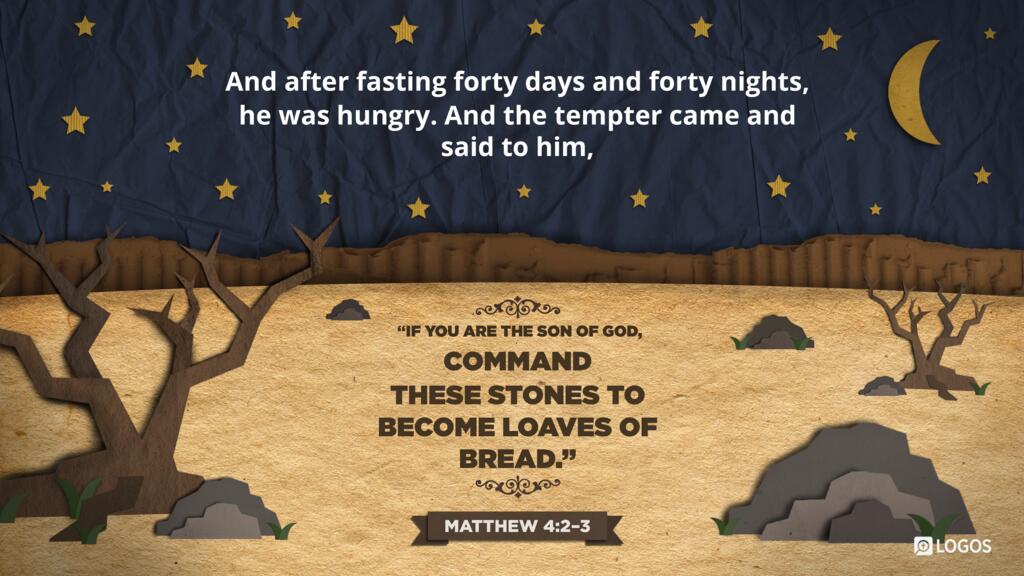
4:1Then Jesus was led by the Spirit into the wilderness1 to be tempted by the devil. 4:2After he fasted forty days and forty nights he was famished.2 4:3The tempter came and said to him, “If you are the Son of God, command these stones to become bread.”3 4:4But he answered,4 “It is written, ‘Man5 does not live6 by bread alone, but by every word that comes from the mouth of God.’ ”74:5Then the devil took him to the holy city,8 had him stand9 on the highest point10 of the temple, 4:6and said to him, “If you are the Son of God, throw yourself down. For it is written, ‘He will command his angels concerning you’11 and ‘with their hands they will lift you up, so that you will not strike your foot against a stone.’ ”124:7Jesus said to him, “Once again it is written: ‘You are not to put the Lord your God to the test.’ ”134:8Again, the devil took him to a very high mountain, and showed him all the kingdoms of the world and their grandeur.144:9And he said to him, “I will give you all these things if you throw yourself to the ground and worship15 me.” 4:10Then Jesus said to him, “Go away,16 Satan! For it is written: ‘You are to worship the Lord your God and serve only him.’ ”174:11Then the devil left him, and angels18 came and began ministering to his needs.
Footnotes
- 1 Or “desert.”
- 2 Grk “and having fasted forty days and forty nights, afterward he was hungry.”
- 3 Grk “say that these stones should become bread.”
- 4 Grk “answering, he said.” The participle ἀποκριθείς (apokritheis) is redundant, but the syntax of the phrase has been changed for clarity.
- 5 Or “a person.” Greek ὁ ἄνθρωπος (ho anthrōpos) is used generically for humanity. The translation “man” is used because the emphasis in Jesus’ response seems to be on his dependence on God as a man.
- 6 Grk “will not live.” The verb in Greek is a future tense, but it is unclear whether it is meant to be taken as a command (also known as an imperatival future) or as a statement of reality (predictive future).
- 7 A quotation from Deut 8:3.
- 8 The order of the second and third temptations differs in Luke’s account (4:5–12) from the order given in Matthew.
- 9 Grk “and he stood him.”
- 10 The highest point of the temple probably refers to the point on the temple’s southeast corner where it looms directly over a cliff some 450 ft (135 m) high. However, some have suggested the reference could be to the temple’s high gate.
- 11 A quotation from Ps 91:11. This was not so much an incorrect citation as a use in a wrong context (a misapplication of the passage).
- 12 A quotation from Ps 91:12.
- 13 A quotation from Deut 6:16.
- 14 Grk “glory.”
- 15 Grk “if, falling down, you will worship.” πίπτω 1.b.α.ב has “fall down, throw oneself to the ground as a sign of devotion, before high-ranking persons or divine beings.”
- 16 The majority of later witnesses (C2 D L Z 33 𝔐) have “behind me” (ὀπίσω μου; opisō mou) after “Go away.” But since this is the wording in Matt 16:23, where the text is certain, scribes most likely added the words here to conform to the later passage. Further, the shorter reading has superior support (א B C*vid K P W Δ 0233 f1, 13 565 579* 700 al). Thus, both externally and internally, the shorter reading is strongly preferred.
- 17 A quotation from Deut 6:13. The word “only” is an interpretive expansion not found in either the Hebrew or Greek () text of the OT.
- 18 Grk “and behold, angels.” The Greek word ἰδού (idou) has not been translated because it has no exact English equivalent here, but adds interest and emphasis ( 1).
The NET Bible First Edition, Copyright 1996-2005 by Biblical Studies Press